
Human Behavior as Story (CANADA)
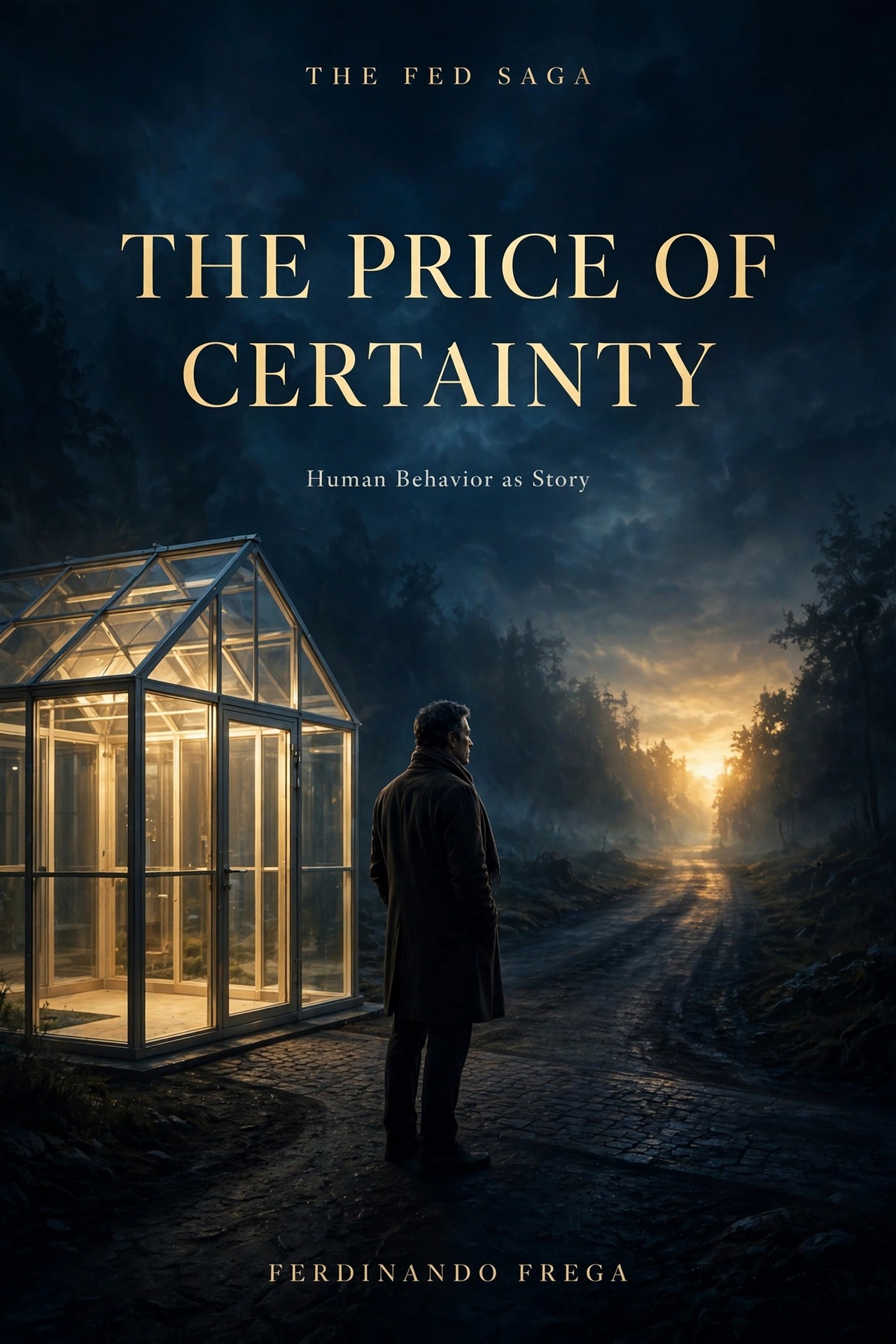
THE PRICE OF CERTAINTY
The Fed Saga — 17
There is a question that rarely appears in economics books.
And yet it governs an enormous part of human life.
How much are you willing to pay to feel safe?
Not to be safe.
To feel safe.
The two are not the same thing.
Quite the contrary.
Sometimes they are opposites.
For years I thought people bought houses, insurance, investments, careers, and pensions to protect themselves from the future.
Then I began to suspect something more unsettling.
Maybe they were not buying protection.
Maybe they were buying relief.
The relief of believing that someone was in control.
A bank.
A State.
An expert.
An algorithm.
A central bank.
Someone.
Anyone.
Because human beings can tolerate many things.
Fatigue.
Pain.
Loss.
Even poverty.
But they tolerate uncertainty very badly.
And so they accept one of the strangest trades in history.
They trade freedom for certainty.
Every day.
In small doses.
Sometimes without noticing.
An employee gives up future possibilities in exchange for a predictable salary.
An investor gives up future returns in exchange for greater safety.
A citizen gives up part of his autonomy in exchange for protection.
A son gives up part of his originality to win approval.
History is full of these trades.
Some intelligent.
Some necessary.
Some tragic.
The interesting part is that certainty does not exist.
Only its representation exists.
A simulation.
A good imitation.
A contract does not eliminate risk.
It distributes it.
An insurance policy does not eliminate risk.
It transfers it.
A strategic plan does not eliminate risk.
It organizes it.
A government does not eliminate risk.
It manages it.
The Federal Reserve does not eliminate risk.
It negotiates it.
All of modern civilization can be read as one gigantic reassurance industry.
We produce models.
Statistics.
Forecasts.
Procedures.
Certifications.
Ratings.
Audits.
Guidelines.
Controls.
None of these truly eliminates uncertainty.
It simply makes it more bearable.
At that point I began to see a paradox.
The more obsessed with certainty a society becomes, the less able it is to face the unexpected.
Because it stops training.
Uncertainty is like a muscle.
If you eliminate it completely, you lose the ability to handle it.
That is what happens to people.
And to institutions too.
A person who is always protected becomes fragile.
A society that is always protected becomes fragile.
A market that is always protected becomes fragile.
A family that is always protected becomes fragile.
Absolute safety creates the very weakness it wanted to avoid.
And here is the hidden price of certainty.
It is not economic.
It is cognitive.
Every time you buy too much certainty, you sell part of your ability to adapt.
Every time you demand a definitive answer, you give up part of your curiosity.
Every time you seek absolute control, you lose part of your freedom.
Reality has a cruel sense of humor.
The more you try to imprison it, the more new ways it finds to surprise you.
Maybe that is why the most solid people I have met were not the most secure ones.
They were the most adaptable ones.
They did not have all the answers.
They had developed something more useful.
The ability to live without them.
The same goes for organizations.
The companies that survive are not those that foresee everything.
They are those that learn fastest.
The nations that endure are not those that control everything.
They are those that adapt best.
Even families work this way.
The winners are not those without problems.
The winners are those able to get through them.
Sometimes I think maturity is simply this.
To stop looking for guarantees.
And start building resilience.
Because a guarantee can fail.
Resilience cannot.
A guarantee depends on the world.
Resilience depends on you.
And it is an enormous difference.
Maybe modernity’s greatest mistake is not that it sought certainty.
It is that it confused it with security.
Certainty is knowing what will happen.
Security is knowing you will be able to face it.
The two do not coincide.
Almost never.
And this is where the paradox is complete.
People spend their lives buying certainty in order to feel secure.
The wise, instead, learn to live without certainty and become secure all the same.
In the end the question is not how much risk you can eliminate.
It is not how much control you can accumulate.
It is not how far you can see.
The real question is another one.
Much more uncomfortable.
If tomorrow you lost all your certainties, how much of you would still be standing?
Ferdinando
The Fed Saga — 17 · Human Behavior as Story
We don’t sell books. We build relationships.