
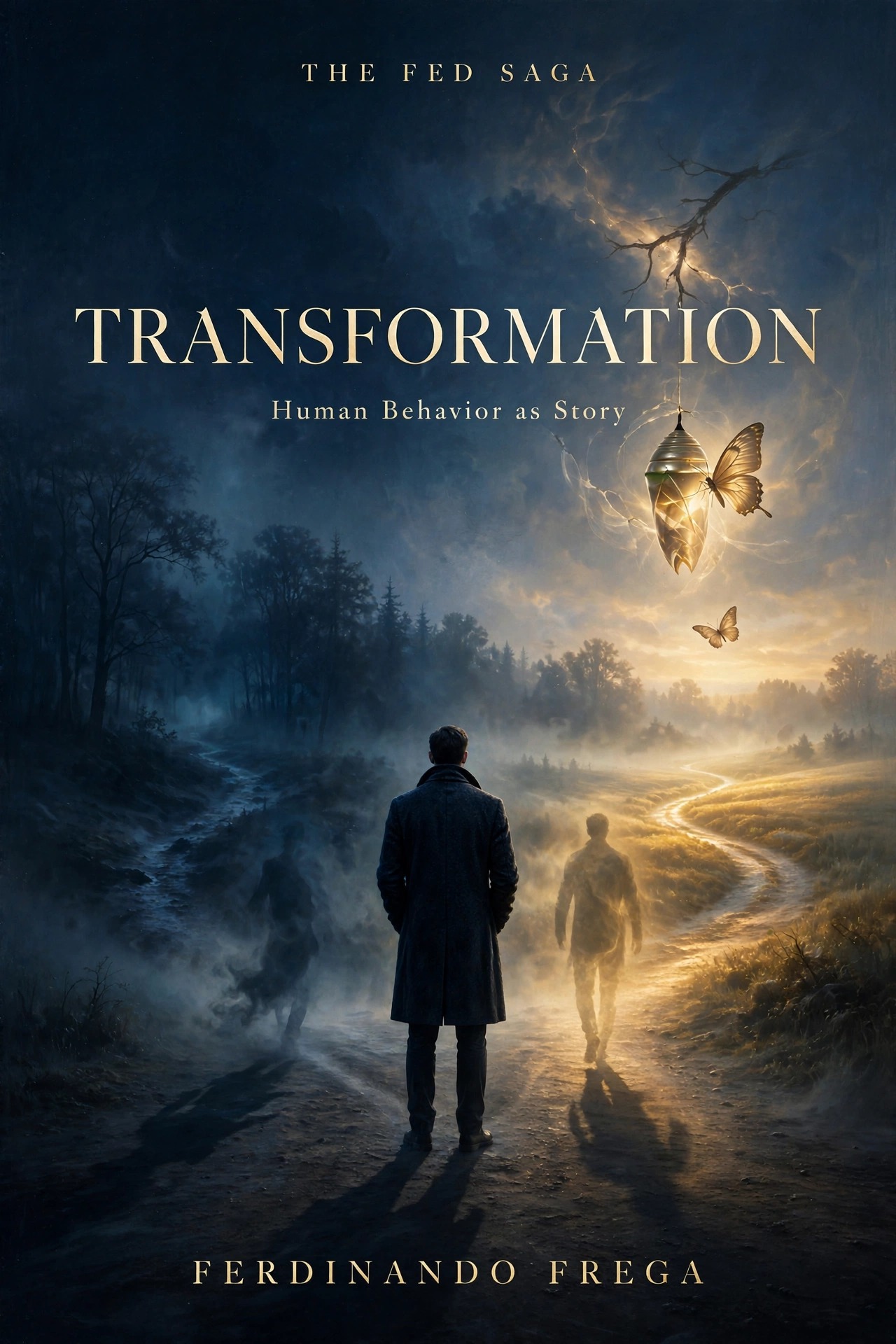
Human Behavior as Story (CANADA)
TRANSFORMATION
The Fed Saga — 20
There is a word that gets used too easily.
Change.
People change jobs.
They change cities.
They change homes.
They change partners.
They change opinions.
They change strategies.
But very often they don’t really change.
They move.
That is different.
Transformation is not a move.
It is a mutation.
It is the moment when something stops being what it was.
And becomes something else.
Irreversibly.
A larva does not improve.
It becomes a butterfly.
A child does not optimize himself.
He becomes an adult.
A civilization does not update its software.
It becomes another civilization.
Transformation does not add.
It replaces.
And that is why it frightens us.
Because every transformation contains a death.
Small.
Symbolic.
Silent.
But inevitable.
To become something new, something old must stop existing.
Human beings love the idea of transformation.
They love the price of transformation much less.
They want the result.
They refuse the process.
They want the new life.
They want to keep the old one.
They want growth.
They want to avoid loss.
They want evolution.
They want to avoid separation.
Reality keeps rejecting these requests.
For a simple reason.
Transformation is a negotiation with letting go.
Every time you grow, you leave something behind.
A conviction.
An identity.
A security.
A definition.
Sometimes a person.
Sometimes a dream.
Sometimes a fear.
The most important transformations are rarely visible from outside.
From outside they look normal.
From inside they feel like earthquakes.
When I left the salesman’s world to enter international management, I wasn’t simply changing jobs.
I was changing language.
A way of observing.
A way of deciding.
A way of existing.
That is what transformation is.
It does not change what you do.
It changes who interprets what you do.
That is why many people spend their lives seeking change and fleeing transformation.
Change is comfortable.
Transformation is costly.
Change modifies the environment.
Transformation modifies identity.
And identity is the most protected asset a human being has.
The Federal Reserve knows this problem very well.
Everyone talks about rates.
About inflation.
About employment.
But beneath those numbers there is a different reality.
Every great economic crisis generates a transformation.
Not only of markets.
Of people.
After a major crisis people don’t spend the same way.
They don’t save the same way.
They don’t trust the same way.
They don’t dream the same way.
Charts tell of the movements.
Transformation tells of the consequences.
And it is always slower.
Much slower.
Transformation has a completely different sense of time.
A revolution happens in a day.
A transformation can take ten years.
An event changes the world.
A transformation changes the meaning of the world.
They are two different phenomena.
That is why history is often written badly.
It focuses on events.
It forgets metamorphoses.
It remembers the date.
It forgets the process.
But real life works the other way around.
Transformation works in the shadows for years.
Then one day someone suddenly calls it change.
As if it had appeared out of nowhere.
Nothing appears out of nowhere.
Transformations are accumulations.
Of experiences.
Of mistakes.
Of disappointments.
Of intuitions.
Of waiting.
Of failures.
Of time.
Above all, of time.
Perhaps that is why time remains the silent protagonist of this saga.
Money changes.
Markets change.
Institutions change.
Technologies change.
But it is time that transforms.
Always.
At a certain point I began to suspect something even more radical.
Maybe a human being does not have one life.
Maybe he has many lives.
Inhabited by the same person.
The boy you were.
The adult you became.
The man you will be.
They don’t really know one another.
They only share the same name.
Transformation is the bridge that connects them.
And this is where the paradox is born.
We spend our lives trying to remain ourselves.
While life spends its time transforming us.
We resist.
We bargain.
We cling.
And yet, looking back, we discover that the most important moments of our existence were precisely the ones that changed us.
Not the ones that confirmed us.
This is perhaps the hardest lesson.
Growth is not becoming a better version of what you were.
Growth is accepting that what you were may no longer be enough.
And letting it go.
With gratitude.
Without nostalgia.
Without betrayal.
Simply because it has completed its work.
In the end the real question is not:
“How much have you changed?”
The real question is much more uncomfortable.
“Which part of you is trying to survive when life is asking you to transform?”
Ferdinando
The Fed Saga — 20 · Human Behavior as Story
We don’t sell books. We build relationships.