


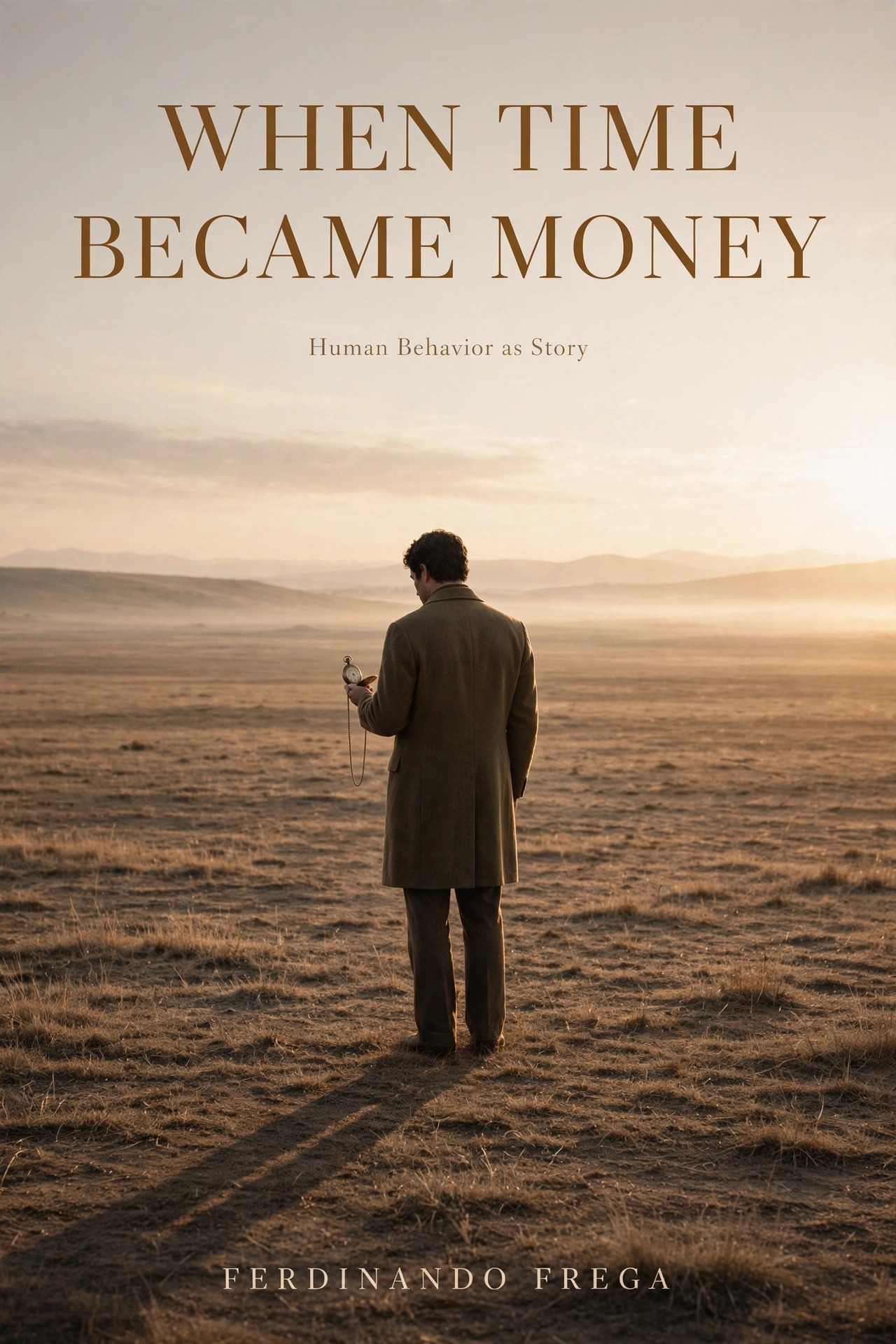
Human Behavior as Story (UNITED KINGDOM)
WHEN TIME BECAME MONEY
The Fed Saga — 01
Nobody knows when it happened.
There is no date.
There is no official document.
There are no minutes locked away in a vault at the Federal Reserve, the Bank of Italy, or the Vatican.
And yet it happened.
Somewhere in human history, time stopped being time.
And became money.
For thousands of years a man woke at dawn and knew exactly what he owned.
A house.
A field.
A horse.
A son.
Two hands.
The future belonged to no one.
It arrived.
All you had to do was wait for it.
Then something happened.
Someone invented a promise.
Not a coin.
A promise.
The coin came later.
First came the idea.
The idea that a piece of tomorrow could be traded today.
And that is the moment time changed its nature.
Suddenly a year had a price.
Ten years had a price.
Thirty years had a price.
A life had a price.
Not a value.
A price.
Which is a completely different thing.
For forty years I traveled selling razor blades.
My father had done the same.
Many men in my family spent their lives knocking on doors without knowing whether they would open.
None of us talked about macroeconomics.
None of us talked about monetary policy.
And yet we all talked about time, constantly.
Even without knowing it.
“How long will it take?”
“When will it arrive?”
“Is it worth it?”
“How long do I have to wait?”
In the end, every sale is a negotiation over time.
Every marriage is a negotiation over time.
Every business is a negotiation over time.
Every dream is a negotiation over time.
Even a disappointment.
Because a disappointment is simply time invested in the wrong place.
One day I began to watch Wall Street.
Then the banks.
Then the Federal Reserve.
Then the language they used.
And I had a strange impression.
They were all talking about money.
But they all seemed obsessed with time.
The market wants to know what will happen in six months.
The bank, in five years.
The investor, in ten.
The government, at the next election.
The Federal Reserve, in the next cycle.
The horizons change.
The question does not.
The question is always the same.
How can we buy a piece of the future?
The human answer has been extraordinary.
We invented loans.
Bonds.
Insurance.
Mortgages.
Stocks.
Pensions.
Funds.
Derivatives.
Interest.
And thousands of other instruments.
All different.
All built around the same obsession.
Tomorrow.
Nobody really buys money.
People buy time.
The young man buys time.
The sick man buys time.
The entrepreneur buys time.
The investor buys time.
Even the billionaire buys time.
He just pays more for it.
At that point I understood something.
The Federal Reserve is not interesting because it prints money.
Everyone knows that.
The Federal Reserve is interesting because it manages the price of time.
Suddenly everything changed.
Interest rates were no longer numbers.
They were the cost of waiting.
Inflation was no longer a statistic.
It was the way time wears things down.
Debt was no longer a formula.
It was borrowed time.
Saving was no longer a virtue.
It was time put away.
The whole economy seemed to transform.
No longer a science of money.
A science of waiting.
And nobody knows waiting better than a human being.
Markets wait.
Companies wait.
Governments wait.
Children wait.
Fathers wait.
Lovers wait.
The sick wait.
The old wait.
Everyone is waiting for something.
Sometimes a promotion.
Sometimes a phone call.
Sometimes a recovery.
Sometimes simply tomorrow.
Maybe that is why the Federal Reserve has always intrigued me.
Not because it is powerful.
Powerful institutions have existed for thousands of years.
It intrigues me because it is one of the few places in the world where very intelligent people try to put a price on something they cannot control.
Time.
And time, to this day, has never taken instructions.
It can be measured.
It can be sold.
It can be told as a story.
It can be wasted.
But it cannot be commanded.
Maybe this whole story begins here.
Not with a bank.
Not with a governor.
Not with a coin.
But with a question.
The same question a father asks himself looking at his son.
The same question an entrepreneur asks himself opening a business.
The same question a man asks himself in front of the mirror.
How much is the time I have left worth?
Ferdinando
The Fed Saga — 01 · Human Behavior as Story
We don’t sell books. We build relationships.