
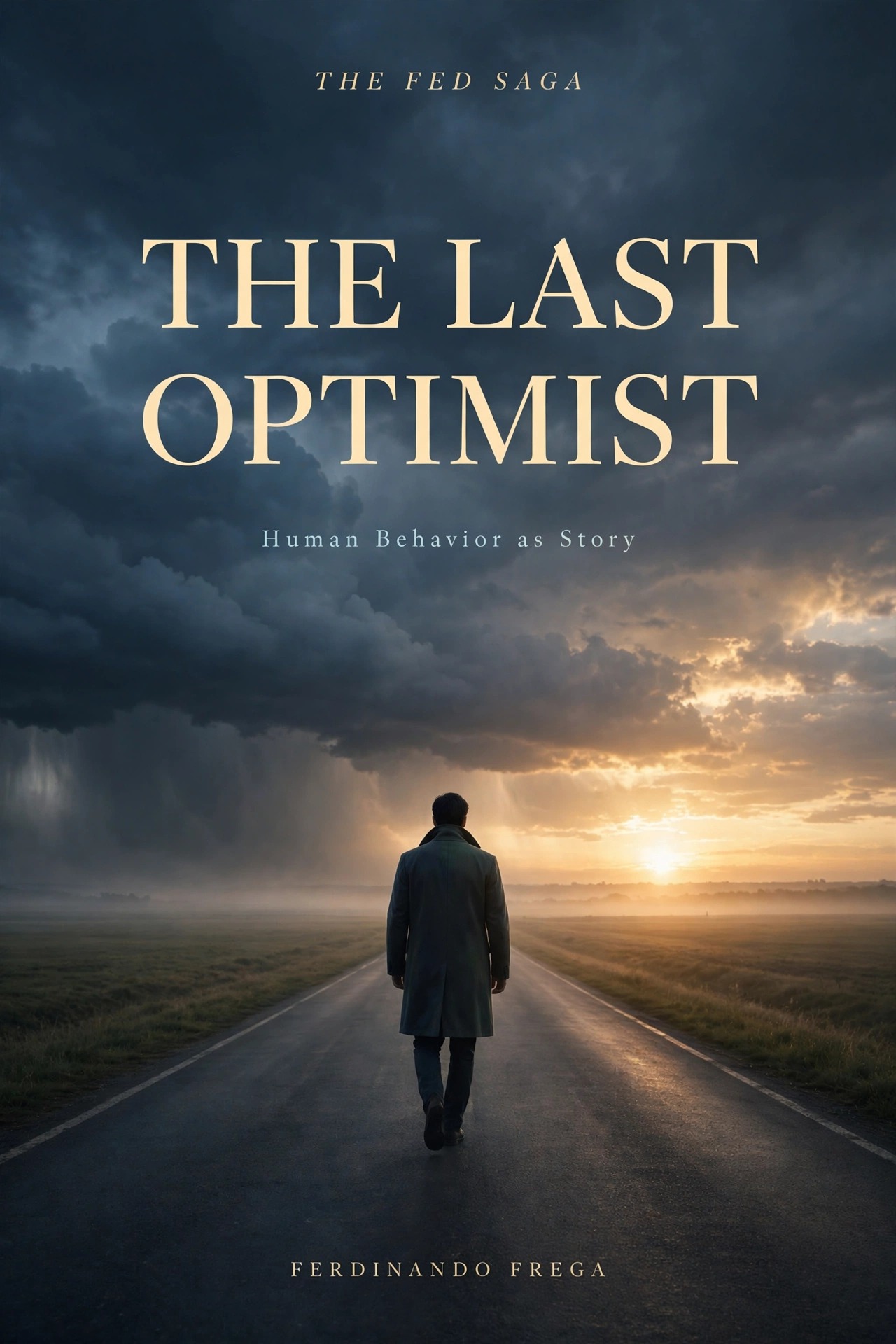
Human Behavior as Story (IRELAND)
THE LAST OPTIMIST
The Fed Saga — 10
The optimist has a terrible reputation.
He is often mistaken for a simpleton.
Someone who doesn’t see the problems.
Someone who ignores the risks.
Someone who smiles while the house is on fire.
But that is not a definition of optimism.
It is a definition of stupidity.
They are two different things.
Very different.
True optimism is not born of ignorance.
It is born of experience.
Because after a certain number of years you discover something curious.
The world has survived almost everything.
Crises.
Wars.
Crashes.
Pandemics.
Inflation.
Deflation.
Speculative bubbles.
Terrible decisions.
Excellent decisions.
Politicians.
Economists.
Experts.
Influencers.
The world keeps waking up in the morning.
Often against every forecast.
When I was young I thought optimism was a form of trust in the future.
Today I think something different.
Optimism is trust in human beings.
Not in the future.
The future is too unpredictable.
Human beings, on the other hand, have a surprising trait.
They adapt.
They fall.
They get back up.
They make mistakes.
They learn.
They forget.
They start over.
They repeat the whole process.
And somehow they keep moving forward.
This is not economics.
It is anthropology.
Look at any financial chart long enough.
In the end you will always find the same story.
Fear.
Panic.
Recovery.
Enthusiasm.
Excess.
Correction.
New hope.
The numbers change.
Human beings do not.
That is why the Federal Reserve amuses me.
Every meeting tries to answer the same question.
How will people behave tomorrow?
The correct answer is always the same.
In a human way.
Which means unpredictably.
An economist might find this conclusion frustrating.
A writer finds it fascinating.
Because it is precisely unpredictability that creates the story.
Imagine a novel where you already know everything.
Who will win.
Who will lose.
Who will love.
Who will betray.
Who will survive.
It would be a terrible book.
And yet many people spend their lives searching for that version of reality.
A reality without surprise.
Without risk.
Without uncertainty.
Without any possibility of error.
The trouble is that when you eliminate uncertainty, you eliminate discovery too.
You eliminate growth.
You eliminate courage.
Even hope stops meaning anything.
Because hope exists only where uncertainty exists.
No one hopes the sun will rise tomorrow.
We take it for granted.
We hope only for the things we do not control.
And human beings control far less than they believe.
This is terrible news for those who love control.
But it is excellent news for those who love living.
Over the course of my career I have met many intelligent people.
Some were optimists.
Some were pessimists.
The most interesting difference was not that one.
The difference was another.
The optimists built.
The pessimists commented.
The optimists opened doors.
The pessimists explained why they would not open.
The optimists were often wrong.
The pessimists were often right.
But the world was almost always changed by the optimists.
For a simple reason.
To build something you have to believe it is possible.
Even when the evidence is not yet visible.
In this sense every entrepreneur is an optimist.
Every parent is an optimist.
Every teacher is an optimist.
Every artist is an optimist.
Every person who begins something without guarantees is an optimist.
Life itself seems built around this principle.
We invest time before seeing the result.
We invest energy before seeing the result.
We invest trust before seeing the result.
We invest love before seeing the result.
Always.
Optimism is not believing that everything will turn out fine.
Optimism is accepting that it could turn out badly and deciding to go on anyway.
This is a form of courage.
Perhaps the most underrated.
Wall Street calls it risk.
The Federal Reserve calls it expectation.
A writer calls it a story.
A father calls it the future.
In the end we are all talking about the same thing.
The will to move toward something we cannot see.
That is why I believe the last optimist is an important figure.
Not because he is always right.
But because he keeps walking when others stop.
And often that is enough.
In the end the question is not whether you are an optimist or a pessimist.
The question is different.
Much more concrete.
When the future shows up with no guarantees, no promises, and no instructions…
do you keep on building, or do you stop believing?
Ferdinando
The Fed Saga — 10 · Human Behavior as Story
We don’t sell books. We build relationships.