


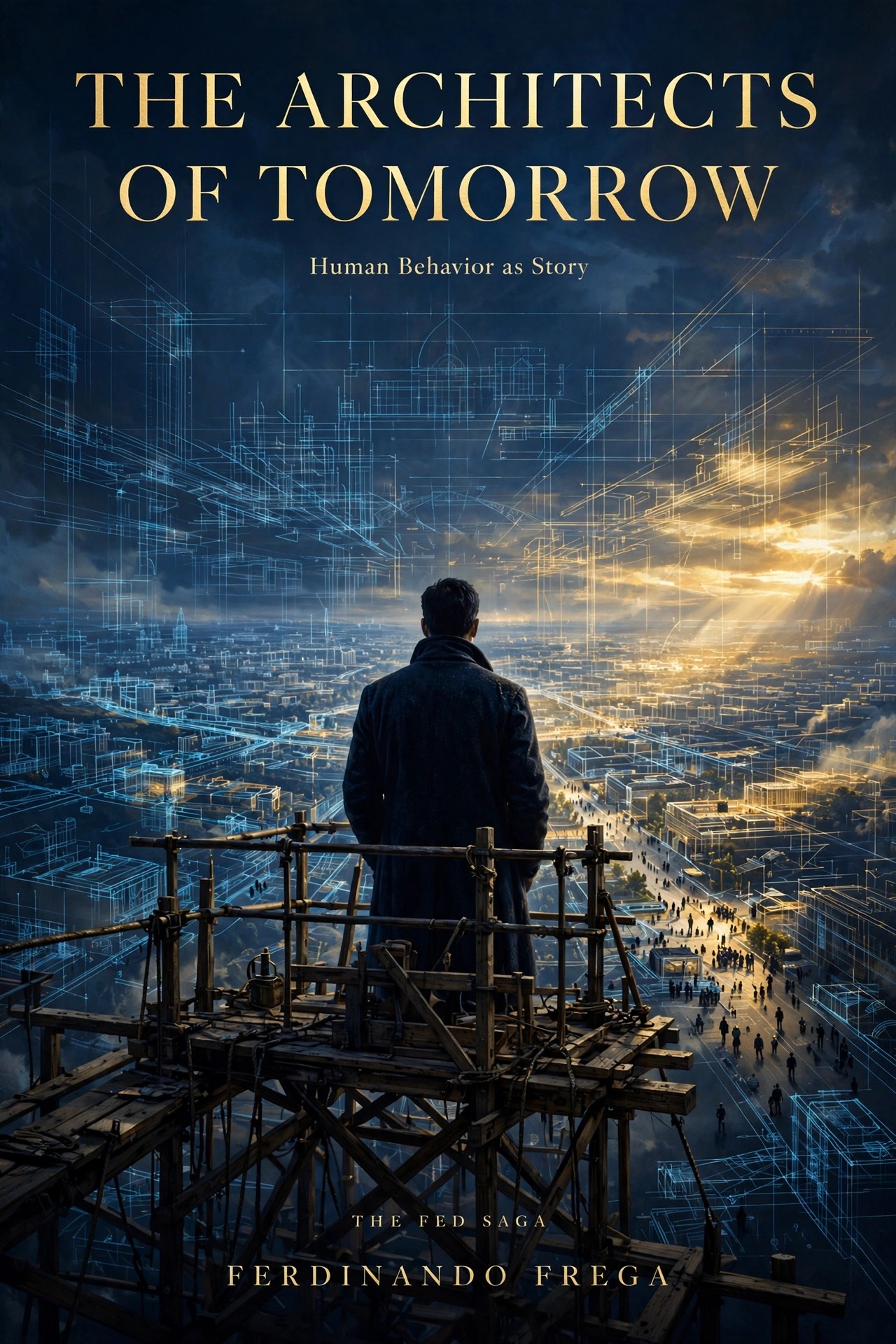
Human Behavior as Story (INDIA)
THE ARCHITECTS OF TOMORROW
The Fed Saga — 14
There’s something that has always made me curious.
Many people spend their lives trying to build their own future.
Others spend their lives building other people’s futures.
The second kind are more numerous than you’d think.
A teacher builds the future of students.
A parent builds the future of children.
A politician builds the future of a nation.
A bank builds the future of its customers.
A central bank builds the future of millions of people it will never meet.
The question is simple.
Who gave you the right to design someone else’s future?
The more I watch the world, the more I realize that this question is rarely asked.
Because we almost always focus on the result.
Much less on the permission.
And yet every form of power is born right there.
The moment someone decides which future is desirable.
For themselves.
Or for others.
As a boy, I thought power was control.
In time I discovered that power is something more subtle.
Power is the ability to influence probabilities.
You don’t control what will happen.
You change the possibilities.
A father doesn’t control his son’s life.
He influences the probabilities.
A teacher doesn’t control a student’s destiny.
He influences the probabilities.
The Federal Reserve doesn’t control the future of the economy.
It influences the probabilities.
Suddenly the world changes shape.
It no longer looks like a machine.
It looks like a gigantic architecture of possibilities.
Some people build walls.
Others build bridges.
Still others build invisible corridors that steer human behavior.
The interesting part is that almost no one thinks of himself as an architect.
And yet we all are.
Every piece of advice.
Every rule.
Every incentive.
Every punishment.
Every reward.
Every choice about how to educate.
Every management decision.
Every public policy.
It is a design.
An implicit statement.
A bet on how human beings will behave tomorrow.
Arrogance begins when we forget one thing.
Human beings don’t read the blueprint.
They reinterpret it.
Always.
A school designs one thing.
The students produce another.
A government plans one thing.
The citizens produce another.
A company launches a strategy.
The employees produce another.
A parent imagines a life.
A child invents a different one.
History is full of architects surprised by the people who were supposed to follow the blueprint.
Maybe because we too often confuse building with control.
They are not the same thing.
To build means to create a space.
To control means to eliminate freedom.
The two rarely live together.
That is why I distrust perfect systems.
Every perfect system contains a hidden premise.
The idea that someone has already figured out how everyone else should behave.
It is a sophisticated form of optimism.
And often an even more sophisticated form of vanity.
For forty years I watched markets.
Managers.
Salespeople.
Customers.
Chief executives.
Economists.
Psychiatrists.
Politicians.
No one was completely predictable.
Not even those convinced they were.
Especially those convinced they were.
There is a sentence reality repeats all the time.
Each time in different words.
Human beings cooperate.
Human beings resist.
Human beings surprise.
That is why the future keeps slipping away from its designers.
An architect can draw a building.
He cannot draw what will happen inside the rooms.
A central bank can design incentives.
It cannot design every human choice.
A father can teach values.
He cannot live his son’s life.
At this point the paradox appears.
The best architects of tomorrow are not those who control best.
They are those who leave room for the unexpected.
They understand that every design will be changed by reality.
They understand that every plan will be negotiated with other people’s freedom.
They understand that the future is not an object.
It is a conversation.
That is why some organizations survive a long time.
Not because they are rigid.
Because they are adaptable.
Not because they are always right.
Because they learn.
Learning is perhaps the highest form of architecture.
You build something.
Reality corrects you.
You build again.
Reality corrects you again.
And slowly a better structure emerges.
Not perfect.
Never perfect.
But alive.
Maybe this is where the difference between power and wisdom lies.
Power wants to design others.
Wisdom wants to understand them.
Power builds systems.
Wisdom builds people.
Power loves control.
Wisdom tolerates uncertainty.
And that is probably why the most enduring works in history are not always those built by the most powerful.
Often they are those built by someone who understood something about human nature.
In the end, the future does not belong to the architects.
It belongs to the inhabitants.
They are the ones who decide whether to live inside the design.
Change it.
Ignore it.
Or tear it down.
And maybe the question every designer should ask is not:
“How can I control tomorrow?”
But a much harder one.
“Am I building a future that others will truly want to live in?”
Ferdinando
The Fed Saga — 14 · Human Behavior as Story
We don’t sell books. We build relationships.