
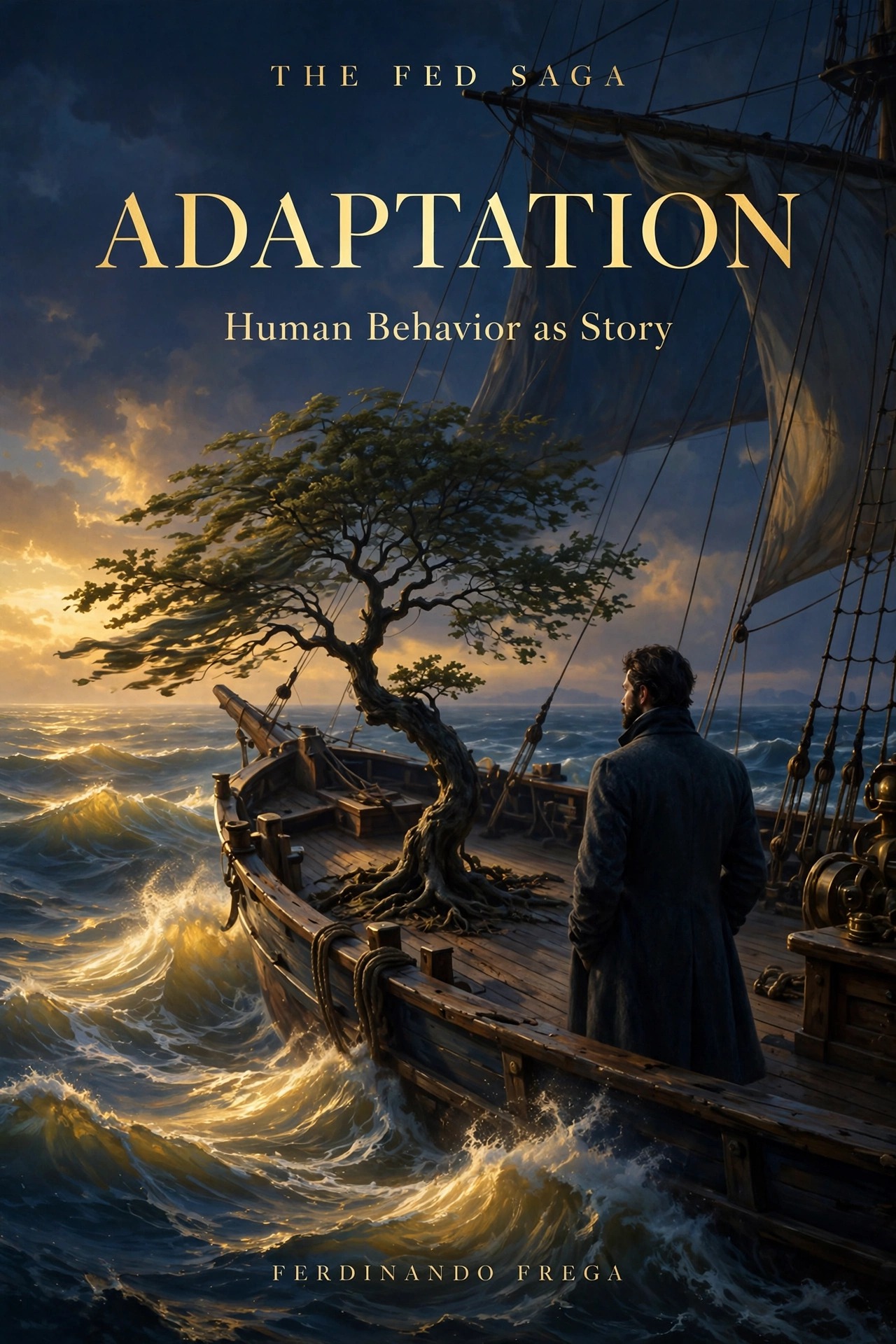
Human Behavior as Story (NEW ZEALAND)
ADAPTATION
The Fed Saga — 19
For a long time I thought the most important quality was resilience.
Then I discovered a problem.
Resilience lets you endure.
Adaptation lets you evolve.
And the two are not the same.
A pole resists.
A tree adapts.
When the strong wind comes, the pole fights.
The tree negotiates.
Sometimes the strongest survives.
More often the most adaptable survives.
Nature has known this for millions of years.
Human beings keep forgetting it every Monday morning.
We have a strange obsession.
We love certainties.
We love structures.
We love definitions.
We love permanent identities.
We like being able to say:
“This is who I am.”
“This is my job.”
“This is my career.”
“This is my strategy.”
“This is my plan.”
Then time arrives.
And transforms everything.
The problem is not change.
Change is normal.
The problem is that we keep behaving as if it were an exception.
Every generation believes it is living through an extraordinary period.
Every generation is wrong.
Change is the norm.
Stability is the exception.
Watch the Federal Reserve.
The governors change.
The models change.
The theories change.
The crises change.
The markets change.
The institution survives because it adapts.
The same goes for companies.
For families.
For nations.
For people.
The funny part is that adaptation is often read as weakness.
As inconsistency.
As lack of character.
Nothing could be more wrong.
Changing your mind in the face of new evidence is not weakness.
It is intelligence.
Insisting on a mistake just to appear consistent is a sophisticated form of stupidity.
And yet it happens all the time.
People defending dead ideas.
Companies defending dead models.
Institutions defending dead procedures.
For years.
Sometimes for decades.
Until reality presents the bill.
Reality has a lot of patience.
But in the end it invoices everything.
Over time I began to see adaptation differently.
Not as an ability to change.
But as an ability to keep what matters while what doesn’t matter changes.
That is the difference.
A ship in the middle of the sea keeps changing direction.
It does not change destination.
A mature person modifies strategies.
He does not necessarily modify principles.
Confused people change everything.
Wise people change what is necessary.
That is why adaptation is harder than resilience.
Resilience asks you to stay on your feet.
Adaptation asks you to understand what deserves to remain.
It is a cognitive problem.
Not a physical one.
Not an economic one.
Almost a philosophical one.
What do you abandon?
What do you keep?
What do you transform?
Every crisis asks exactly these three questions.
That is why crises are so useful.
They are expensive teachers.
But extremely clear ones.
They separate what was essential from what was merely comfortable.
Wall Street discovers it at every crash.
Companies discover it at every recession.
Families discover it at every important change.
People discover it when life suddenly stops cooperating.
At that point an uncomfortable truth emerges.
We are not paid to be right.
We are rewarded for correcting ourselves fast enough.
Evolution works this way.
History works this way.
Life works this way.
No species conquered the planet because it was the strongest.
It survived because it was the most adaptable.
Perhaps the real capital of the future will not be money.
Nor technology.
Nor artificial intelligence.
Perhaps it will be the ability to learn.
To unlearn.
And then to learn again.
Repeatedly.
Without feeling betrayed by reality.
Because reality owes us no consistency.
It owes us no stability.
It owes us no confirmation.
It offers us only a continuous conversation.
And adaptation is the language we answer with.
Sometimes I think most suffering comes from a useless war.
The war between what is and what we thought it should be.
Adaptation puts an end to that war.
Not because it gives up.
Because it understands.
It understands that the world is not a contract.
It is a negotiation.
Continuous.
Endless.
Unpredictable.
And maybe this is exactly where the advantage of extraordinary people lies.
They don’t see change as a threat.
They see it as a raw material.
Something to use.
Something to shape.
Something to turn into possibility.
In the end the question is not how strong you were.
The question is not how long you endured.
The question is not even how many times you won.
The question is much harder.
When the world changed, did you manage to change with it without losing yourself?
Ferdinando
The Fed Saga — 19 · Human Behavior as Story
We don’t sell books. We build relationships.