
Human Behavior as Story (NEW ZEALAND)
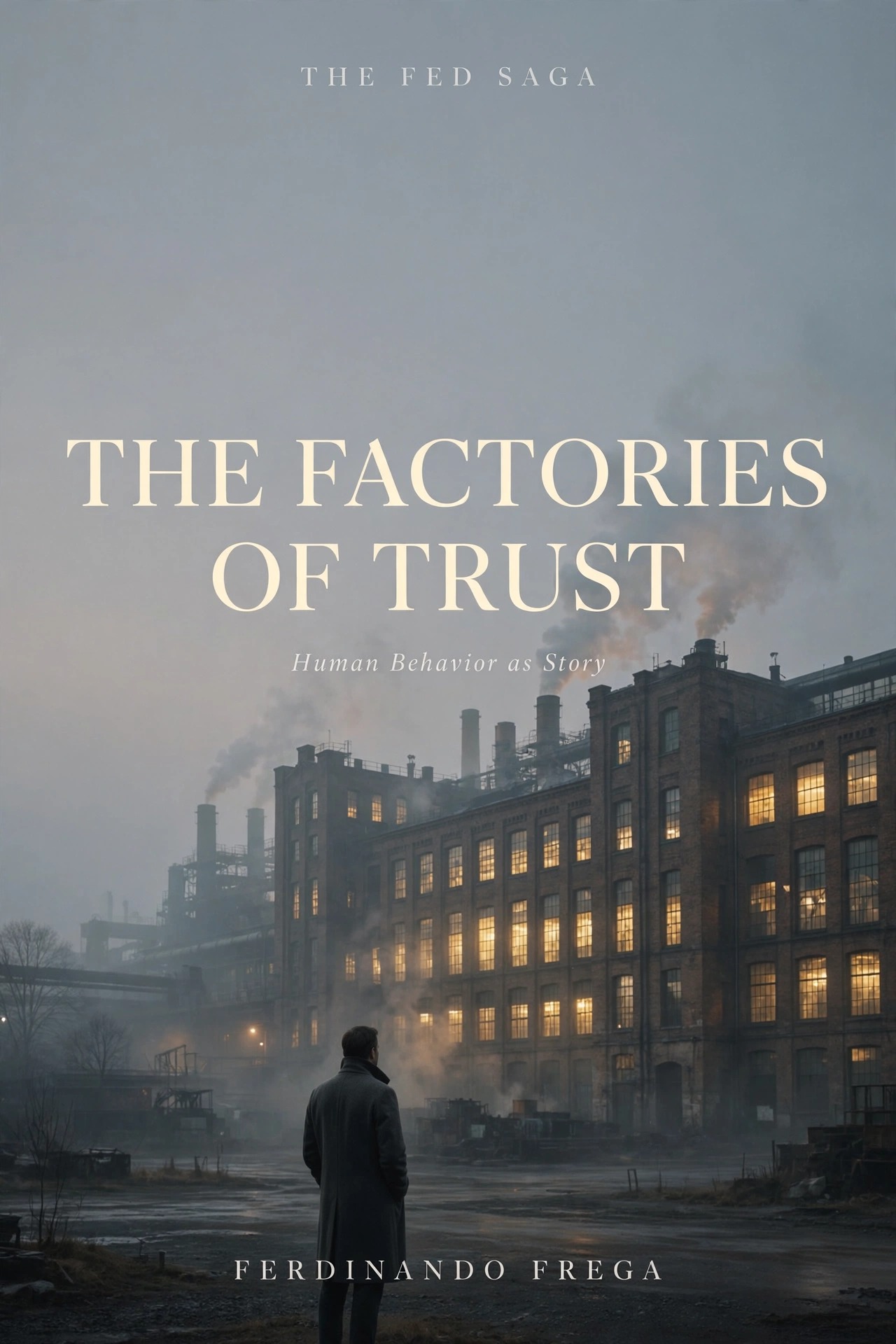
THE FACTORIES OF TRUST
The Fed Saga — 05
If I had to explain money to a child, I would not start with a coin.
I would start with a promise.
Because a coin is metal.
A banknote is paper.
A number on a screen is light.
But money is none of these things.
Money is trust.
And trust is one of the strangest inventions in human history.
No one has ever seen it.
No one has ever weighed it.
No one has ever photographed it.
And yet it moves the world.
Every morning millions of people get up, work, buy, invest, save, and plan the future using something that exists only because everyone agrees to believe that it exists.
If you think about it too long, it almost looks like collective madness.
And maybe it is.
An extraordinarily well-organized madness.
When I was young I believed factories produced objects.
I saw them produce razor blades.
Cars.
Clothes.
Detergents.
Real products.
In time I discovered that the most important factories on the planet do not produce objects.
They produce trust.
A bank produces trust.
A school produces trust.
A family produces trust.
A religion produces trust.
A nation produces trust.
Even a brand produces trust.
When a person buys the same product for thirty years, he is not purchasing an object.
He is purchasing a promise that has been kept over time.
It is a form of industrialized trust.
And this is where the story gets interesting.
Because the Federal Reserve does not only print money.
It prints trust.
Or at least it tries.
This is an enormous difference.
Banknotes are simple.
Trust is complicated.
A banknote comes out of a machine.
Trust comes out of behavior.
You can print paper in an afternoon.
You can build trust in a generation.
And destroy it in a week.
History is full of empires that learned this too late.
Markets rise when trust grows.
Markets crash when trust disappears.
Banks work when trust circulates.
Banks collapse when people stop believing.
Even money keeps its value only as long as someone goes on accepting it.
Take away the trust.
The paper remains.
The metal remains.
The computer system remains.
But the money disappears.
This should give anyone pause.
Because it means that the most important asset of the modern economy is not money.
It is trust.
And yet almost no one puts it on a balance sheet.
No one locks it in a vault.
No one accounts for it properly.
We take it for granted.
Like air.
Until it is gone.
Then suddenly it becomes the only thing that matters.
I have seen companies lose millions for lack of trust.
I have seen projects fail for lack of trust.
I have seen very intelligent people sabotage their own future for lack of trust.
Not always trust in others.
Sometimes trust in themselves.
The difference between many success stories and many failure stories is surprisingly small.
Often it is one person who goes on believing a few months longer.
The Federal Reserve fights the same battle.
Every central bank in the world fights the same battle.
It is not only trying to manage money.
It is trying to manage expectations.
Because expectations are the laboratory where trust is born.
A person who believes in tomorrow behaves one way.
A person who no longer believes in it behaves another.
The economy changes afterward.
First trust changes.
It has always been this way.
Long before Wall Street.
Long before banks.
Long before finance.
Tribes lived on trust.
Cities lived on trust.
Families lived on trust.
Armies lived on trust.
Civilizations lived on trust.
Every human society is a gigantic web of promises.
Most people keep their word.
Most bridges do not collapse.
Most airplanes land.
Most doctors heal.
Most teachers teach.
Most banks open again tomorrow.
We live immersed in an ocean of trust that we notice only when something goes wrong.
Maybe that is why distrust is so loud.
Trust works in silence.
Distrust always makes the news.
No newspaper runs the headline:
“Millions of people trusted correctly again today.”
It would be a rather boring article.
And yet it would be the most important news of the day.
Because without that invisible trust, almost nothing would work.
In the end, though, the question is not about central banks.
It is not about Wall Street.
It is not even about money.
It is about you.
Every relationship you have built.
Every word you have kept.
Every promise you have honored.
Every time someone has trusted you.
In the end, the greatest wealth is not the money you own.
It is the trust you leave behind you.
And maybe that is the real question.
If your life were a bank, how much would the trust that others have deposited be worth today?
Ferdinando
The Fed Saga — 05 · Human Behavior as Story
We don’t sell books. We build relationships.