


Human Behavior as Story (SINGAPORE)
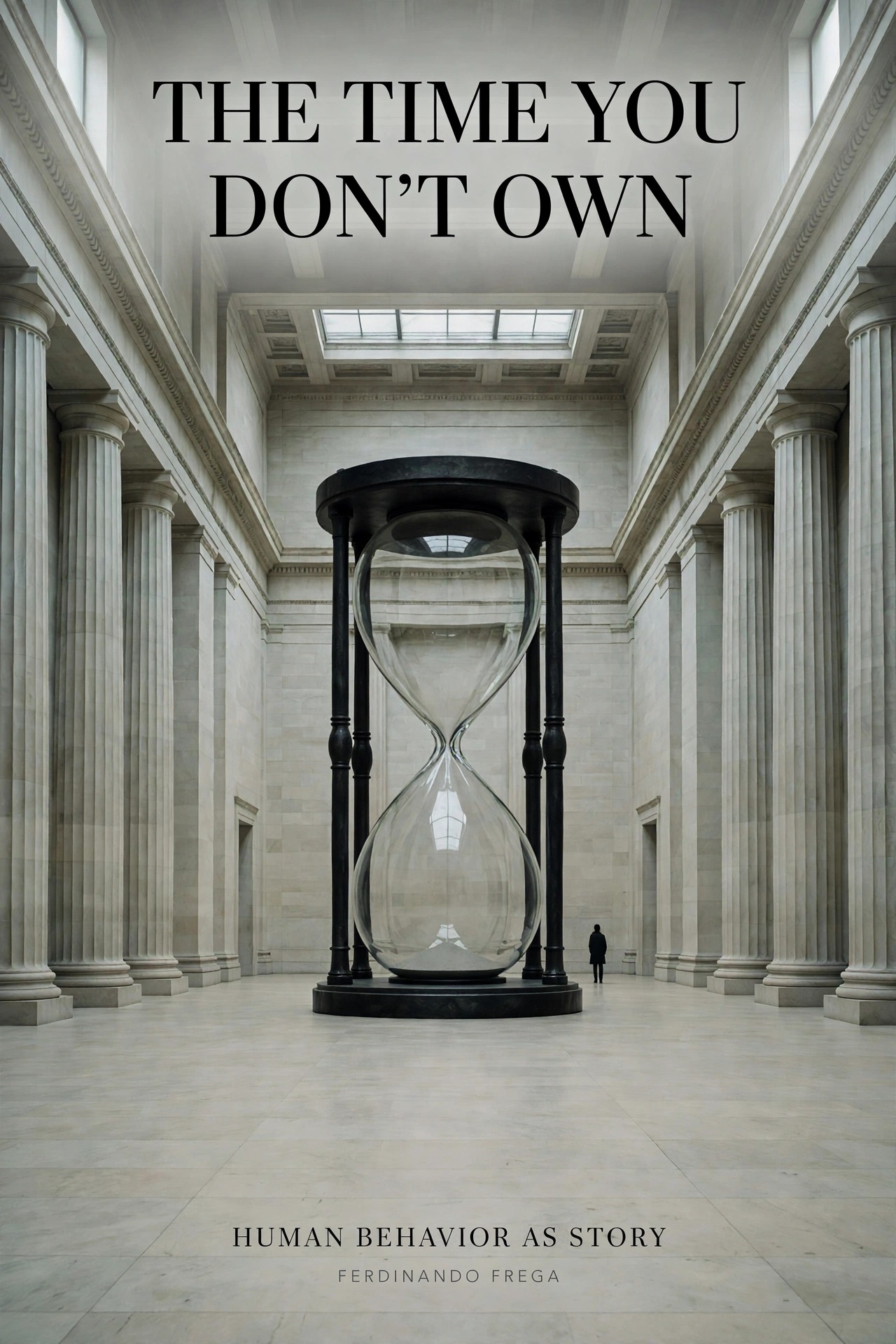
THE TIME YOU DON’T OWN
The Fed Saga — 21
For twenty chapters we have talked about time as if it were a resource.
It was a little deception.
A necessary one.
But a deception all the same.
Because the language of economics accustoms us to thinking that time is something we own.
We spend it.
We invest it.
We lose it.
We save it.
We manage it.
Even the expressions we use betray this belief.
As if time were money.
As if it were private property.
As if it were deposited in an invisible account under our name.
Then something happens.
You grow old.
And the whole conceptual system begins to show cracks.
You realize you have never owned time.
Not even for a second.
You have owned clocks.
Planners.
Calendars.
Deadlines.
Memories.
Never time.
Time was there before you.
And it will go on being there afterward.
It is a simple conclusion.
And a devastating one.
The Federal Reserve can influence the cost of money.
It can influence rates.
It can influence credit.
It can influence expectations.
But it cannot influence time.
No central bank can.
No government can.
No technology can.
Not even artificial intelligence.
Because time does not belong to the category of things that can be controlled.
It belongs to the category of things that can only be walked through.
For years I watched managers talk about time as a productive resource.
Economists describe it as a variable.
Investors treat it as a multiplier.
All correct.
All incomplete.
Because there is an enormous difference between using time and understanding it.
You can use a river without understanding water.
You can sail the sea without understanding the ocean.
You can live a life without understanding time.
Many manage it perfectly.
The ironic part is that the more successful a person is, the more he tends to believe he owns time.
He can buy a house.
He can buy a company.
He can buy an island.
He can buy a jet.
He can buy almost anything.
And slowly he begins to develop an illusion.
The idea that every problem can be solved by buying something.
Then time arrives.
And presents a bill that accepts no currency.
Suddenly the body changes.
Energy changes.
Priorities change.
Urgencies change.
People change.
And reality brings back a truth that had stayed hidden behind success.
You were not using time.
It was time that was using you.
That sentence haunted me for years.
Because it turns the perspective completely upside down.
Modern man talks constantly about time management.
As if he were a director.
As if he were an administrator.
As if he were the owner of the system.
Maybe we are simply guests.
Or perhaps raw material.
Maybe time is not the container of our life.
Maybe our life is one of the ways time makes itself visible.
At that point money changes meaning.
Success changes meaning.
Even the Federal Reserve changes meaning.
It no longer looks like a place that manages money.
It looks like a place that tries to put a price on the passage of time.
And it is an enormous difference.
Because if time does not belong to us, no price will ever be enough.
Modernity keeps looking for shortcuts.
Productivity.
Efficiency.
Optimization.
Acceleration.
Doing more.
Faster.
More often.
With less friction.
And yet the most important things keep rejecting this language.
Love takes time.
Friendship takes time.
Trust takes time.
Competence takes time.
Healing takes time.
Maturity takes time.
Wisdom takes time.
As if the universe had decided to protect the important things from any attempt at acceleration.
Perhaps that is why human beings are so drawn to speed.
Because they know intuitively that there is something they will never be able to overtake.
And so they run.
They run toward the future.
They run away from the past.
They run after goals.
They run after opportunities.
They run after themselves.
Sometimes I think many are not looking for success.
They are trying to beat time.
And time keeps winning without even entering the race.
Not out of cruelty.
By nature.
A mountain does not win against the wind.
An ocean does not win against the rain.
Time does not win against man.
Time simply is.
Man is the one who passes.
And this is where the paradox reaches its highest point.
All our lives we behave as if time were a limited resource.
Then we discover something more unsettling.
It is not time that is limited.
We are.
Time goes on.
The scarce resource is the human being.
And maybe this is exactly what makes every instant so precious.
Not because it is worth a great deal.
But because it does not belong to us.
Ferdinando
The Fed Saga — 21 · Human Behavior as Story
We don’t sell books. We build relationships.