


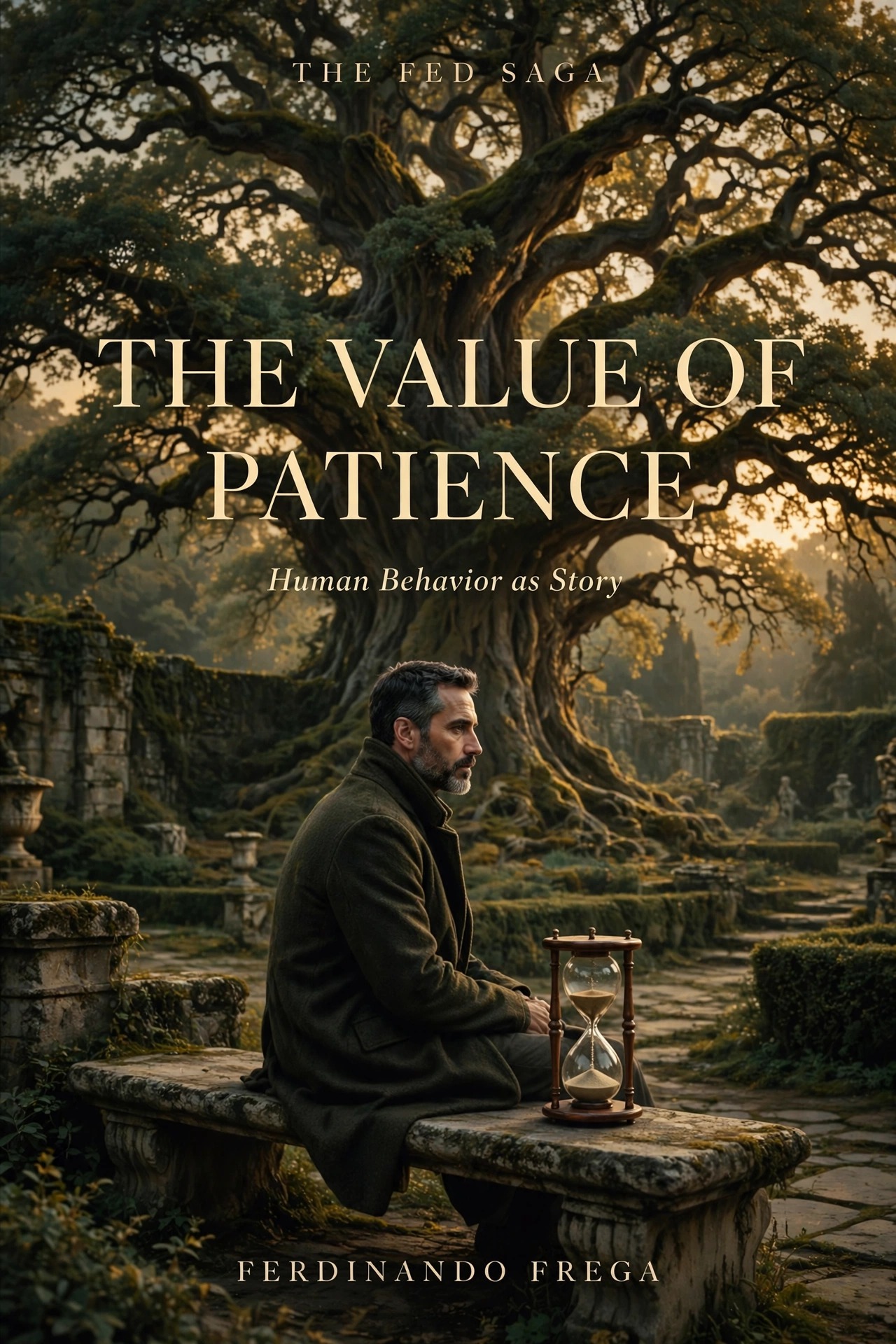
Human Behavior as Story (UNITED STATES)
THE VALUE OF PATIENCE
The Fed Saga — 15
For many years I thought the competitive advantage was intelligence.
Then I thought it was talent.
Then I thought it was capital.
Then I thought it was information.
At some point I realized that all of these can be bought, imitated, or replaced.
Patience cannot.
Patience is a strange resource.
Because no one wants it when they have it.
Everyone misses it when they no longer do.
We live in an age that has declared war on waiting.
Same-day delivery.
Immediate answers.
Quarterly results.
Real-time notifications.
Instant opinions.
Even boredom has become a problem to solve.
So we have built a very fast civilization.
And an incredibly impatient one.
The consequence is curious.
People know how to react faster and faster.
But they find it harder and harder to mature.
Because maturing takes time.
And time does not accept acceleration.
You can speed up an internet connection.
You can speed up a delivery.
You can speed up a transaction.
You cannot speed up an experience.
You cannot speed up a relationship.
You cannot speed up trust.
You cannot speed up character.
These things grow at the speed set by reality.
Not by technology.
Wall Street knows it.
Even if it rarely admits it.
Many of the great fortunes were not born of superior intelligence.
They were born of the ability to wait longer than others.
Patience is the compound interest of decisions.
Small right choices.
Repeated for a long time.
Nothing spectacular.
Nothing heroic.
Nothing you could photograph for social media.
And yet that is where much of the value is born.
When I worked in international management, I often saw the same scene.
A brilliant person arrived with a strategy.
A less brilliant person arrived with perseverance.
Ten years later the result surprised everyone.
The smartest one did not always win.
Often the one who had stayed long enough won.
Patience has a quality that intelligence lacks.
It accumulates.
Every year it adds something.
Competence.
Relationships.
Credibility.
Experience.
Perspective.
Intelligence can impress a room.
Patience can transform a life.
That is why the Federal Reserve looks to me less like a bank and more like a psychological experiment.
Every one of its decisions concerns a single question.
How long are we willing to wait?
Markets want results.
Companies want results.
Governments want results.
Voters want results.
Everyone wants the harvest.
Very few are interested in the sowing season.
And yet a society that loses the ability to wait becomes vulnerable.
Very vulnerable.
Because it begins to sacrifice the long term for the short term.
It replaces building with reacting.
It takes movement for progress.
It mistakes speed for direction.
And these are costly mistakes.
Very costly.
The ironic part is that patience is often described as passivity.
It is not.
The impatient man reacts.
The patient man observes.
The impatient man looks for relief.
The patient man looks for understanding.
The impatient man wants an answer.
The patient man wants a correct answer.
They seem like nuances.
In fact they build different destinies.
Over the years I began to suspect that patience is a form of trust.
Trust in the process.
Trust in time.
Trust that not everything needs to produce immediate results to have value.
It is a position against the current.
Perhaps even a revolutionary one.
Because the modern world rewards urgency.
But the things that truly matter still grow slowly.
A forest.
A reputation.
A friendship.
A craft.
A marriage.
A child.
A culture.
A civilization.
None of these accepts shortcuts.
And this is where patience stops being a moral virtue.
It becomes a cognitive technology.
A rare ability.
The ability to tolerate time without constantly trying to force it.
The more I watch the world, the more convinced I become of one thing.
The difference between success and failure is often less spectacular than books tell.
Sometimes the one who knows the most does not win.
The one who speaks best does not win.
The one who runs fastest does not win.
The one who wins is the one who stays long enough to see what others gave up too soon.
Maybe that is why time remains the harshest judge.
Because it does not reward enthusiasm.
It does not reward impulsiveness.
It does not reward desire.
It rewards continuity.
And continuity is a sophisticated form of patience.
In the end the question is not how long you are waiting.
The question is much more uncomfortable.
Are you waiting because you’re afraid to act?
Or are you acting with the patience it takes to let time do its work?
Ferdinando
The Fed Saga — 15 · Human Behavior as Story
We don’t sell books. We build relationships.