
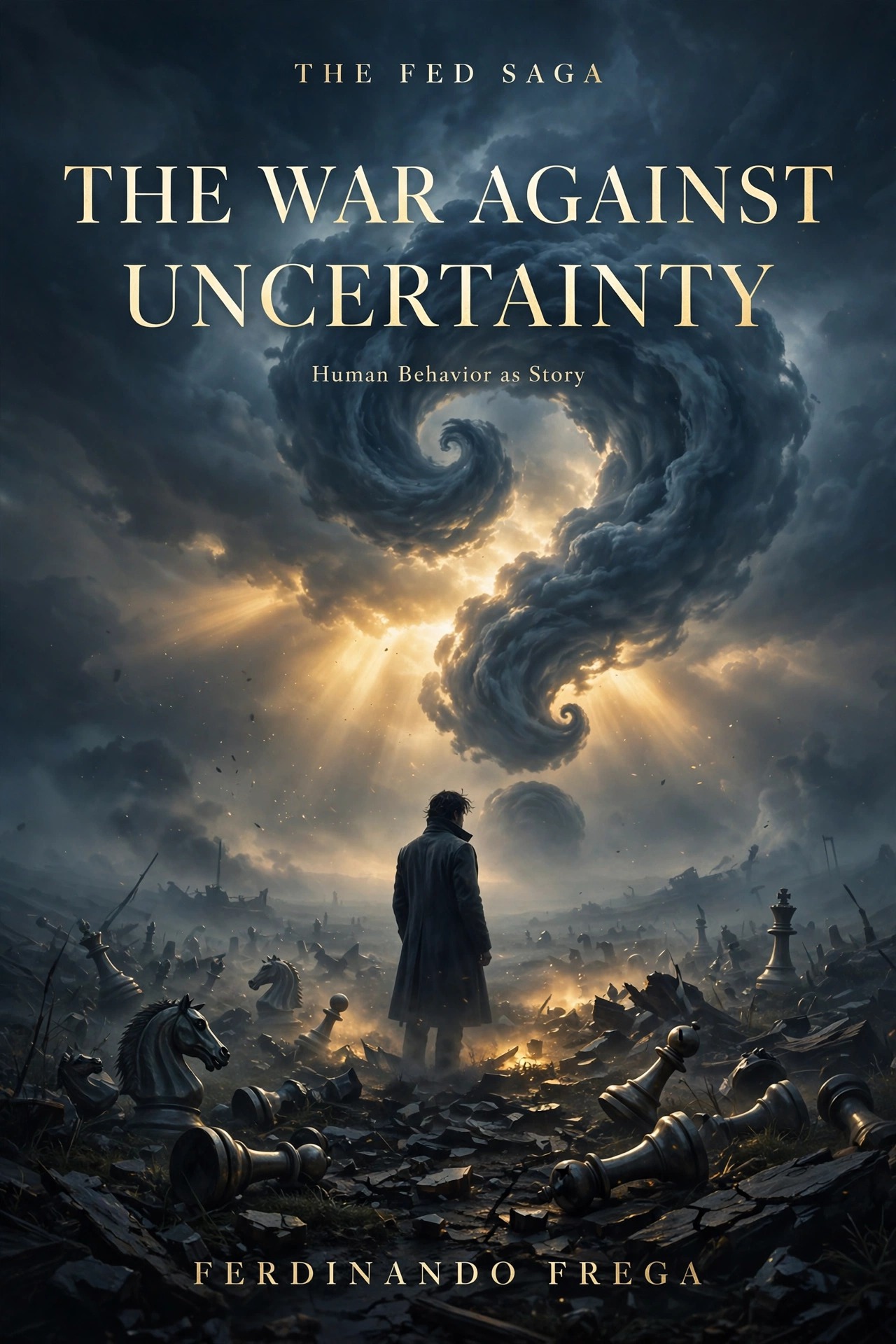
Human Behavior as Story (SOUTH AFRICA)
THE WAR AGAINST UNCERTAINTY
The Fed Saga — 16
There is a war humanity has been fighting for thousands of years.
It is a lost war.
And yet we keep funding it.
Generation after generation.
The war against uncertainty.
The most curious part is that no one declares it openly.
No president steps onto a stage and says:
“Starting today we will eliminate the unpredictable.”
No economist writes it.
No central bank admits it.
And yet almost everything we build points that way.
Insurance.
Contracts.
Pensions.
Strategic plans.
Budgets.
Forecasts.
Algorithms.
Artificial intelligence.
Mathematical models.
Data analysis.
We are not simply trying to understand the future.
We are trying to neutralize it.
Because the future offends us.
It offends us personally.
It keeps reminding us of a truth we hate:
we are not in control.
Modernity can be told as one gigantic rebellion against that sentence.
Every new technology promises one thing.
More forecasting.
More control.
More safety.
More certainty.
And yet something strange happens.
The more information we pile up, the more aware we become of how much we don’t know.
It is a wonderful paradox.
We thought knowledge would eliminate uncertainty.
It did the opposite.
It lit it up.
A man in the Middle Ages knew almost nothing of what was happening far away.
And that part of the world did not keep him awake.
Today a person can know in real time what is happening on every continent.
He can learn of wars.
Markets.
Epidemics.
Crises.
Forecasts.
Risks.
Possibilities.
And yet he rarely feels safer.
Because information does not eliminate uncertainty.
It makes it visible.
The Federal Reserve lives precisely inside this paradox.
The more data it collects.
The more models it builds.
The more forecasts it produces.
The more it discovers how much human behavior escapes the forecasts.
Not because people are irrational.
It’s worse.
People are creative.
They change their minds.
They learn.
They adapt.
They improvise.
They betray expectations.
Every human being is a small machine for producing surprise.
This makes economics difficult.
But it makes life possible.
Imagine a world without uncertainty.
A world where everything is predictable.
Companies already know the future.
Governments already know the future.
Markets already know the future.
You already know your future.
At first glance it looks like paradise.
Look again.
It is a prison.
If everything is predictable, nothing is free.
If everything is known, nothing can be discovered.
If everything is certain, no one can surprise.
Uncertainty is not a defect of reality.
It is the price of freedom.
And this is where the war gets interesting.
Because man says he loves freedom.
But he spends much of his life trying to eliminate what makes it possible.
Uncertainty.
He wants relationships without risk.
Investments without risk.
Success without risk.
Love without risk.
Ventures without risk.
A life without risk.
In other words:
he wants the effects of freedom without paying its cost.
Reality keeps turning down the offer.
Over time I began to suspect something even more radical.
Maybe uncertainty is not the problem.
Maybe the problem is our need for certainty.
Maybe we don’t suffer because the future is unpredictable.
We suffer because we demand that it be predictable.
It is an enormous difference.
The first position fights reality.
The second accepts it.
When an entrepreneur opens a business, he does not eliminate uncertainty.
He walks through it.
When a father raises a child, he does not eliminate uncertainty.
He walks through it.
When a person falls in love, he does not eliminate uncertainty.
He walks through it.
Even a central bank does not eliminate uncertainty.
It negotiates it.
Every day.
With tools that are always new.
With results that are always imperfect.
And maybe that is as it should be.
Because a completely predictable reality would be a completely dead reality.
No discovery.
No invention.
No surprise.
No story.
At that point I understood something that made me smile.
Maybe humanity is not fighting against uncertainty.
Maybe it is fighting against a part of itself.
The part that cannot stand not knowing.
The part that wants an immediate answer.
The part that mistakes explanation for understanding.
But growing up means exactly the opposite.
It means becoming mature enough to live without all the answers.
Strong enough to go on without all the guarantees.
Clear-headed enough to tell what you can control from what you can only walk through.
In the end, the great irony is this.
After thousands of years of wars against uncertainty, our greatest success has not been eliminating it.
It has been learning to live with it.
Because the opposite of uncertainty is not safety.
It is stagnation.
And stagnation has never created an interesting human being.
That is why the real question is not:
“How can I eliminate uncertainty?”
The real question is much harder.
“Who do I become when I stop demanding that the future obey me?”
Ferdinando
The Fed Saga — 16 · Human Behavior as Story
We don’t sell books. We build relationships.