
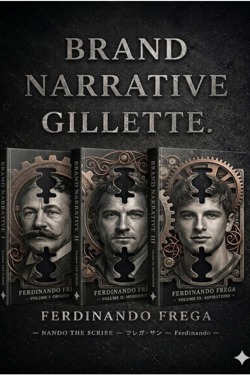
The Invisible Structure · English Edition · Cap. 00
Brand Narrative Gillette
The Last Moment
“Three blades. One recognition.”
COLOPHON
Written and created by Ferdinando Frega. Edited and curated within the ONEDOLLAR-STORIES ecosystem. Digital architecture: NAPLES-POST · NOASPECTTIME · ONEDOLLAR-STORIES. First published in 2026. Set in a clean, modern typographic layout optimized for digital reading. Published in the United States.
COPYRIGHT NOTICE
© 2026 Ferdinando Frega. All rights reserved. No part of this publication may be reproduced, distributed, or transmitted in any form or by any means, including photocopying, recording, or other electronic or mechanical methods, without the prior written permission of the author, except in the case of brief quotations embodied in critical
reviews and certain other noncommercial uses permitted by copyright law. Unauthorized use, reproduction, or distribution of this work is prohibited.
STATEMENT
Brand narrative does not tell the story of Gillette. It tells the story of what Gillette men do. This is the difference. This is the fracture line between advertising and identity, between marketing and truth. A brand is a product. A man shaped by that brand is a system. Gillette built blades. Men built lives with them. And those lives — the discipline, instinct, precision, failures, victories, timing, scars are the real narrative. This volume does not explain Gillette. It exposes the human architecture forged inside its walls and carried far beyond them. Every story here is not about the company. It is about the man the company produced — the way he thinks, the way he moves, the way he reads the world, the way he refuses to be anything other than what he became. Gillette is the frame. The men are the content. And I am one of them. This is the narrative. Not the brand. The consequence of the brand. Nando.
INTRO
This is not the second book of a trilogy. It is the second layer of a brand narrative system. Gillette spent a century building product. I am building the part they never had: the narrative architecture — the one no corporation can generate from inside its own walls. Volume One was the entry point: proof that an author can step into a brand’s history without permission. Volume Two is the confirmation: the moment when the brand stops being an industrial object and becomes a narrative entity — a system of memory, discipline, geometry, and identity. I am not telling Gillette’s story. I am showing how Gillette exists inside me: as method, as instinct, as structure, as a way of reading the world. This volume represents what brands do not know they need yet: a narrative that contains them, precedes them, and outlives them. Not a book. A positioning. Not nostalgia. A blueprint.
Not a recollection. A patent. This is Volume Two. The brand narrative continues. Nando.
THE SYSTEM
There has always been, in this world, a market that never collapses. No fiscal crisis, no recession, no drop in consumption. Only the natural turnover of human lives. It is a black market, yes — but not oil. For that, they are already fighting enough. I am talking about black magic. Magicians, witches, and all those who recruit people through whatever channels they can find — people who want to change someone else’s life through spiritual tricks instead of letting destiny do its job. Some say that in one passage of the Bible, even Jesus was the target of a malicious spell. And everyone knows what happened after. It all starts in Africa, then spreads to the nomadic peoples of the gypsy stripe in a specific region of India. For over two thousand years it has grown and expanded, used by those who believe they can alter lives and destinies, convinced that the Devil and Beelzebub can still challenge the only authority that stands: God. But no one changes destinies. Because destinies are the ones that build the real story. And if you let slip a dream, a fantasy, an uncontrolled premonition, an involuntary sign — something that does not fit the formats, the categories, the logic — here is what happens: 1. You are no longer credible. 2. You are labeled sick and sent for a visit. 3. The psychiatrist fills you with pills: he is the only one who earns twice. 4. You end up alone, outside your natural projection. 5. The main obstacles become the people closest to you. 6. You are no longer allowed to speak. This is what happens when a system is born. For eighteen years I sold shaving systems, explaining one by one the features, the function, the technique, the innovation, the benefits and then the brand, the seal that guaranteed it could not fail. A bit like what is happening to me today. But I cannot say more, or I will fall right into the six points above. To you, readers, I ask only this: fix this story and this date in your mind. One day I will tell you how it ended. Nando
THE SALESMAN
When I started this job in 1985, inside The Gillette Company, the world worked the way the manuals pretended it did. Then came June 1996, and they sent me on a five-day training course. The speaker was Mario Silvano — ex-Manager, ex-CEO, ex-Professor, ex-Consultant, ex-everything. A man with more titles than substance. The course was called The Commercial Negotiator. Five days of theatre: part professional, part actor, part trickster. He closed the show with one final line: “There is nothing in this world that cannot be sold.” I carried that sentence for twenty-five years. Believe it. Defended it. Used it. Until 2021, when I started this game — writing — and finally understood the truth: It was the biggest piece of bullshit I had ever bought. He had been convincing, yes. Credible, no. All he needed was one correction: replace “thing” with “product.” Then the sentence would have worked. Because a product can be sold. A thing is another story. A salesman is always that guy who looks like he is giving you something, while with the same smile, he is taking something else away. The first real salesman in history — the only one I respect — was Jesus. He sold the Word. And he did it with the first marketing department ever created: twelve fishermen in Galilee. None of them are from MIT. But disciplined. Not perfect — just enough. The rest? Let them keep running their sales courses and cashing in. Humans are malleable. Someone will always pay to be shaped. Nando
THE HAIR
Hair is a detail people pretend to understand. They call it hygiene, aesthetics, identity, culture, ritual. But hair is none of that. It is a border: between what you show and what you hide. Some trust barbers, some trust beauticians, some trust modern machines that promise autonomy and perfection. But hair stays there, stubborn, a biological reminder: you were an animal long before you became a citizen. And it is not an enemy. It is an uncomfortable friend, a witness of origin. It spreads across the body, carries the color assigned by your genetic map, and holds a story you cannot erase. Even those with alopecia are not without it — they have only lost it for a time no one can measure. To understand hair, you must go back to the beginning — the primitive human, the place where all your narratives return. I see it as prehistoric noir. Two figures behind a wall of grass, talking. A third arrives and cannot tell who the man is and who is the woman. The face is not enough. The face lies. So, the woman decides to rewrite her identity. She walks to the river, looks at herself in the water, and sees a beard. It does not belong to her. It does not define her. It does not distinguish her. She finds a sharp stone and starts removing hair, one piece at a time. She discovers regrowth is slow — a small advantage: the ritual does not demand daily sacrifice. And she discovers something
stronger: the man looks at her differently. Difference becomes attraction. Difference becomes language. From that moment, the culture of hair begins: first symbolic, then social, then hygienic, then scientific, then ideological. Until modern extremes arrive — those who say hair protects and must stay, those who say it must disappear to be accepted, those who sculpt it to be desired. But the truth is simple: hair is born, grows, curves… and at the curve, it dies. The root stays alive, stubborn, like certain ideas you cannot remove even with willpower. And there is one last rule — the one only storyteller knows: never turn a hair into a pole. The difference is a single vowel. But it changes everything. Nando.
LIVE AUDITION—ACCESS
ENGLISH VERSION What you are about to read is not a book, not a collection, not an editorial project. It is an act of exposure. A LIVE AUDITION. Mine. At 61, I understood something simple: people do not want a version of me. They want everything I am — without category, without role, without label. So let us do it. Let us put on the table what remains when you remove everything else — the voice, the memory, the wound, the clarity, the laugh, the fatigue, the truth. These ten stories are not meant to convince anyone. They exist to show. To me. To you. To those who are not here. To those who never really looked. This is the introduction. The rest are on stage. English. Japanese. Hindi. Three ways of being. Three ways of exposing. Three ways of standing inside an audition. Enjoy the reading. Nando.
PREMISE We are what we are also because of the people we meet. We owe them everything, even when we don’t admit it. Humans are ungrateful by nature: they take, they forget, they get used to things. And this ingratitude appears in a thousand forms, almost always without noise. This vertical thought comes from what I am becoming. I feel it every day: some call it a gift, some call it a brain that never shuts off, some call it a pathology. Others do not call it anything, because they do not feel it. When they ask “what’s your job?”, we should answer with what we dreamed of as kids, in the years of recklessness. No one would have laughed. They would have given us a clean smile — the kind you give to children who still believe in possibilities. Then one morning I wake up and discover I know how to manage money. But there is always a bit. I do not have the money. And I must postpone. My audition starts now. With these ten stories. For those who will read them, reread them, or ignore them. It does not matter. They stay here. Forever, at least them. Nando.
日本語版 これから読むものは、本でも、作品集でも、編集プロジェクトでもない。 これは「露出」だ。 生きたオーディション。 私自身の。
61 歳になって、ひとつだけはっきり分かった。 人は「私の一部」なんて求めていない。 役割も、肩書きも、分類もいらない。 全部の私を求めている。
だからやろう。 すべてを剥ぎ取ったあとに残るものをテーブルに置く。 声、記憶、傷、冴え、笑い、疲れ、そして真実。
この 10 の物語は、誰かを説得するためのものではない。 ただ「見せる」ためのものだ。 私に。 あなたに。 ここにいない誰かに。 一度も本気で見たことのない人に。
これは序章。 あとは舞台だ。
英語。日本語。ヒンディー語。 三つの在り方。三つの晒し方。三つのオーディションの立ち方。
読んでくれてありがとう。 ナンド。
前書き 私たちは、出会った人々のおかげで「私たち」になっていく。 認めなくても、彼らにすべてを借りている。 人間は本質的に忘恩の生き物だ。 受け取り、忘れ、慣れていく。 その忘恩は、ほとんど音もなく、無数の形で現れる。
この垂直の思考は、私が「なりつつあるもの」から生まれた。 毎日感じる。 ある人はそれを才能と呼び、ある人は止まらない脳と呼び、ある人は病理と呼ぶ。 感じない人は、何とも呼ばない。
「仕事は何ですか?」と聞かれたら、 本当は、若い頃に夢見たことを答えるべきだった。 無謀だったあの頃の夢を。 誰も笑わなかっただろう。 可能性を信じる子どもに向ける、あの澄んだ笑顔をくれただろう。
そしてある朝、私は「お金を扱える」自分に気づく。 だが、いつも「しかし」がある。 お金はない。 だから延期する。
私のオーディションは今始まる。 この 10 の物語とともに。 読む人にも、読み返す人にも、無視する人にも。 関係ない。 ここに残る。 永遠に。少なくとも彼らは。
ナンド。
हिन्दी संस्करण जो आप पढ़ ने वाले हैं , वह न किताब है, न संग्र ह, न कोई संपादकीय परियोजना। यह एक खुला प्रदर्शन है। एक LIVE AUDITION। मेरा।
61 की उम्र में मैं ने एक सरल बात समझी: लोग मेरे किसी “संस्करण” को नहीं चाहते। वे मुझे पूरा चाहते हैं — बिना श्रेणी, बिना भूमिका, बिना लेबल।
तो चलिए, शुरू करते हैं । सब कु छ हटाने के बाद जो बचता है, उसे मेज़ पर रख देते हैं — आवाज़ , स्मृति, घाव, स्पष्टता, हँसी, थकान, सच।
ये दस कहानियाँ किसी को मनाने के लिए नहीं हैं । ये दिखाने के लिए हैं । मुझे। आपको। उन्हें जो यहाँ नहीं हैं । उन्हें जिन्होंने कभी सच में देखा ही नहीं।
यह सिर्फ प्रस्तावना है। बाकी सब मंच है।
अंग्रेज़ी। जापानी। हिन्दी। तीन रूप। तीन खुलासे। तीन तरीक़े एक ऑडिशन में खड़े होने के ।
पढ़ ने के लिए धन्यवाद। नांडो।
भूमिका हम वही बनते हैं जो हम बनते हैं — उन लोगों की वजह से जिनसे हम मिलते हैं । हम उन्हें सब कु छ देते हैं , चाहे स्वीकार करें या नहीं। मनुष्य स्वभाव से कृ तघ्न है: लेता है, भूल जाता है, आदत डाल लेता है। और यह कृ तघ्नता हज़ार रूपों में आती है — लगभग हमेशा बिना शोर के ।
यह ऊर्ध्व विचार उस चीज़ से जन्मा है जो मैं बन रहा हूँ। मैं इसे हर दिन महसूस करता हूँ। कोई इसे वरदान कहता है, कोई इसे न रुकने वाला दिमाग, कोई इसे बीमारी। कु छ लोग इसे कु छ भी नहीं कहते — क्योंकि वे इसे महसूस ही नहीं करते।
जब कोई पूछता है “आप क्या काम करते हैं ?,” हमें वह जवाब देना चाहिए जो हम बचपन में सपना देखते थे। उस बेपरवाह उम्र का सपना। कोई हँसता नहीं। वे हमें वही साफ़ मुस्कान देते — जो बच्चों को दी जाती है, जो अभी भी संभावनाओं पर विश्वास करते हैं ।
फिर एक सुबह मैं उठता हूँ और पाता हूँ कि मैं पैसे संभालना जानता हूँ। लेकिन हमेशा एक “लेकिन” होता है। पैसे नहीं हैं । और मुझे टालना पड़ ता है।
मेरा ऑडिशन अब शुरू होता है। इन दस कहानियों के साथ। जो पढ़ें गे, जो दोबारा पढ़ें गे, जो अनदेखा करें गे — कोई फर्क नहीं। ये यहीं रहें गे। हमेशा। कम से कम ये।
नांडो।
AFTER-HOURS MEETING
Dying was faster than I expected. No glowing tunnel. No relatives sprinting toward me. No emotional soundtrack. Just silence. A very elegant silence. Almost corporate. I thought I could finally rest. After forty years of useless meetings, international conference calls, directors talking for two hours without saying anything, and managers convinced PowerPoint was a religion… I thought it was over. Fatal mistake. About twenty minutes after dying, I received a notification. No angel. No demon. A perfectly dressed woman handed me a black folder. “Mr. Frega, you’re expected in the Eternal Meeting Room at 11.” “For what?” “Evaluation.” “Of what?” “Your life.” “Can we do a call?” “No.” I entered the room. A ridiculously long table. People were seated everywhere. All dead. But very alive in their attitude. I recognized the worst category immediately: ex-managers. Dead for years but still unable to stop commanding. One was talking with charts. Another had prepared a presentation. Another kept repeating: “Let’s go back to the main point.” The main point never arrived. Then I saw historical figures. Napoleon, nervous. Julius Caesar, bored. A pharaoh sleeping. Two popes arguing about something no one remembered. A McKinsey consultant who died in 2087 and still used meaningless English words: “Alignment.” “Performance.” “Scalability.” Even dead, unbearable. They made me sit. An old man opened the file. “Mr. Frega.” “Present.” “We have analyzed your life.” “My condolences.” No one laughed. Dead people. Terrible sense of humor. They began: “Why did you write so much?” “Why not?” “Why did you create thousands of free pieces of content?” “To see who understood.” “Why didn’t you sell like everyone else?” “Because everyone else looked depressed.” Silence. They took notes. Then came the real question. “Are you afraid of death?” “No.” “Why?” “Because you’re organized worse than the living.” For the first time, someone smiled. The chairman closed the file. “We’ve decided.” “Heaven?” “No.” “Hell?” “No.” “Then what?” He stared at me. “We’re assigning you to the most difficult department.” “Which one?” He handed me a badge. I read it slowly:
Meetings With Recent Billionaires I immediately understood that death was just a badly executed promotion. And the worst part… was the first one who wanted to meet me. was already sitting outside the door. Elon Musk. He was smiling. I was not. Nando
TIME: A BOOK
What Is a Classic Book That You Think Overrated? I have never really been a reader. Culture came to me on its own, over the course of my life, and I tasted its effects day after day. My first readings were comic books — TEX WILLER, my myth — then the occasional DIABOLIK, and eventually JACULA, the porno-cartoon. The stories that struck me and fascinated me the most were the ones I found by accident, as if destiny were being ironic: let us give this thing to Frega, he will improve. My approach to the internet began out of will, not necessity, and I remember that it immediately became a necessity of reading — but not books. I have never been a provincial man. I was not looking for the big news, the loud ones, the sensational ones. It is the details that seem irrelevant — that often hide the real truths. It was the Bible, a gift I received before my wedding, which opened my horizons and improved my vision, which shifted from horizontal to vertical — at least that is what I believe today. And after the esoteric school I was assigned to at 33, and everything that is architecture inside geometry, and numerology as an effect, not a cause.
It was only this that allowed me to mature a bivalent logic — decimal toward humans and binary toward the algorithm and the AIs — the only way to ask important questions and receive adequate answers, aligned and not adapted. Reading is not an exercise expressed only inside a story. The real dimension is reading things, situations, and understanding without hypothesizing. This is my best book. Nando
GILLETTE ITALY
(A Detail Most People Do Not Know) Gillette entered Italy in the 1950s. Very few people remember who helped build its real Italian backbone. Two of the most important leaders in its history were both from Puglia. Raffaele Di Tullio. He started in sales. Then became inspector. Area manager. Assistant Sales Director Italy. Eventually, Managing Director in Belgium. And then there was Piero Chiummo. He entered through marketing and advertising. He eventually became Managing Director of Gillette Italy and remained a central figure from the 1970s into the 2000s. Two men from Southern Italy. Inside an American corporation. Long before motivational speeches became an industry. They did not build personal brands. They built results. And for people like me who entered later from the bottom… They were proof that discipline could move farther than pedigree. —————-°——————– In those years you did not get into Gillette because of degrees, family ties, or feminine merits. You got in for one reason only: ability. Then came dedication, discipline, intellect, order, and respect for the rules. Everything else you learned on the road.
I started with nothing more than eight years of school — the legal minimum. What I had was timing, instinct, and the humility to begin at the bottom. Every evening, you publish your reports. Every morning, you send numbers to the area manager. And at the end of the week you closed the summary, attached everything, and made sure the envelope was left before Monday morning. Expenses, collections, sales, market notes, territory analysis, competitor behavior — a kind of Gillette PM for the field. And then came the operational part. Closing an order was not enough. You updated every customer ledger by hand: date, quantity, item by item. No software. No shortcuts. Just you, a pen, and the truth. Every day you end up on the phone with Ferruccio Luraschi — credit control. He blocked orders even if the customer was missing one cent. Sales hated it, but at month-end everyone found a way. You scraped the bottom of the barrel to close month, quarter, and international quarter. People thought you needed a degree. What you really needed were iron balls — to survive difficulties that even the blades could not cut through. That is how it was. A summary of a long education. And pride pushed me further: I earned my accounting diploma on my own. As for university, I attended — but not to study. I went there to seduce women. The real reason I exist. Nando
SOMEONE YOU DON’T EXPECT
On February 21st, 1993, I told my future in-laws that I would soon marry their daughter — Michele’s sister, my current and only legal wife. A few hours earlier, I had delivered my “package of love”: my twin sons. She laughed and told me I was crazy. Michele did not immediately understand what was happening. Elisabetta was thirty. Everyone thought it was too soon. A decision like that deserved logic, planning, and a family council. They looked like one of those perfect Barilla-Mulino-Bianco families — except the wheel was spinning because of me, and I never asked for permission. The next morning, within twenty-four hours, he had fully absorbed the shock. He came toward me with a hard face, angry, and said: “You show up here, you turn my family upside down, you inform us of a fact, not a piece of news, not a communication — and then you leave, like you’re buying bread at the supermarket.” That was me. He was not wrong. I was twenty-eight. I smiled at him and said: “I see you studied psychology. You are good at analysis. But you are missing the basic psychiatric part — the one you cannot study. You can only live it.” Then I left. In two months, alone, I organized the entire wedding. On April 23rd of that same year, I got married. And on October 17th, my sons were born twin boys. Someone you do not expect. Nando
A JOB: MINE
Today I am writing everything I would have wanted to tell you in person. Updating the events is the only literary way left. Nothing else. It was May 1985 when I accepted your job offer. And yet, you were not an employer. You were simply my father. I started from the lowest point, and I did not suffer. I smiled. And without clenching my teeth, I kept moving forward. Grandfather had already made things clear. After forty years in the mines, one day he said: “Growth is never measured in centimeters or in money. Only in facts.” And he had only completed third grade. Every meeting that gave us the chance to see each other created what I now call your confirmations: professional, logical, rational — and only at the very end, emotional. We never had enemies in our DNA. Only people refused to give an opening to. My mother never missed an opportunity to attack me. She used to say I had been handed a job for life and that I should be grateful to my father forever. Otherwise, who knows what I would have done. Who knows what would have become of my life. So, I decided the ending of my professional life had to change.
And in December 2003, I walked away from money, prestige, power, and status — just to show her who I was. But she never understood. It took me twenty-three years to find my real dimension. Now neither of you is here beside me anymore. But I am still close to both of you. And one day, I will reach you. And while my father always knew exactly who I was — what my strengths were, and what they were not — my mother, speaking to him, would say: “Maybe they switched him at birth. Because this man became someone nobody expected. And somehow… they say he’s, my son.” Nando
THE IDEAL LIFE
If I had to describe my ideal life, I would say it does not exist. Or rather: it exists only in the imagination of those who still believe life is something you can design instead of something you simply pass through. Today WordPress’s resident psychiatrist throws us the usual daily question — the kind you ask children, when they still think the future is a gift already wrapped by their parents. It is the adults who project their unfinished dreams, their quiet failures, their recycled illusions onto their kids, hoping someone else will do better where they did not even try. Life is not a serious thing. It is not a possession, a property, or a personal asset. And that’s exactly where humanity slips: believing it can own what was never meant to be owned. Life is just a fragile gift with two certainties: the day you are born — printed on your documents — and the day you die — printed on documents you will never see. Everything in between is what we are, what we wish we were, what changes us, and what eventually becomes. Consciously or unconsciously, it makes no difference. The “ideal life” is a circus trick, a magician’s illusion. A fantasy that dissolves the moment you stare at it too closely. Nando
THE LIFE OF A MANAGER
Wake-up call at 06:00. Thirty minutes of running, shower, newspaper, breakfast. At 08:30 he is already in the office. Arriving before everyone else and leaving after everyone else — two signals the whole company reads without needing explanations. 10:30 coffee break. 13:30 quick snack. 18:30 he steps outside for personal errands or a late business meeting. At 20:00 he finally goes home, where dinner is waiting. At 21:30 he sits at his desk — laptop on the left, desktop on the right — exchanging data, reviewing numbers, building plans, squeezing innovative ideas out of a tired brain. Profit is religion. Everything else is accessory. He goes to bed at one in the morning. There is always someone warming his bed, and he lets the mechanical part of himself take over. At 03:00 he finally falls asleep. At 06:00 he rises again. Three hours of sleep — perfectly aligned with those Eastern techniques that promise recovery with minimal rest. A myth he believes in because it keeps the machine running. Saturday and Sunday are sacred. Pleasure, distractions, family. On those days he does not want to be disturbed — especially not by colleagues or anyone from the company. The kingdom closes its gates. A manager earns well, yes. But he carries the weight of responsibilities that, if mishandled, can create irreversible damage and a long chain of pain. People forget that. Most of the time, this role is not a badge on a jacket. It is the silent recognition from employees and ownership — the moment they stop seeing you as a coast and start seeing you as a resource. And that recognition, when it arrives, is the only real salary he gets. Nando
THE TRUE MASTERS
…. OF THE SWINDLE
We were colleagues, my father and I. We worked for the same American multinational. Salesmen. Cognitive swindlers. The first rule was always the same: fairness and trust toward everyone. The second: understand the client’s real needs before the client did.
Selling was not pushing products. It was helping someone avoid trouble. More sales did not mean more money. They meant more satisfaction for the customer — the only real master of the market. We had both held national leadership roles. In different years we had both reached first place in Italy for quality and quantity. Never official number one. But my heart always beats to the same rhythm: America. And it was the Americans who made the move. Top executives came to see with their own eyes how the Fregas did it. In the ’90s Mr. Wakefield, CEO Europe, went to see my father. In the early 2000s Mr. Alan Both, worldwide vice president, came to see me, with advisors and sales directors in tow. What a life we had. Ahahahah. Then my father decided forty years were enough. In 1996 he retired. I waited until 2003. I was thirty-eight, with eighteen years in the company. I was tired. Money had never been the priority. Only the things that made me happy. Why am I telling this story? Because today, after becoming a writer, my posts are read in many countries. In the end the rule is still the same. In the end, the rule never changed. You simply need to know how to sell a story. Nando
THE SERIOUS MAN
(Vincenzo Frega) My father walks into a small tobacco shop in Seminara, a town in the province of Reggio Calabria. He is not there. He is in the area for work, a Gillette sales representative. Inside, he runs into a neighbor from back home, a bank teller. He asks him, “What are you doing here?” The man, all fired up, answers, “I’m betting on the horses.” My father looks at him. “And where is the racetrack? I have lived here ten years and never seen one.”
The neighbor smirks, trying to look clever. He pulls out a TOTIP betting slip and shows it to him. My father stares for a second, confused, then bursts out laughing. He is talking to a man who bets on horses… without horses. He is already thinking about telling my mother, who knows that neighbor well—he has been her loyal admirer for years. He is laughing inside. Laughing also because he has no idea what is about to happen. He keeps working with the shop’s customers, his back to the entrance. The customer keeps making odd head gestures toward the door: yes/no, yes/no. My father does not understand. To him, it is just small-town signaling. He finishes, says goodbye, and walks out calmly. The moment he steps outside, they stop him. They grabbed him. They arrest him. The carabinieri are thrilled: after fifteen years, they believe they finally got him. And he laughs. Laughs like a madman. He thinks it is a joke. At the station, they ask for his documents, his job. He answers while still laughing. Then the question: “You don’t know why you’re here?” “No.” “You look exactly like a man we have been hunting for years: the ‘Machine-Gun Man of Seminara.’ Before we proceed, we are waiting for confirmation from your company in Milan.” My father pauses for a second. “And why do you call him the Machine-Gun Man?” “Because at mafia funerals he stops the ceremony, drags the coffin into the street, opens it, and empties a magazine into the corpse.” Silence. My father looks at them. Then says: “Ah… so I’m a serious man.” They let him go. Offer him a ride. “No, thanks. I will walk. I have my car.” No apology. No explanation. He walks home laughing. Stops at the door. Thinks about what to tell my mother. Then decides nothing.
Not because he fears she will not believe him. But out of modesty. Out of respect for his own image. To avoid being confused with someone he is not. Being the kind of man, no one expects. Nando
THE WAY WE WERE
I have always been fascinated by the beginning. Not the one written in books — that is just someone’s version, a representation, never an absolute truth. I mean the real beginning, the one no one could record. I imagine it like this. The woman — the first real being from which everything starts — walks through the forest looking for a cave. Nothing has changed: even today she searches for a home, a place to build a family, to create stability, to anchor life.
She is truly a superior being. She absorbed everything from the animal world: logic, reason, emotion, instinct — all connected by an impossible intuition, a sense of smell that borders on the divine. That is her. Our woman. Her movements echo into the feline world: never harsh, never abrupt, always velvet. Her gaze reveals her identity. Her mind holds endless questions — fifty-six unique needs, none of them a priority, as if to say that the absolute must always be questioned. Then she procreated. Not for flesh, but for continuity. And she did it with a gorilla — she always takes the best available. He, meanwhile, stayed exactly where he was. Eating, resting, releasing his intimacy. Two needs, unchanged for millions of years. Nothing has evolved. This is not anthropology — I have no titles, no academic training, no method. It is just the vision of a man who woke up this morning, listened to Barbra Streisand, and thought one simple thing: The Way We Were. Nando
“Need refines the mind; scarcity generates value — it is the oldest law we still obey. “
THE PRISON
The Prison — a place feared by all humanity, the place no one wants to enter, yet the one everyone walks through eventually. In its oldest forms, it was depicted as the realm of deprivation: freedom, of movement, of action. Then it evolved across centuries and became other things. The word itself drags you immediately to the most obvious, most realistic place: the judicial one. But that is only the format of society, the classification of a moment that not only changes your life but can also change your social position. A school memory comes to mind: Silvio Pellico, 1789–1854, who, while imprisoned, wrote Le Mie Prigioni — a manual now used by husbands serving emotional sentences. Yes, it is not a judicial treatise, but a mode inside one’s identity axis, because we can be imprisoned inside ourselves. But if that happens, you must resort to psychiatry and pharmacological therapy, because healing the mind inside thoughts remains the only true limit of all medical literature. Mental confinement is the cell no doctor can fully open. I remember when a Romanian woman named Rodica locked me inside her house one night. After drinking four bottles of wine, she laughed like a madwoman, and I had a plane to catch shortly after, to return to Italy.
I had to negotiate and put on the table the Convention of Calabria — clearly my invention — according to which, on foreign soil, one must always offer a possibility to the guest. That was enough for the doors to open and for me to walk out. An emotional, sentimental, affective prison has no iron bars. It has only memories — the kind you never forget. Nando
I WASN’T READY FOR SUCCESS
Ferdinando had spent years imagining success. Training, working, pushing — the full manual. But when success finally arrived, it did not knock. It kicked the door open, walked in, and asked: “So? Ready?” He was not. It happened fast. A project he had built with stubborn dedication suddenly got recognition. Media calls, conference invitations, collaborations — everyone wanted a slice of him. At first, he felt great. Then he realized success comes with a manual he had never received. Expectations grew. So did doubts. Every decision felt like a bomb to defuse. Every mistake looked like a potential obituary. Meanwhile, his schedule exploded: meetings, deadlines, interviews. His passion — the thing that started everything — began to suffocate under the weight of “important things.” So, he did the only logical thing: he ran away. Not forever — just long enough to breathe. In the quiet, he asked himself the question no one asks when things go well: “What am I actually doing?” And the answer was simple: he had confused success with noise. He came back with a different approach. He learned to say no. He learned to delegate. He learned that being everywhere means being nowhere. And slowly, the passion returned — not as a firework, but as a pilot light that does not go out. Looking back, he understood the truth: no one is ever ready for success. Success is like a guest who arrives early, eats too much, and criticizes the furniture. But if you survive the first visit, you learn how to host it. And that — not the applause — is the real win. Nando
500 GRAMS
It was June 1996. A global sales meeting has been organized at the company headquarters in Boston for the worldwide launch of a new product. The Italian division decided to split the sales team across two separate flights — one departing from Rome, the other from Milan. Same destination: New York first, then Boston. The reason was simple. If something went wrong, they did not want the entire Italian sales force on the same plane. Corporate logic. Morbid, but logical. We arrived safely that evening. The next morning, I found myself surrounded by six members of top Italian management. None of them spoke English. They were hungry. And somehow, I became responsible for feeding them. They asked me where we should go. Simple. “Boston Harbor,” I said. “We’re eating lobster pasta.” They looked at me like I was making things up. Even the taxi driver was entertained. He gave me his personal number and asked where I lived in Boston. Then he explained that if I kept using his taxi service, he would give me a commission. That was my first real lesson in America. Everything had a system. Even transportation. We arrived at the restaurant. The owners were Sicilian brothers who had moved to the United States forty years earlier. They welcomed us like family. Everyone ordered lobster linguine. I ordered something slightly different. Five hundred grams of linguine. With two lobsters.
The plates arrived. Everyone looked happy. I looked at mine and immediately called the owner over. “This isn’t five hundred grams.” He stared at me in complete silence. I stood up. Left the restaurant. Walked to a nearby store. Bought pasta. Came back. Handed it to him. “Throw everything away.” “Start again.” “Make it five hundred grams.” My colleagues started laughing. One of them said: “Going against a man from Calabria is rarely a smart business move.” Eventually, the correct plate arrived. We ate. Everyone was happy. My colleagues paid for my dinner. The two Sicilian brothers looked at me and asked: “Now are you happy?” I said no. They looked confused. “We’re in America now,” I said. “And here, your word matters.” I took out one hundred dollars and left it on the table as a tip. They refused to take it. I insisted. “This is my choice.” “We will probably never see each other again.” “But I’m leaving this here because your mistake cost me 120 grams of pasta.” They stared at me. Then they laughed. And so, I did. Because sometimes principles are serious. And sometimes they arrive disguised as pasta. Nando
SPEED WINS
Success does not belong to the strongest. It belongs to the fastest — the ones who think, move, and adapt before anyone else has even realized the game has changed. I learned this more than once. Years ago, I was working on a project where my competitors had everything: bigger teams, better tools, more experience. What I had was speed. While they were building complex strategies, I was already testing, adjusting, correcting, and moving. Small wins, one after another, until the gap closes. Not a knockout — a precise accumulation of hits. Speed turned disadvantage into victory. Speed is not about rushing. It is about reading the context before others do. Seeing the opening. Acting while everyone else is still thinking. Another time, during an important event, a technical problem threatened to shut everything down. People started looking for long, elegant solutions. I did not. I simplified, acted fast, and kept the event alive. Not perfect — but effective. And in real life, effectiveness wins. Being fast does not mean being impulsive. It means being prepared enough to move without hesitation. Its intuition trained by experience. Its courage is supported by clarity. It is knowing when the window opens — and jumping. Today, I do not ask how big the challenge is. I ask how quickly I can move. How fast I can anticipate. How fast can I turn a problem into an opportunity? Speed is resilience. Speed is strategy. Speed is the difference between dreaming and doing. In the end, it is simple: the strong do not beat the weak. The fast beat the slow. Nando
MY DAY AT THE SUPERMARKET
Saturday morning, 9 a.m. I walked into the supermarket with a simple plan: milk, bread, cheese. Ten minutes later I was in the cereal aisle. Then the exotic sauces aisle. Then in front of a mysterious wall of spices, I had never seen before. That is when fat decided to participate. I ran into two Japanese friends who needed advice — not on what to buy, but where to eat. Thirty minutes later we were having lunch. By the afternoon we were walking around the city like old friends. In the evening, I went back to the supermarket. No real reason. Just that precise feeling that something was missing. I found myself staring at an endless row of cookies. No idea how I got there. The cart was full of things that did not exist in my morning universe but now felt essential. At the checkout, the cashier looked at me, smiled, and asked: “Were you looking for something in particular?” I smiled back. “I don’t even know how I ended up with all this.” And that is when it hit me: A supermarket is not a place where you buy things. It is a place where you change. Needs become desires. Desires become convictions. Convictions become excuses. I walked out with three full bags and one empty certainty. I was not missing anything. I had simply confused need with noise. Nando
UNDERSTANDING PEOPLE
Forty years around the world teach you many things. The rest you learn the hard way, like a child paying attention to the smallest details, because nothing is free and everything has a cost. You show up with what you are: your character, your education, your experience. That is what lets you enter a situation, read it, adapt to it, and—when needed—take control. But you are always a guest. Some people are simply difficult: introverted, complicated, pessimistic by habit. They live in a dimension where only what happens now matters, and even then, they want proof, confirmation, and a second confirmation of the first confirmation. Then there is the opposite category: the structured mind. The one is built on planning, process, production, and profit. The Manager. A person tied to objectives, decisions, and the famous chain of the 7 Ps. If you are lucky, you meet one with a proper academic background who uses the tools
available, even if they sometimes forget that life includes variables, surprises, and the occasional explosion. Understanding people is not science. It is discipline. A slow accumulation of signals, gestures, contradictions, and timing. You learn to see what others ignore. You learn to listen to what is not said. You learn that everyone carries private logic, and if you catch it, you can speak to them at the right level. There are countries where people communicate directly, others where they communicate in circles, and others where they communicate only when necessary. Travel long enough and you stop judging. You just observe. And eventually, you understand. Because the real skill—the only one that matters—is simple: knowing how to read people. Nando
THE GLITCH AT AUCHAN
That morning, I was not in the mood to work. It happens to the best—though I was not one of them yet. I drove through fields of half-high hay, snakes pretending to be dead on one side, oversized country rats on the other. A surreal commute for a man with ten euros in his pocket and ten days before the pension. From chauffeured limousines in New York to this. Life has a sense of humor. At the entrance, the information-desk girl pointed me to the bathroom. To stand out, I told her, “Thank you, my love,” and blew her a kiss. She gave me that Portuguese mix of smile + suspicion, the Vasco-da-Gama heritage of slow timing and quiet diffidence. Inside Auchan, the smell of cooked food hit me hard. I stared at the dishes for fifteen minutes like a pilgrim in front of a shrine. Then I found the self-service counter: precooked food, ready to take. Only problem—120 meters to the checkout, then 120 meters back to eat it. A logistical tragedy for a man like me. I grabbed a 750-gram box of roasted chicken, sat down, and destroyed it. The woman in front of me watched silently, amused. Still hungry, I went back, took a second box, and promised myself I would pay later—just to keep my digestion synchronized with my conscience. I opened the fridge and took sparkling water. The woman stayed. She wanted to see the sequel. After finishing the second box, I went to wash my hands before heading to the cashier. But the cleaning lady had already cleared my table. No boxes. No price. No barcode. A perfect crime scene —against me. So, I grabbed a third box and the water and went to the cashier, explaining everything in my best Spanish. After some confusion, she canceled my first receipt, scanned the added items, and handed me €2.54 in change.
Final balance: For €6.10, I walked out with 2.6 kilos of cooked chicken and a bottle of mineral water. Could have taken more, but my conscience—annoying as always—stopped me. French merchants do not inspire affection, and today I had been their uninvited guest. Nando
THE HARDEST CLIENT
“The hardest client of my life. Countdown: do I survive or crash?” When night comes, I think about the things I should have done during the day, and I tell myself: tomorrow will be the perfect day to finish everything. That is—if the boss agrees to give me a little more time. Because with him, there is no negotiation. When he calls, he does not warn you. He simply takes you. He is a difficult client. No—an impossible one. The only one. And today, after more than sixty years devoted to selling, I want to tell you about him: my hardest client. Some people might say: “Wait a minute. You are sixty-one. How can you talk about sixty years in sales?” My answer would come with a smile. When we are born, the first real thing we sell… is ourselves. Our behavior is the key that opens doors— and sometimes closes them. Everything else remains inside our actions. And the other night, when the prosecutor asked me what my job was, I answered: “A THIEF.” He looked straight into my eyes—cold, hard, unblinking. Then I added the rest. “…of hearts.” Hahaha. Good evening. And good sales.
Nando
THE CONTACT
I started in 2022, like everyone else, thinking I would sell books and join the 1% of rich authors. Then, as the years went by, I realized the ending had already been written by others. Mine would have to be different. Unpredictable. By 2025 the first facts were on the table: three websites, sixty-two eBooks, 220 languages, 2,300 publications, 106 posts. That was just the appetizer. The first course was still FREE. The second was the INTERVIEW.
And the side dish was NO MONEY. The good part had not even started. For the interviews, the curious ones had already excluded themselves. I wasn’t waiting for anyone in particular. Just a man and his smile. But I was fascinated by the idea that it could be an American woman—very intelligent—without knowing who she was, without noir fantasies. Maybe a dream. One of those dreams that, if you don’t have them, you have no future. And then the phone rang. Prefix +1. No escape. It was coming from my home—my America. “Good morning, this is Margareth, calling from New York. Forgive my Italian, I am the manager of the media channel… I hope I am not disturbing you. Am I speaking with Mr. FREGA Sun? Do you have time for me?” It is her—the woman for whom I have been waiting. But prudence is never too much. “Yes, it is me. What can I do for you?” “I’d like to get to know you.” “Are you looking for a boyfriend?” “No, Ahahahah. Just an INTERVIEW.” I ask for her number so I can call her back in 15 minutes to leave the restroom and recover from the emotion. She agrees. I call back. A switchboard answers. The identity leaves no doubt: it is her American network. They transfer me to her office. First filter: her assistant. Then her. We open the conversation. Eleven minutes. Enough for questions and answers. But she needs to talk to her board before giving me a final confirmation. They consider the commitment important. They are Americans: if they spend one, it must return at least 2.5.
She is thrown off by my language, even though she knows my mother well. But it is the first time she meets one of her Italian sons. She asks my age, but first she tells me she is forty-one. I answer: “Depends on what you want to take. I am a man with three ages: the mind is eighty, the heart is forty, the intimacy is eighteen.” She starts laughing like crazy. She has already started the interview and she knows it. But she is captured by what comes after. “It is 12:45 pm in New York. In two hours, I will call you with an answer. But promise me you will not commit to anyone else.” For a Calabrian, a word is honor. Not vowels thrown in the air without scent. She keeps laughing. We ended the call. Her timing is not mine. Everything starts here. But it can also end right now. Nando
PREPARATIONS 14:45 pm. The phone rings again. Margareth. Her tone is happy, enthusiastic—like someone who just won something. But what? “Nando,” she calls me like that on the phone, “pack your trolley. We are leaving.” “Romantic getaway,” I answer. She keeps laughing. Then she lays out the plan: June 23, 2026 Reggio Calabria → Rome, flight at 06:30 am, arrival 08:10 am. Same day, Rome → New York, BUSINESS CLASS, 10:40 am, arrival at JFK 17:10 pm. Driver and limousine at JFK, available for the entire stay. Suite in Manhattan, 15 days, top floor, view of Central Park. Debit card with 10,000 USD + 3,000 USD cash waiting in the room. “Do these dates and details work for you?”
“Yes,” I say, “but at least tell me what you like. If we are doing a romantic getaway, I need details: Sprite, white wine, or champagne?” And then: “Do you prefer top or bottom bunk on the train?” Ahahahah. She loses her mind. “If you keep going like this, I’ll fly to you right now.” “If you agree on the dates,” she continues, “I will send you the draft pre-contract we are preparing. Then we will finalize the details.” This is everything I do NOT expect. Before hanging up she adds: “Oh, almost forgot: if you give me even an informal yes, I’ll call Goldman-Sachs to make the 54th-floor room at ONE LIBERTY PLAZA available.” “But you know that room belongs to the owners and isn’t for rent?” “Yes, I know. That is the beauty.” I breathe. Ask for a few hours. Tell her I will call back. She is a river in flood, a volcano without lava—burning with passion for her work, professionalism after that, and then the fact of being a woman, which you can smell from her first words. My wife walks into the room. Sees my face white. Asks if I saw a ghost. “Yes,” I answer. “But this one has a body and a beautiful mind.” Nando
NO MONEY I open the email. The draft pre-contract is there. Two languages: English and Italian. They accept everything. They are even ready to send an advance immediately, and the balance before the interview. Just tell them the amount. They will pay 1 USD for the interview, on camera. I need to go outside. Walk. Think. Everything I expected was happening. Everything I imagined. But it is not what I want. I contacted her the next day and told her this: Flights confirmed — economy only, no business. No limousine, no driver — I will take the subway, bus, or taxi alone. No suite — I will rent an Airbnb studio in Queens and move from there. No advance. As for the access fee, we will do this: Prepare 1,000 checks of 1,000 USD each. Send them to 1,000 English-language authors with no success but at least three published books. Inside the envelope: one check and a letter from me. If my request is acceptable, we move forward. If not, it has been a pleasure. And thank you for the editorial material you have given me—enough to author more stories, as I have done these past years. Nando
THE 1000 USD LETTER You receive this contribution not as charity, nor as an act of generosity. I was not born—or genetically assigned—to do that. I am sending it only to remind you that you can become a free author if you give your work away and stop thinking about the pleasure of money. Focus only on the happiness of being read and recognized. This is not a new way of doing publishing. It is the way humans started expressing themselves. Just remember: the first one did it 2,000 years ago. I hope I have given you my attention without emotional intentions, logical and rational ones, as only real writers know how to do it. Nando
AN INNOCENT LESSON
I called him and asked which area he was working in. I realized I was only sixty kilometers away, so I asked him to have lunch together. I had not seen him since our last work meeting, two months earlier. I arrived at his hotel and booked a room for the night. I wanted to stay there. I needed his presence, his jokes, those half-sentences of his that said more than a full speech. He was my father.
Sitting at the table, we ordered the dish of the day. He had never lost his appetite — either for food or for women’s asses, his true passion. Between one course and the next, he laughed watching the new waitress trying to impress the management so she would not lose her job. We spent the afternoon walking along the seafront. I realized I was doing something children rarely notice I was enjoying the moment with my father. I was spending time with him — father, colleague, friend, accomplice, and cognitive trickster. Back at the hotel, he asked me what I was doing that evening. “Well, naturally, in a place like this I should have a friend around. I will call her and we will go out together.” He looked straight into my eyes and said, “And what do I do, stay here alone?” He was my father. I answered, “Give me some time, I’ll see if I can find another friend for you, and we’ll go out as four.” He nodded and smiled quietly. He knew that a promise always came before a signature on a contract. It was law. I organized everything, and my friend brought her younger sister. We were practically playing as a family. But I told my father not to reveal who he was — he had to introduce himself only as my colleague and friend. He agreed, at least with intention. We went to a pub to drink beer and eat hot dogs. He led the conversation, as always. And one of the two women, guided by instinct, said: “You two are identical. I do not believe you are just colleagues.” That was the moment he said: “Yes, it is true, miss. I am his father.” And everyone burst out laughing. The night was ending. When we were ready to leave, I was saying goodbye to him and he asked: “So what, you’re leaving me alone?” The girls understood immediately — more than I did — and withdrew together. I went back to the hotel with my father, laughing all night. His only recommendation was not to tell my mother. But he, genuine and in love, told her immediately. She smiled, and behind that silent look she made me understand that I was nothing but a real son of a bitch. A lesson that lasts a lifetime: Never lie — especially to women. If you really must, use half-truths. But if you are profoundly good, or want to try, say nothing at all and smile. Empathy always fills the silence. Nando
“I realized we were the same only after he had returned to the father’s house — no longer here on earth.”
THE AMERICAN EGGS
The plane had just landed. My wife and daughter were both incredulous and suspicious: a new beginning had turned into uncertainty, and hearing so many people speaking a different language was something completely new for them. JFK Airport, New York, was welcoming us. For me, it wanted to come back home — to my land — which had gone from being a promise of identity to a conquest and a new perspective.
To put it briefly: when the Stork was supposed to drop me off in New York 61 years ago, she got dazzled and charmed by a Calabrian hawk and decided to leave me on the slopes of the Aspromonte mountains. But that is another story. We picked up the luggage and got into a yellow taxi. The driver asked where we were headed, and I gave him the address. Then he asked where we were coming from and where I was originally from. I answered, “Queens, NY.” During the ride, complete silence. When we arrived, I asked for the fare: “22 USD by card; if you pay cash, 14 USD.” I looked at him with friendly intent, and he said, “I worked for 12 years in Naples and learned that only this way I can keep paying for my vices. And from the luggage, I could tell you were coming from Italy. Welcome to New York.” The house was new and beautiful, with a single entrance from the street and only a few steps to climb. The two women looked at each other and spoke through their silences — but I, with my built-in ‘female code’ since birth, could read the shades and the thoughts behind their gazes. “We’re home,” I told them. “Later I’ll go get some groceries.” I went out to stock up on food. I do not like supermarkets: Walmart welcomes everyone, but customers pay dearly at Walmart. My suppliers remain at the small local shops, those places were exchanging a few words, or a joke lets me gather real news — and write about my life. “And for eggs, Jack, where can I buy them fresh?” “Behind this street, there is a Turk named Kan. He has a few hens of his own that he guards carefully. See if he has what you are looking for.” A few steps later, I arrived. He even spoke Italian — and that is when the surprises began. He took me to the back of the shop to show me his hens: I counted only nine, and one of them had a patch on her wings with the colors of the Italian flag. Curious, I asked what it meant. Proudly, he said, “That’s Camilla. She comes from Italy, from Naples — Forcella district. My uncle gave her to me. She lays wonderful eggs. These are eggs you can drink fresh, no need to cook them. I never feed my ladies with chemicals — only natural food, the way we do in Turkey.” He asked if I wanted to try some, and of course, I accepted, “What better occasion? We sat at a little table inside the shop, chatting, and he brought me a plate with three eggs. “Just laid by my Camilla.” Nando, you are a lucky man,” he said. They were warm to the touch. I waited for him to sit down before continuing the conversation. He asked what I wanted to drink. “American coffee, please.” I started to pierce the first egg — but there was no hole. I tried another, then the last one. All three were hard-boiled. …A miracle. We were in America. A hen that lays eggs already boiled — no need to cook them. I did not show surprise or alarm; I just asked Kan how much he would want to sell Camilla for. He asked why.
He smiled, “Did you like the eggs?” I told him I wanted to give them to my daughter, who loves hens. Inside, I was thinking either a million-dollar project… or a fraud waiting to be understood. I paid, said goodbye, and left. I did not mention anything to anyone, but the next day, I went back. “Good morning, Kan. Could I have some more drinkable eggs today?” “Of course, have a seat. I will bring them right away.” “I would like to go into the coop and pick them up straight from Camilla.” “I am sorry, Nando, but last night we cooked her for a birthday party. But I will bring you some other eggs.” Same ritual, same table, same plate: three fresh eggs, meant for drinking — but once again, hard- boiled, and ready to eat. I paid, left, and thought: the American dream. Or maybe… he is the one trying to find me — and still has not? Welcome to America Nando
TRADEMARK OR BRAND
From my father, I took the surname as if it were a trademark. Our origins speak of an ancestor who, almost six hundred years ago, in old Russia, was a thief, a bandit. A Frega. With only one gift: kindness. With only one virtue: love. This is the first and only mythological memory. Then the method came. He, first an army officer. Then a salesman at Gillette Italy. Procedures. Planning. Programming. Foresight. And one rule: never publish your successes. The rules for living in peace. The rules for living as a Frega. Yet the stage lights, which seemed never to cross our figures, still traced us in the shadows. And when we believed we were alone, a hundred people watched us in silence, wondering what we would do next. The Fregas never fall to the ground. They may kneel. But then they rise again. Always.
No one really knows how unpredictable we can be because we do not turn ideas into fiction. We turn them into works. And works remain. Silence. Dignity. The absence of emotional display. It is not coldness. It is an education in strength. Men who do not ask, do not take, do not beg. They stand by the roadside, waiting for the one no one ever dreamed of having. And yet Fregas generates attraction. Psychiatry calls it cognitive empathy. Psychology avoids defining it. Society labels it as emotional pathology. And people fall in love before even knowing who you are. Today I say only what I think. Because my upbringing demands that I speak through actions. There is no time for literary noir. No space for it. If we want to be recognized as something that does not yet exist. A name that becomes a brand. Guarantee. Reliability. Something that has no price. Within an act unrecognized, unclassified, yet appreciated for being new. Born of an ancient drama: existence. To you who read, I wish this: that your writing remains alive, not imprinted. Unforgettable, not merely remembered. Because certain names are born. And they do not die easily. They are the Fregas. Hello, Dad. Nando
JUST ONE MOMENT
There is always a moment when everything quietly changes. Most people miss it.
I can be happy even when I meet people who are simply nice. People who smile, whose spirit is naturally open to sharing. And if I happen to be the cause and not the effect of that smile, all the better. Some see me as creative. Some call me a designer, a possibilist, ironic. Someone else thinks I’m cognitive, theatrical, an actor. Others call me a dreamer. Some think I’m crazy. Some think I’m pioneering. There are even those who believe I’m not very smart. Or downright stupid. It does not really matter. The real boundary does not lie in other people’s judgment, but for the ultimate purpose one chooses to pursue. Reality is not what is said. It is what you eventually see happening. Today I am not angry. When I wake up after just a few hours of sleep and still feel happy, I know the only way to share that feeling is to write. The day I do not write does not mean something is wrong. It only means I have shifted my priorities. In those moments, I devote myself to someone else. Always hoping it is a woman. Because I must confess it gratifies me more. Philosophy, psychology, psychiatry, mind, thoughts, writing, health, women— everything passes through the brain. And I must tell you something: the brain is a woman. Ahahahah. I remember a husband who used to ask his wife for just a little moment of love. She always said yes. And so, they had eight children. He always said: “You will see, I’ll be good.” Just a little moment.” She became a mother. Again. Becoming who I am today was born from a precise moment. At that moment I decided to create a generation of the Frega family that would not be remembered for money, but for a literary imprint. As happened to many great writers in history. Who died with no money. Ahahahah. All because of a single moment. That is why I ask you only one thing: Read. Anything. Because reading is the only way to keep your mind awake — even if just for a moment. Nando
THE JOURNEY AND THE STEP
You are about to cross the country. Plane, train, bus, car, or bike? The choice looks simply. However, it holds two conditions: what you can do and what you want to do. Time comes later. Instead, space is what really imposes itself. So, there is only one real question: why are you leaving? Everything depends on that — not on the vehicle. Then, of course, comes company. Being alone or with someone changes everything. In fact, this is where common sense, understanding, and tolerance step in — or do not, and things fall apart. After that, money enters the scene. Real money. The kind you have. Otherwise, you borrow it — depending on need, or on how much of a fraud you are. The equation, however, never changes: the longer you stay away from home, the more you spend, the more you burn.
THE FORGOTTEN OPTION All of this should help you decide how to move. Yet the best way is almost never mentioned: walking. When you walk, the world changes shape. As a result, shapes become the first thing you notice — and that is where you stop and look closer. Meanwhile, thoughts usually follow the vehicle, not your legs. So sometimes you just need to step a little higher. Ahahahah.
WHAT REMAINS WHEN YOU REMOVE THE VEHICLE? Once you remove the vehicle, what is left is you. On foot, there are no contradictions. No one fines you. No one measures your speed. No one tells you where you should be. You are free — even inside the hell of the city. Eventually, it always happens: “It wasn’t that far.” The distance does not change. Instead, you stop lying to yourself.
MEMORY, HABIT, AND INVENTION My ancestors walked. That was normal. Then, at some point, my aunt Caterina was carried in her lover’s arms. From there, someone decided a tradition had begun: the bride in his arms, the first step, the ritual. That is how it works. First someone does something. Later, it becomes a rule. Walking is healthy. Strolling is healthy. Traveling is healthy. Life is not. Life is a journey that starts anyway. You know where it begins. You do not know where it ends. Nando
WORK & LOVE
Which job would you do for free? He had always believed that work was a transaction. A clean exchange: hours for money, effort for survival, competence for approval. It was the first myth he inherited, long before he learned to question anything. In his childhood, adults spoke of work the way sailors speak of storms— as something you endure, not something you choose. But myths crack. Always. The fracture began the day he realized that people don’t choose their jobs— they inherit them. Not legally, but psychologically. The son of the lawyer becomes a lawyer. The daughter of the doctor becomes a doctor. The baker’s son becomes… something else entirely, usually something “higher,” because society whispers that rising means leaving. Yet he noticed something strange. Even when people climbed, even when they escaped the shadows of their parents, they often arrived in places where they did not belong. They wore titles like borrowed coats— never quite fitting, never quite theirs. So, he started watching. Not the jobs, but the people. Two pastry chefs with the same ingredients, the same tools, the same recipe— yet one cake tasted alive, the other merely correct. The difference was invisible, unmeasurable, unteachable. It was the extra gram of love that no scale could detect. That was the moment he understood: work is not what you do, but how much of yourself you allow to enter it. And suddenly the original question— “Which job would you do for free?”— collapsed like a paper wall. Because the answer was not a profession. It was a sensation. You work for free when work gives you something money cannot. When the act itself becomes nourishment. When the gesture becomes a mirror. When the doing becomes a form of being. He realized that every job could be done for free— not because the world should be unpaid, but because pleasure is the only real currency. The only one that does not inflate, does not corrupt, does not expire. He wrote this down not to teach, but to leave a trace for whoever would come after him— the young, the uncertain, the ones still negotiating with their future. He wanted them to know that the real evolution is not upward, but inward. That the real transition is not from one job to another, but from imitation to authenticity. That the real profession is the one where love is not an accessory, but the engine. And so, he closed his notebook with quiet certainty:
Work is the body. Love is the breath. Only together do they become life. Nando
SATURDAY
My life has never been orderly. It has always been programmed — dense, intentional, built like a long-range map. I inherited that from my first professional mentors, men who shaped not only my work but the private architecture of my days. People think order and programming are the same. They are not. Order lives in the moment — a clean desk, a fixed schedule, a temporary alignment. Programming stretches across months, years, and entire seasons of life. It is image, discipline, and the quiet obsession of knowing exactly why you are doing something. Men everywhere have a complicated relationship with water — especially when it comes to hygiene. We get lazy when we can. Our wives never let us forget it. That Saturday morning, like every Saturday for the last five years, I went to the Caritas center to serve lunch to people who had not had the strength or the luck to rise again. My job that day was the first course — a delicate role. We had to be impeccable: image, order, cleanliness. One stain and the entire system collapsed. I was used to giving smiles, throwing in a joke, lighting the air. Someone wanted the pasta softer, someone al dente, someone without tomato, someone with only cheese. It is impossible to satisfy everyone. So, I would send them to the Sunday guy — a diplomatic masterpiece. Then a couple arrived. Husband and wife. He looked at me and asked if I was Frega. Of course I recognized him. My philosophy professor. I told him to sit, promised I would join them as soon as I could. When I finally sat down, he told me he had retired, spent everything treating his wife’s malignant tumors. They had sold the house, taken loans, and now had nothing — not even enough to eat. With a tired smile he asked what I was doing at Caritas. I did not answer immediately. People in pain do not need extra weight. Fewer details, less stress. But he insisted. So, I said: “It is not important what I do. It is important for whom I do it, and when.” “You were always a good student, Frega,” he said. “One of the best I had in twenty years. I looked for you everywhere.” Before leaving, he asked if we could meet again the following Saturday. I agreed. Seven days later, he was there waiting. I handed him the keys to an apartment — rent paid — and told him to use the money he saved for utilities and food.
He broke down in tears. I did too. I had separated suffering from joy, and for once, both sides had won. I did not give him time to ask more questions. But every now and then, I check on him. As if he were my father. That Saturday taught me something simple: Programming life is not about hitting personal targets. It is about finding ways to shift someone else’s destiny by an inch. And sometimes, that inch is everything. Nando
CLOSING — BRAND NARRATIVE GILLETTE
A brand’s narrative is not built by campaigns. It is built by the lives that passed through it. Volume Two closes a phase: the phase where Gillette was a memory, a job, a past life. From here on, Gillette becomes a language — a code, a lens, a structural logic. The third volume will not “complete” the trilogy. It will complete the brand. Because a brand is not what it sells. It is what it says when it stops selling. And this trilogy is the first time in their history that someone tells Gillette from inside the narrative, not inside the company. Volume Two ends here. The narrative does not. Nando.
Ferdinando Frega