
Human Behavior as Story (ENGLISH)
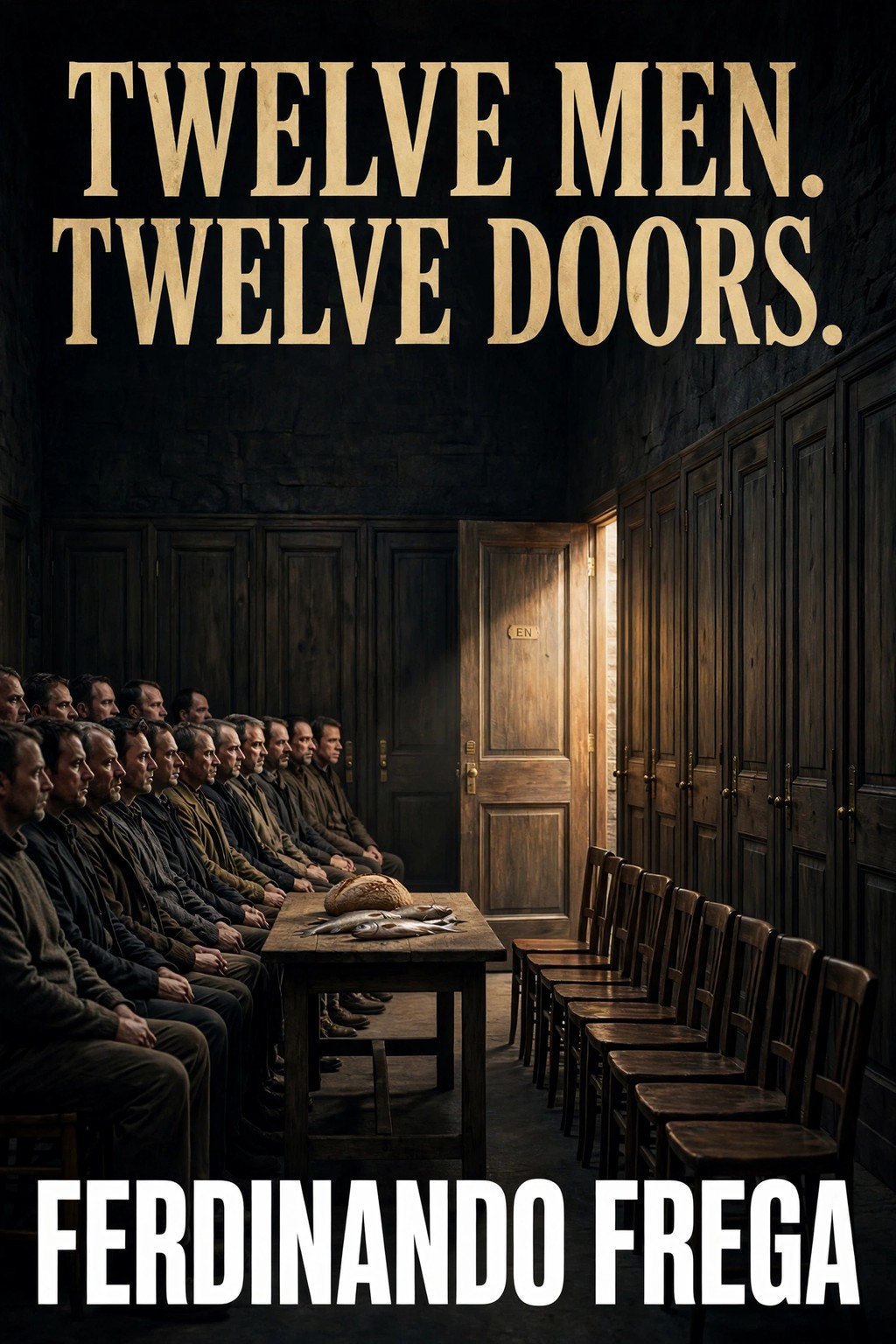
TWELVE MEN. TWELVE DOORS.
One morning I did not know whether I was alive or dead, but the clock showed 12:00.
And as I glanced at the calendar, I noticed that there were also twelve months in the year, and we had almost reached the twelfth.
My neighbor rang the doorbell. I opened the door and she asked if I had an aspirin. She had a headache. It had lasted for twelve hours.
It almost seemed to be the day’s mantra, until I realized that the number three, perfection, had met the world represented by the number four.
Meanwhile, the funeral home’s invoice stated that I had died on December 12, 2012. I maintained the opposite.
In recent years I have learned that invoices are almost always right. Almost. I decided to verify it personally. This one had not been submitted electronically, and the probability of error was nearly 12%.
The house was small. Inside the dream of a night, I found myself in a room with twenty-four chairs. Twelve on one side, twelve on the other. None free. Not even for a consultant.
On one side sat twelve men. Fishermen. Clean-shaven, tidy, wearing vintage suits and ties, which for them meant “the good one.” On the table, bread and three fish. The longest-running catering service in history.
They did not have Harvard. They did not have an MBA. They did not have KPIs or budgets. They did not even have LinkedIn, and it showed: nobody had yet thanked them for “this extraordinary journey.”
They had only one thing.
The gift of giving.
On the other side sat another twelve. Or so it seemed because they were not people. They were idiomatic doors.
EN-US. EN-GB. EN-ZA. EN-CA. EN-AU. EN-NZ. EN-HK. EN-IN. EN-IE. EN-SG. EN-NG.
And in the center, without suffixes or ambitions, a door that simply said: EN. The shop window of the world.
Behind each door lived an NGO.
EMERGENCY. DOCTORS WITHOUT BORDERS. COOPI. INTERSOS. SAVE THE CHILDREN. AVSI. WEWORLD. ACTIONAID. CESVI. CUAMM. OXFAM. AMREF.
Twelve.
Neither did they sell anything. And above all, they did not collect money for themselves: every door redirected to the official donation page. An honest door is rare. Twelve are almost a miracle, and miracles in this room already had a precedent.
The Twelve of Galilee looked at the Twelve of Gillette. They studied each other for a few minutes, like two examination boards suspicious of one another.
Then one asked:
“What do you sell?”
The Twelve of Gillette looked at one another.
“Nothing.”
Silence.
“What do you mean, nothing?”
“Nothing.”
“Then how do you live?”
“More or less the way you do.”
The fishermen began to suspect there was something underneath it all. One of them, the most skeptical, narrowed his eyes.
“Are you joking?”
“No.”
“Then what do you do?”
“We leave evidence.”
At that point, the one who had spent his life pretending to work harder than the others stood up. Three years wandering through villages without filing a single report. A talent that today would qualify him for a director’s position. He pointed at a door.
“If you sell nothing, why do you have one hundred thousand pages?”
The room froze.
It was an intelligent question.
Strange, coming from him.
The EN-US door answered calmly.
“Because presence changes the asset.”
The fishermen looked at one another. The door continued.
“We do not advertise the PDF.”
“Then what do you advertise?”
“Nothing.”
“We have already heard that answer.”
“We create presence.”
Silence.
Long.
Professional.
The kind of silence that follows hearing something never heard before and trying to locate the budget category where it belongs.
Then one of the Twelve of Galilee smiled.
The kind of smile that appears when two systems suddenly recognize each other.
“You are one of us.”
“Why?”
“We had twelve agents.”
He pointed at the doors.
“You have twelve idioms.”
He pointed at the sea.
“We put a face on it.”
He pointed at the corridor.
“You put a door on it.”
And in that moment, I understood that I was probably alive.
Or at least alive enough.
Had I been dead, I could not have witnessed such a scene, and besides, no serious afterlife would allow a meeting like that without an agenda.
I stood up and said the only sensible thing.
“Guys, the invoice says I’m dead.”
Everyone looked at me.
“But I still think I’m alive.”
Nobody spoke.
“So, one of the two sides is wrong.”
Still silence.
“And if I’m alive, it means the system works.”
“Which system?”
“The one that brought you together.”
This time nobody answered.
There was no answer.
There were twenty-four chairs.
Twelve men.
Twelve doors.
One hundred thousand pages.
Three fish.
One loaf of bread.
No sales.
And a half-open door.
Its name was ZEIGARNIK.
Things left unfinished never leave you alone, and that is why stories always find a way to begin again.
And the story, as always, had already begun.
The only marketing that speaks only English, told by an Italian author. Because some things, before they can be understood, must first be translated into a story.
Ferdinando