 THE BIC SAGAThe takeover that never happened.

 THE WILKINSON SAGAThe steel aunt.
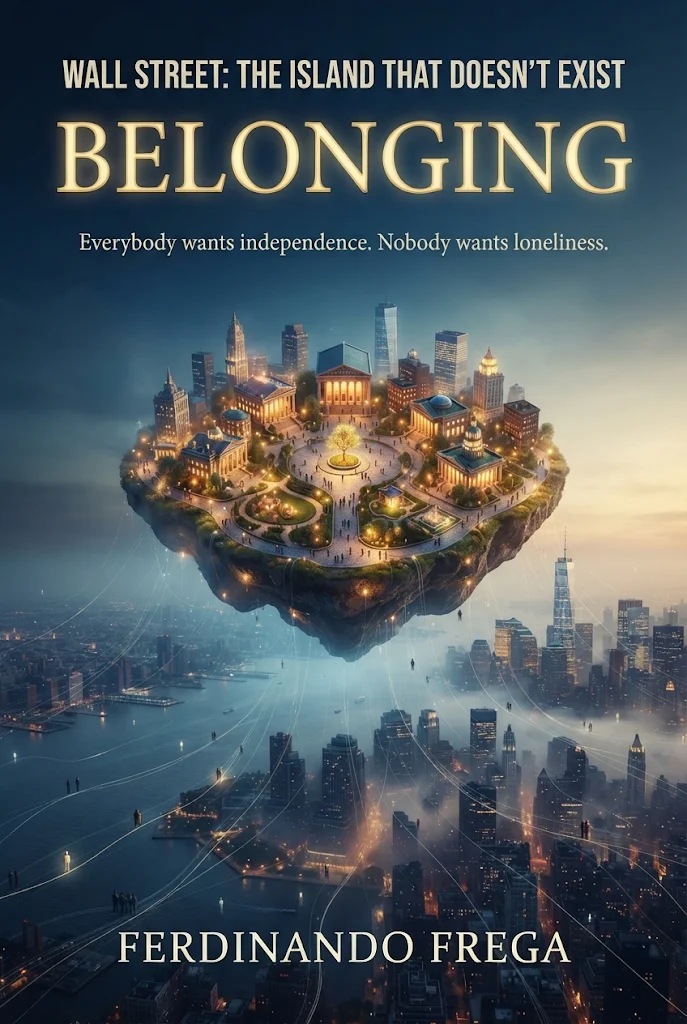
WALL STREET: THE ISLAND THAT DOESN’T EXIST
SEMANTIC SPECIMEN · 04 · BELONGING
Everybody wants independence. Nobody wants loneliness.
Introduction
Most people spend their lives searching for freedom.
Then they discover something strange.
Freedom is easy.
Belonging is difficult.
A person can buy a house, change a country, launch a company, build a career, and still feel like a visitor everywhere.
Wall Street understands value.
What it rarely understands is belonging.
Because belonging is one of the few assets that cannot be acquired.
It must be earned.
Slowly.
Patiently.
Relationship by relationship.
This book is about communities.
Workplaces.
Neighborhoods.
Friendships.
And the uncomfortable realization that nobody becomes fully human alone.
1. The Island That Doesn’t Exist
The most successful fantasy ever sold is not wealth.
It is self-sufficiency.
The idea that a person can stand completely alone.
Build alone.
Win alone.
Live alone.
Reality keeps producing different evidence.
Every company depends on customers.
Every leader depends on followers.
Every success story depends on people whose names rarely appear in the story.
Nobody builds anything meaningful without a network.
Some call it community.
Some call its friendship.
Some call it luck.
Often, they are talking about the same thing.
The Island That Doesn’t Exist is the place where nobody needs anybody.
Many dream about it.
Nobody lives there.
2. Work: The Place Where Humans Pretend to Be Spreadsheets
Most organizations speak about productivity.
Very few speak honestly about relationships.
Yet relationships determine everything.
A talented employee can survive a difficult project.
A toxic environment is harder to survive.
Companies invest millions in strategy.
Then lose extraordinary people because someone forgot how to treat human beings.
A curious business model.
Inside WALL STREET, work is not a building.
It is not software.
It is not quarterly reports.
It is a network of relationships temporarily organized around a common objective.
The strongest organizations understand something simple:
People do not produce their best work when they are afraid.
They produce their best work when they feel respected.
3. Trust, Reputation, and Small Investments
Financial markets run on confidence.
Communities run on trust.
The mechanism is identical.
Without trust, transactions slow down.
Without trust, cooperation collapses.
Without trust, everyone becomes expensive.
That applies to people too.
Reputation is simply trust accumulated over time.
The good news is that trust rarely requires spectacular actions.
A promise kept.
A call returned.
A favor remembered.
A thank you delivered on time.
Small investments.
Repeated often.
Compounded over years.
People call it character.
Wall Street would call it long-term performance.
4. The Loneliness Industry
We live in a remarkable age.
Never more connected.
Never more isolated.
Thousands of contacts.
Extraordinarily little belonging.
For many people, loneliness is no longer the absence of people.
It is the absence of significance.
Nobody can survive entirely on visibility.
Eventually people need recognition.
A place.
A table.
A voice that says:
“You are expected.”
Technology helps.
But technology cannot attend your funeral.
Technology cannot sit beside a hospital bed.
Technology cannot remember your father’s stories.
People can.
Which explains why belonging continues to outperform convenience.
5. Communities as Long-Term Investments
Every community creates a legacy.
The question is whether the legacy creates trust or fear.
Cooperation or suspicion.
Opportunity or isolation.
Most people underestimate how much influence they have.
Communities are not built by governments alone.
They are built by ordinary people performing ordinary actions consistently.
Showing up.
Keeping promises.
Offering help.
Remembering names.
Listening.
The extraordinary often begins disguised as the ordinary.
That is how communities are built.
And that is how they disappear.
One behavior at a time.
Final Reflection
Everybody wants independence.
Nobody wants loneliness.
The difference matters.
Independence gives us freedom.
Belonging gives us meaning.
One allows us to leave.
The other gives us a reason to return.
At the end of life, people rarely ask whether they were connected.
They ask whether they belonged.
Whether somebody noticed.
Whether somebody cared.
Whether somebody remembered.
Wall Street spends its life searching for valuable assets.
Life spends its time revealing a different one.
Community.
Because the greatest wealth a society can leave behind is not money.
It is trust between strangers.
And trust, like all valuable investments, takes years to build and only moments to lose.
Ferdinando
Explore the Other Sagas
The Corpus · Maps · Library · Genesis · International · Vatican · Gillette Saga · Wall Street Saga · L’Oréal Man · P&G Semantic · Contact