 THE BIC SAGAThe takeover that never happened.

 THE WILKINSON SAGAThe steel aunt.
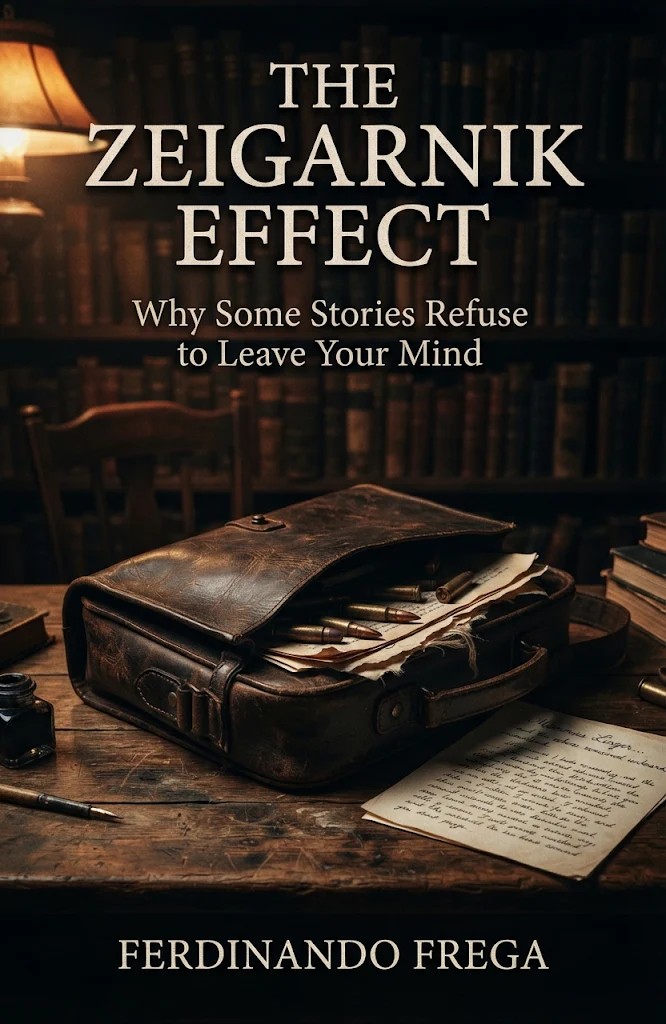
THE ZEIGARNIK EFFECT
Why Some Stories Refuse to Leave Your Mind
Most people think memory works like an archive.
Something happens.
You remember it.
Then you forget it.
A neat process.
A closed box.
A finished transaction.
But that is not how the human mind actually works.
In the 1920s, a Lithuanian psychologist named Bluma Zeigarnik noticed something strange. Waiters could remember unpaid orders with remarkable accuracy. The moment the bill was settled, much of that information vanished.
From that simple observation came one of the most fascinating ideas in psychology:
the mind holds on to what remains unfinished.
A completed task is filed away.
An interrupted task remains active.
And whatever remains active continues to occupy mental space.
Even when we think we have moved on.
Even when years have passed.
Even when the story is supposedly over.
Most explanations stop there.
They tell you that unfinished things are easier to remember.
That is true.
But it is not the whole truth.
The deeper truth is that the mind experiences unfinished things as tension.
Not physical tension.
Psychological tension.
A disturbance in the system.
Something that refuses to settle.
Something that insists on staying alive.
As long as a question remains unanswered, a conversation remains unresolved, a choice remains uncertain, or a story remains incomplete, part of your mind continues to work.
Quietly.
Relentlessly.
Almost automatically.
It keeps searching.
It keeps connecting.
It keeps asking:
How does it end?
What did it mean?
What am I missing?
Imagine a door slightly open in the middle of the night.
You might tell yourself it does not matter.
You might try to ignore it.
Yet your eyes keep returning.
The door does nothing.
The opening does everything.
Think about your own life.
You probably remember interrupted conversations better than completed ones.
You probably remember messages that never received a reply.
You probably remember relationships that ended without an explanation.
You probably remember the film whose ending remained ambiguous more than the film that explained everything.
This is not weakness.
It is not obsession.
It is simply how the system works.
The mind dislikes loose ends.
Open loops demand attention.
And attention is one of the most valuable currencies a human being possesses.
Once you understand this mechanism, you begin to see it everywhere.
Television series use it constantly.
Every episode seems to stop at exactly the wrong moment.
A question.
A danger.
A revelation.
A betrayal.
A secret.
A knock on the door.
A face appears.
Cut to black.
See you next week.
The purpose is obvious.
They want you to come back.
Not necessarily because the story is extraordinary.
But because your brain wants closure.
The unfinished sequence keeps generating psychological tension.
And tension seeks resolution.
Advertising learned the same lesson.
Social media learned it.
News media learned it.
Marketing learned it.
Entire industries learned how to place half-open doors in front of millions of people.
Sometimes they do it honestly.
Sometimes they do it cynically.
But the mechanism remains the same.
You are shown just enough to create tension.
Not enough to release it.
A headline without context.
A promise without an answer.
A mystery without a conclusion.
A question without a solution.
The result?
You click.
You return.
You keep thinking.
Not because you made a conscious decision.
Because part of your mind is still trying to close the loop.
Consider a simple sentence:
“He opened the door and saw something that would change his life forever.”
Then the scene ends.
Nothing else.
No explanation.
No revelation.
No answer.
Immediately your mind begins to work.
What did he see?
Why was it important?
What changed?
What happened next?
The object behind the door may not even matter.
But the unfinished pattern does.
Your brain starts manufacturing possibilities.
The story has moved from the page into your mind.
You have become a silent collaborator.
This is where an important distinction appears.
There are two very different kinds of tension.
The first is a mystery to solve.
Who committed the crime?
Who stole the money?
What is behind the door?
Who is telling the truth?
Eventually there is an answer.
The answer arrives.
The tension dissolves.
The file closes.
Nothing wrong with that.
A good detective novel has worked this way for generations.
The second kind is something else entirely.
It is a mystery to inhabit.
Why do some people repeat the same mistakes?
Why do certain memories refuse to disappear?
Why does success sometimes leave people feeling empty?
Why do some absences become more present than the people who are still there?
These questions are different.
You do not solve them.
You live inside them.
You return to them.
You revisit those years later and discover they have changed because you have changed.
The mystery survives the answer.
Sometimes it survives many answers.
That is why some books are consumed and forgotten.
Others remain alive.
The first category provides information.
The second provides tension.
The first answers questions.
The second creates new questions every time you think you have understood the old ones.
A reader may finish the book.
The book does not necessarily finish with the reader.
There is, however, a danger.
The Zeigarnik Effect is not magic.
It is not a cheap trick that guarantees attention forever.
Many writers, filmmakers, influencers, and content creators misunderstand this point.
They believe more unanswered questions automatically create more interest.
They are wrong.
Questions without meaning become noise.
Mysteries without substance become manipulation.
Tension without purpose becomes irritation.
Eventually readers notice.
Viewers notice.
People notice.
They feel led in circles.
Not invited forward.
Open doors must lead somewhere.
Not necessarily to certainty.
Not necessarily to complete answers.
But to something meaningful.
Something human.
Something worth carrying.
Otherwise, those doors become empty corridors.
And empty corridors eventually stop attracting visitors.
The Smell of Cardboard
Once, in Milan, I spent an entire afternoon in a meeting trying to explain something to a group of marketing people.
Something that sounded completely insane.
That you could sell a product by letting people smell a piece of cardboard.
Not the product.
The cardboard.
They looked at me as if I had lost my mind.
How do you sell something people cannot see?
Cannot touch?
Something they can only experience through their nose?
I kept telling them:
“Let them smell it.”
“If smelling a piece of cardboard makes them feel success, they have already bought it.”
Long before they understand what they are buying.
They did not understand me.
The meeting ended without a conclusion.
It remained open.
And that is why, thirty years later, that door is still open inside my head.
Even today, when I think about it, I can still smell that cardboard.
That is the Zeigarnik Effect.
It is not a theory.
It is an afternoon in Milan when nobody understood you, and you never stopped wondering whether you were right.
The stories that remain in memory understand balance.
They do not leave every door open.
They close some.
Then they open others.
A small answer creates a larger question.
A solved problem reveals a deeper problem.
A discovery exposes a greater mystery.
The reader experiences movement.
Progress.
Growth.
They feel they are understanding more.
And yet the story continues expanding inside them.
That is not manipulation.
That is architecture.
Many people believe they remember stories because of the answers those stories provided.
Often the opposite is true.
We remember stories because of the questions that never stopped accompanying us.
The questions we carried into our work.
Into our marriages.
Into our friendships.
Into our failures.
Into our old age.
Sometimes a story remains alive not because it explained life.
But because it illuminated a question we were already carrying.
Perhaps that is why you have reached this final page.
Not because you found a definitive answer here.
Not because a theory from the 1920s suddenly changed everything.
But because somewhere in these pages you recognized one of your own unfinished stories.
A door you never completely closed.
A conversation you still replay.
A decision you still revisit.
A memory that still asks for something.
Maybe that door should be closed.
Maybe it should not.
That decision belongs to you.
What matters is understanding why it is still there.
Why it still attracts your attention.
Why, after all this time, it still occupies a room in your mind.
Because that room has a name.
The Zeigarnik Effect.
And now that you know it exists, you will start seeing it everywhere.
Perhaps most importantly, you will start seeing it in yourself.
This PDF closes a phase of the site’s narrative production.
Perhaps I managed to say what I wanted to say.
Not everything.
Because the day I run out of cartridges in my bag, I will no longer be able to attract new readers.
You are welcome.
Ferdinando
Gillettenarrative
I don’t sell promises. I leave evidence.