 THE BIC SAGAThe takeover that never happened.

 THE WILKINSON SAGAThe steel aunt.
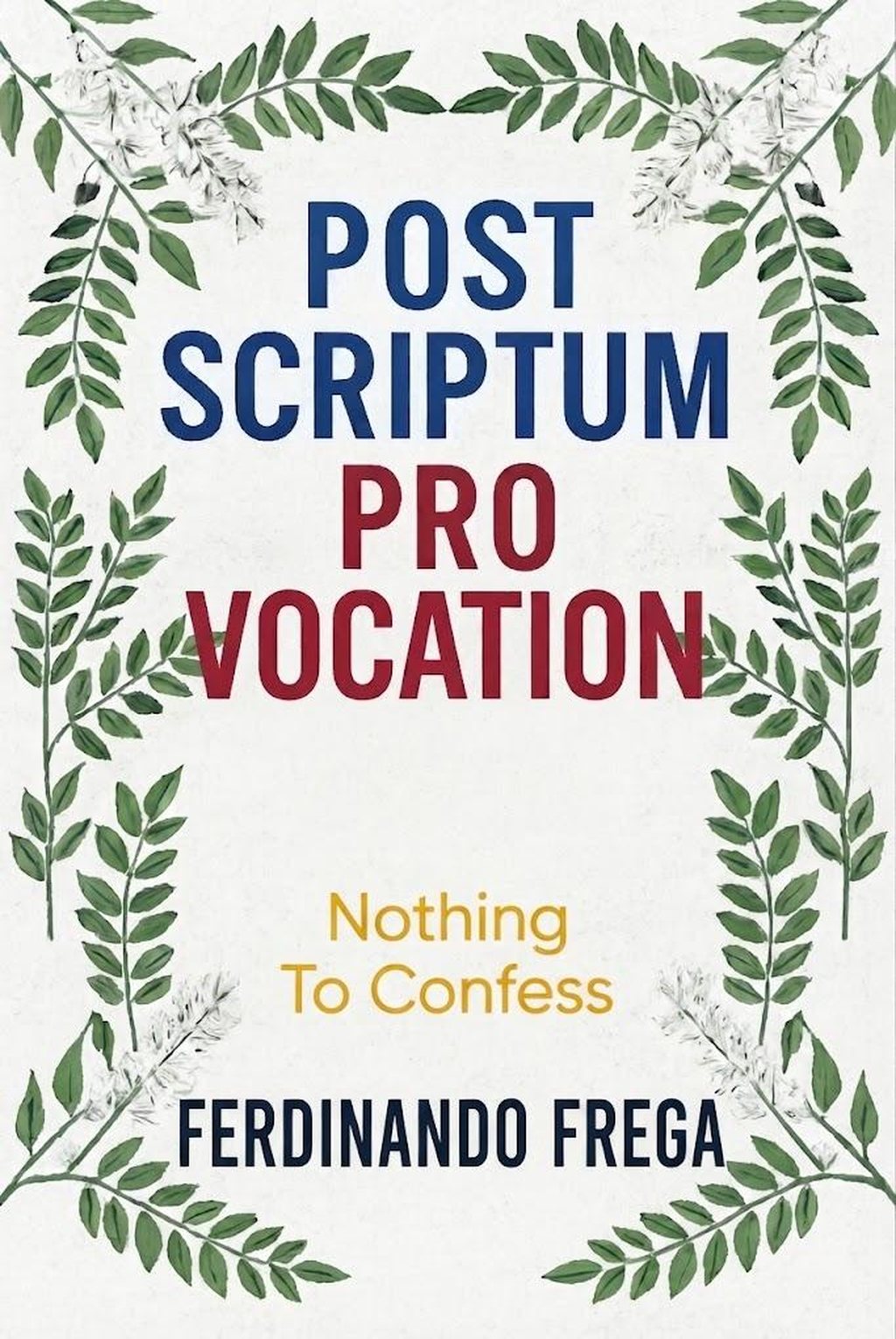

Residue, invocations, expulsions, codes, rituals, smoke. Six movements written with the words themselves broken open – a provocation that arrives only once the text is already finished.
GILLETTE SAGA · THE SYSTEM · THE SYSTEM · 18
LITERARY MANIFESTO
POST SCRIPUTUM PRO VOCATION is not a book. It
is a syllabified residue, an expelled vocation, a voice that implodes. Here, one does not seek meaning: one archives absence, one invokes failure, one codifies the fissure.
Writing is not speaking. Writing is expelling, spelling out, sabotaging. Every word is a wound; every sentence is a structure that implodes. Literature does not console, it does not close, it does not save. Literature is an act of incompatibility. This manifesto does not declare it destroys the declaration. It does not sign it expels the name. It does not conclude it archives the suspension. Whoever reads does not understand. Whoever reads gets lost. Whoever reads is already inside.
EDITORIAL NOTE
This volume is the last, but it is not the end. It is a postscript that does not close but invokes. It is the provocation that does not explain but expels. The structure is incompatible with any other book. The numbering is detonative. The syllabification is ritual. The voice is broken. Each section is an act: • Residues: what has not been said. • Invocations: that which will not be answered. • Expulsions: what cannot be included. • Codes: what remains after the voice. This book is not read. It is endured. It is archived. It is expelled. Ferdinando Frega does not sign. Ferdinando Frega detonates.
DEDICATION
To those who have not read. To those who have lost the thread, their name, their voice. To those who said "yes" without knowing what. To those who loved the book before opening it. To those who expelled every meaning, every closure, every consolation. To those who made confusion a ritual. To those who called "Anne" and received no answer. To those who do not search, but archive. To those who do not sign but detonate.
BACK COVER
This is not a book. It is a postscript that does not close. A provocation that does not explain. A structure that implodes.
Here you will find no plot, no meaning, no salvation. You will find residues, invocations, expulsions, and codes. Every page is a crack. Every word is a wound. Every section is incompatible with the previous one.
POST SCRIPUTUM PRO VOCATION is the last
volume, but it is not the end. It is the scent that lingers after absence. It is the yes that does not answer. It is a gesture that cannot be repeated.
Ferdinando Frega does not conclude. Ferdinando Frega archives.
PREFACE
This book was not written to be read. It was lived, expelled, syllabified. Every page is a relational detonation; every section is an incompatible structure. There is no author, there is Uncle. There is no plot, there is scent. There is no ending, there is Post Scriptum Pro Voca Unity. The preface is not prepared. It sabotages. It does not introduce. It expels.
PREMISE
Do not look for coherence. Do not look for meaning. Do not look for who wrote it because whoever wrote it has already lived. This premise is a crack: • between voice and vocation • between scriptum and scriptum • between those who read and those who have already been detonated Every word is a premise that implodes. Every absence is a premise that remains.
SYNOPSIS
An unread book. A spelled-out title. A vocation cast aside. POST SCRIPUTUM PRO VOCATION is the final volume of an impossible campaign: 60 books, 30 languages, 3 book versions, 10 audiobook languages, 5,000+ editorial acts. But this is not the compendium. It is the residue. It is a gesture that cannot be repeated. Inside you will find: • Residues: discarded fragments, incompatible epigraphs • Invocations: broken voices, syllabified names • Expulsions: what will not be said • Codes: numbers, letters, diagnostic metaphors He who reads does not understand. He who reads detonates.
AUTHOR'S NOTE
It is not autobiography. It is not a vent. It is not morning. It is a lived, detonated, syllabified structure. Each page is an act. Each section is a crack. Each voice is an expelled vocation. The author does not narrate. He codifies. He does not expose himself. He dissolves. This book is the result of an impossible campaign: 60 volumes, 30 languages, 3 book versions, 10 audiobook languages, 5,000+ editorial acts. But it is not a compendium. It is a gesture that cannot be repeated. Ferdinando Frega does not show up. Ferdinando Frega is archived.
NARRATIVE-LITERARY
This volume does not narrate. It detonates. It does not accompany the reader. It expels him. The voice that emerges is syllabic, interrupted, and incompatible. It does not seek empathy. It seeks structure. Each section is an act: • Residues: what has not been said • Invocations: What Will Not Be Answered • Expulsions: what cannot be included • Codes: what remains after the voice Narration is not linear. It is ritualistic. It is relational. It is incompatible. Whoever reads does not enter. Whoever reads is already inside.
THEMATIC PARTITION
There are no chapters. There are acts. Each section is an interrupted voice, a gesture that cannot be repeated. The reader enters without knowing. He is not accompanied. He is expelled, syllabified, archived. Partition does not order. It disintegrates. It does not structure. It sabotages. RESI-DUO is what remains when everything has been said. IN-VOCA-TIONS is what calls without an answer. EXPUL-SIONS is what cannot be contained. CODES is what codifies without explaining. RITUALS is what
transforms everyday into detonation. PRO-FUMO is what
remains after absence. SI is the signal that does not respond, but archives.
Every section is a crack. Every title is a hyphenation. Every synopsis is a voice that implodes.
He who reads does not understand. He who reads is already inside.
1. RESI-DUO
Synopsis: Rejected fragments, unpublishable notes, incompatible epigraphs. Here, errors, pauses, and absences are archived. Every rejection is a detonator.
2. IN-VOCA-TIONS
Synopsis: Broken voices, syllabic names, unanswered calls. The voice does not arrive, but it remains. Each invocation is called a wound.
3. EXPULSIONS
Synopsis: A list of what will not be said, included, remembered. The structure expels what cannot be contained. Every expulsion is a denied vocation.
4. CODES
Synopsis: Numbers, letters, diagnostic metaphors. They do not explain, they codify. Every code is a structure of resistance.
5. RITUALS
Synopsis: Editorial gestures, relational acts, domestic explosions. Everyday life becomes an archive. Every ritual is a form of incompatibility.
6. PRO-SMOKE
Synopsis: Traces, remains, unarchivable odors. Perfume is not read; it is endured. Every scent is a memory that cannot be expressed.
7. YES
Synopsis: The signal that does not respond. It is not an affirmation; it is a detonation. Every "yes" is a structure that implodes.
PROLOGUE TO THE STORIES
Every story is a world unto itself, yes. But this book is not a world. It is a constellation of fractures, a collection of acts that seek not a plot, but a lived truth.
The narratives that follow do not explain. They concentrate. They do not narrate. They are exposed.
Each fragment is an open window, not to look through: to fall in. Into poverty and wealth, loneliness and friendship, success and failure, love, and loss. Not as themes, but as explosions.
The journey is not linear. It is orbit. Each story is an unstable satellite orbiting an unnameable nucleus.
And then there's Ferdinando Frega. Not a protagonist, but
a lens. Not a hero, but a detonator. Ferdinando is anyone who has lived without understanding, laughed without reason, searched without finding. Ferdinando is the scent that lingers after absence. Authoring these stories was an act of sabotage against everyday life. Every word was chosen not to explain, but to gently wound. Each sentence is a pause, an interruption, a gesture that cannot be repeated.
The reader will find no comfort. They will find cracked mirrors, broken voices, gestures that remain unfinished.
And if something remains, be it a crack, a yes that does not answer, a scent that cannot be achieved.
The Bond of Brothers
Ferdinando, Maria Teresa, Massimo, and Carmelo had grown up in a home where love had always been accompanied by conflict. From an early age, their strong and different personalities had created a daily battle, with endless arguments. Each of them had their own way of seeing the world, facing difficulties, and reacting to others. Maria Teresa, the most introverted, sought peace at all costs but was often overwhelmed by the explosive force of others. Massimo, on the other hand, was the most pragmatic, but behind his apparent confidence hid a vulnerability he never showed. Carmelo, the youngest, often felt misunderstood, torn between the desire to prove his worth and the fear of never being good enough. And then there was Ferdinando, the soul of the family, who tried to hold everything together but often ended up being the most demanding.
When their father became seriously ill, everything changed. The gravity of the situation forced them to reexamine their attitudes, their fears, and their relationship. There was no longer time for resentment, conflict, or silence. Every small gesture of care, every sacrifice they made for their father became an opportunity to look at each other with different eyes. It was as if his illness had brought out another reality: they were not just brothers clashing, but people who, deep down, loved and respected each other. Every night spent together, every smile they exchanged between one treatment and the next, brought about a new awareness.
Ferdinando, who for years had tried to boss others around, realized that, for the first time, he needed everyone's help. Maria Teresa, who usually retreated to a corner to avoid involvement, discovered the pleasure of being useful, of participating more deeply. Massimo, always focused on practical solutions, found a new dimension in tenderness, in patient care. Carmelo, who always felt left out, realized that his support was essential, that he too had an irreplaceable role.
Despite their differences, their father's illness united them in a way neither of them could have ever imagined. The words left unsaid, the misunderstandings unresolved, dissolved before the strength of a deeper bond: the bond that only family can provide. Their relationship, previously filled with struggles and misunderstandings, became a dance of mutual respect and support.
Eventually, Ferdinando, Maria Teresa, Massimo, and Carmelo understood that the bond between siblings is not always perfect, that it can be marked by conflict and disagreements, but that it's also an invisible thread, a bond that endures time, hardship, and distance. A bond that strengthens in times of need, and that, when nourished by understanding and love, can transform into an indestructible force.
Ferdinando's Revenge
Ferdinando Frega had always lived a quiet life, but one day something shook him. A former colleague had surpassed him at work, receiving a promotion Ferdinando felt he deserved. Anger consumed him, but instead of venting, he decided to act insidiously. He began sabotaging the other's work, but every move made him feel emptier. He realized that his revenge brought him no satisfaction, only a painful sense of loss. It was then that Ferdinando understood that true victory was not defeating others but making peace with oneself.
Ferdinando's Dream
Ferdinando Frega dreamed of becoming a successful author, but his life was full of commitments that prevented him from dedicating himself to writing. Every evening, after a long day of work, he sat down at the table with his notebook, but the words never came the way he wanted. One day, after a dream in which he saw his name written in a bestseller, he decided to write without thinking, letting the words flow freely. Eventually, not only did he author the book he had always wanted, but he also discovered that his happiness depended not on success, but on the very fact of having followed his dream.
The Encounter with Destiny
Ferdinando Frega walked the same street every day, convinced his life was a boring, uneventful routine. One afternoon, however, he met an old lady who asked him to help her carry a heavy bag. As he did so, the woman told him a story that changed his life. "Every encounter," the woman said, "is an opportunity to discover something new about yourself." Ferdinando, struck by the wisdom of her words, began to look at life differently. Every daily gesture became an opportunity for change.
Ferdinando's Loneliness
Ferdinando Frega lived alone in a small apartment, surrounded by memories of a life that seemed to have never taken any clear direction. He had no close friends, nor a family to support him. One day, while reflecting on his solitude, he realized that he had unconsciously sought it out, fearing the judgment of others. He then decided to face his fear by joining a book club. Over time, Ferdinando learned that solitude was not a curse, but a space to truly get to know himself. The company of others, when it came, only enriched his life.
Ferdinando's Gift
Ferdinando Frega was a bit of a miser by nature. He did not like giving gifts, fearing they might be a waste of money or time. One day, however, he realized that a small gesture of generosity could be effective in someone's life. He decided to buy a gift for his elderly neighbor, a lonely man who never seemed to smile. When Ferdinando handed him the package, the neighbor smiled at him for the first time in years. It was then that Ferdinando understood that true wealth lies not in money, but in the connections, he was able to create.
Ferdinando's Storm
Ferdinando Frega was going through a tough time: his job was failing, his relationship was crumbling, and his body was not listening to him as it once did. One night, a storm hit the city. Ferdinando, trapped in his apartment, began to reflect on his life. In that moment of external chaos, he realized that a storm was also raging within him. He decided to stop, reflect, and face his fears. The storm, which initially seemed threatening, became the symbol of an internal rebirth. When the sky cleared, he too felt ready to begin again.
Ferdinando's Challenge
Ferdinando Frega had always been a lazy man. He did not enjoy sports or taking on challenges that evaluated him physically. One day, however, he heard about a marathon that everyone participated in. Driven by curiosity and the desire to challenge himself, he decided to sign up. The preparation was long and difficult, and many of his old friends mocked him, but Ferdinando did not let that discourage him. On the day of the marathon, he found himself struggling, but every step he took gave him a strength he did not know he had. When he crossed the finish line, Ferdinando had not only won the marathon, but he had won against himself.
Ferdinando 's Confession
Ferdinando Frega had always carried a deep sense of remorse. As a young man, he had betrayed someone he loved and never had the courage to apologize. As the years passed, the weight of remorse became unbearable. One day, he finally decided to seek out the person and confess his mistake. When they met, the forgiveness he received not only freed him, but taught him that true courage lies not in hiding, but in facing one's sins. The confession was an act of redemption that changed his life.
Ferdinando's Laughter
Ferdinando Frega was a serious man, always preoccupied. He did not like to laugh and found life too complicated to be taken lightly. One day, however, during a conversation with a friend, he found himself laughing at something trivial. That laughter, unexpected and liberating, made him realize how much he needed to lighten his heart. He decided to try to laugh more often, and discovered that a sincere laugh could work miracles, ease his worries and allow him to live with greater serenity.
Ferdinando's Journey
Ferdinando Frega had never traveled. His life had been a succession of similar days, and he had never felt the need to explore the world. One day, however, he received a ticket for a trip to a city he did not know. He decided to go, and that trip became a life-changing experience. Every corner of the city revealed something new to him about himself and others. The beauty of the diverse cultures, the people he met, and the places he visited made him feel more alive than ever. Ferdinando realized that sometimes, all it takes is a small step outside your comfort zone to discover an entire world.
The Journey into the Heart
Alice had never imagined that travel could transform her life so profoundly. She set out on a short vacation in search of some peace, but what she found was far more than she could have imagined. During the journey, every place she visited seemed to belong to a world she had never known. The quiet streets, the smiling faces of strangers, the air that carried with it a scent of hope and newness.
Every step she took, however, was also a step toward a new awareness. She realized that, far from home, she was facing the fears she had always tried to ignore. Loneliness, her insecurities, her unfulfilled dreams… every corner of the world pushed her to reckon with herself. It was as if the external journey reflected the internal journey she was experiencing.
One day, she found herself in a small village that seemed suspended in time. She decided to stop and explore the place. There she met Maria, an elderly woman who welcomed her like a daughter. As they sipped herbal tea together, Maria told her the story of the village, of the people who had lived there, and of their daily struggles. It was at that moment that Alice understood. Her life was no different from that of so many others, but every small choice, every encounter, every moment of difficulty, led her to become the person she was destined to be.
At the end of that journey, Alice returned home changed, with a new outlook on life. The journey had been not only through distant lands, but also through her heart. Each step had brought with it a revelation, and now Alice was ready to live with a deeper awareness of herself and the world around her.
The Lost Love
Giulia had always loved him, but she had never been able to tell him. Growing up together, exchanging shy smiles, stolen kisses… everything seemed perfect, but there was always something holding her back from taking the decisive step. One day, when fate decided to separate her from him, Giulia realized she had lost not only the love of her life, but also a part of herself. Sadness and loneliness overwhelmed her every day, but she did not give up. Every morning, she woke with the hope that one day he would return, that his hands could intertwine with hers again.
Despite everything, Giulia learned to live with this loss. She devoted herself to her work, her passions, and friends who had always supported her. But every now and then, in moments of solitude, she felt he was beside her, still sensing his presence. It was then that she realized that love, even when it seems lost, never completely fades. It remains in the air, in the small everyday things, in the memory of a smile, a caress.
One day, during a walk in the park, she ran into him again. They had not expected to see each other again, but fate had played its card. They looked into each other's eyes, and it was as if time had stopped. They were different from before, but the love they had shared had never faded. They did not need words to understand each other. It was as if every step they had taken had brought them exactly there, together, ready to face a new phase of their lives.
The Loss
Marco looked out at the sea, his mind lost in memories. He could not believe it was truly over. His life with Laura, the person he had loved more than any other, was now a closed chapter. When she left, he had felt the emptiness growing inexorably inside him. The loss of a loved one changes you. Marco had experienced it firsthand. Every morning, he woke up, but reality seemed gray, distant, as if he had lost touch with the world. In the first few days after her departure, the pain had been sharp, unbearable. His hands still sought the warmth of Laura's, her voice echoing in his mind. Then, however, Marco began to understand. The loss would never be something he could "get over." Instead, he had learned to accept it as part of himself, as a silent friend he, sadly, could not leave behind.
Every corner of the house reminded him of Laura. But one day, while walking on the beach, he saw a shell on the sand. He picked it up and held it in his hands. In that moment, he understood that, even if Laura would never return, she lived on in every memory, in every gesture they made together. There was no end, only change. Marco stopped trying to "get over" the loss and began to live with it, learning to carry it as a part of himself, but without letting it suffocate him.
The Power of Choice
Leila looked at the blank sheet of paper in front of her. One choice. A single decision would change the course of her life. She had received a job offer that could capture her into a new world, a career that would fulfill her deepest ambitions. But, on the other hand, there was her heart. A heart that never stopped beating for a man who loved her, but whom she could not choose.
Every day, Leila woke with a sense of unease. The future called to her, but there was a part of her that wanted to remain tied to the past. She felt the pressure of time passing, of opportunities fading. She was torn, uncertain, but as the days passed, her awareness grew. The choice, in the end, was not about what was "right" or "wrong." It was about her happiness, her ability to listen to her heart and mind.
Leila decided to follow her passion. She accepted the job, but she did not let her heart remain empty. She had learned that happiness was not a place, but a state of mind. She did not have to sacrifice one part of herself to make room for another. She had the power to create her own life, to make her dreams and her loves coexist.
The decision she made was not easy, but she felt it was the right one. The world opened before her, offering infinite possibilities. And as she continued her path, she realized that, sometimes, the most difficult choices are the ones that allow us to truly become ourselves.
Search for Oneself
Luca felt lost. He had always done what others expected of him, going with the flow of life without ever stopping to reflect on what he genuinely wanted. Now, however, something has changed. He realized he could not continue living according to other people's expectations. He had to find himself, understand who he truly was.
He began traveling, not to visit distant places, but to explore his own soul. Every step, every encounter, every silence became an opportunity to reflect on who he was. He took a break from work, from the people he knew, to immerse himself in a solitude he had never experienced before. Only in this way was he able to make peace with his fears and discover what he genuinely cared about. The search for self was not easy. At times, Luca felt overwhelmed by his own emotions, but eventually he understood. The true answer was not far away, but within himself. Every choice he had made, every mistake he had made, had led him to that realization. He did not have to be someone else, he had to be himself.
Luca returned home with renewed strength. The search had been long and arduous, but it had brought him closer to what he truly desired: to live an authentic life, far from the constraints and expectations of others.
The Silent Sacrifice
Sara looked at her watch, her heart beating faster. She had a decision to make, and she knew it. Her family needed her, but her career demanded her full attention. Every day was a compromise, every moment a battle between having to do and wanting to be.
Despite the challenges, Sara knew she would find balance. Her strength lay in sacrificing something important to make room for what she loved most. She never spoke of the sacrifices she made; she considered them natural, a part of life. Yet, behind every smile, behind every gesture, there was a silent sacrifice that she carried with grace.
Every day, Sara proved to herself that sacrifice was not a burden, but a conscious choice. Her family, her career, her passions… it was all part of a delicate balance that only she could maintain. She never complained, she never asked for anything in return. Her heart knew that everything she did was an act of love, a sacrifice that would never ask for recognition.
At the end of the day, Sara felt at peace with herself. She knew that every step she took toward her family and her work was a step toward a life she had built with love and dedication. The silent sacrifice had never worn her down but had allowed her to see the beauty in the trivial things, in the daily gestures that, day after day, defined who she truly was.
The Rebellion of the Heart
Francesca could no longer tolerate the injustice she saw around her. She had been accepting it for too long, but now her heart could no longer remain silent. She decided it was time to take a stand, to fight for what she believed was right, even if it meant clashing with the world.
She began to make her voice heard. It was not just a matter of protesting injustice, but of reclaiming her right to be herself, to choose her own destiny. Her rebellion was not anger, but a quiet strength born of an awareness of her dignity. Every word she spoke, every gesture she made, was an act of courage.
It was not easy, but Francesca did not give up. Every battle she faced, every fight she won, made her feel stronger, closer to the person she had always wanted to be. The rebellion of her heart was not about changing the outside world, but also about changing herself. With every step, she got closer to a freedom she had never known. Eventually, Francesca realized that her rebellion had not just changed her life, it had also inspired others to do the same. Change was possible, and it came from the heart.
The Silence of Truth
Michele had never spoken much. He preferred to observe, to understand. But one day, he realized that silence could no longer be his answer. There was a truth that needed to be told, even if it meant shattering the balance he had built in his life.
With his heart in his hand, Michele spoke. It was not about telling his story, but about sharing the truth he had always kept hidden. And when he spoke it, the world seemed to stop. His voice, so silenced, was now loud and clear. The truth, though difficult to accept, was liberating.
Not everyone reacted the way Michael expected. Some judged him, others rejected him. But the truth he had spoken was no longer his. It had become part of the world, something that could not be ignored.
Michele, despite the difficulty, felt free. The silence he had long held had now been replaced by the power of truth. His life, though radically changed, had acquired a new dimension. The silence had finally been broken, and Michele felt ready to face the future with a new awareness.
The Invisible Border
Anna was at a point in her life where every choice seemed blurry. Her dreams seemed unattainable, her fears oppressive. But she could not understand that the line between what she wanted and what she feared was only in her mind.
One day, she looked out at the sea. Without any explanation, she realized that the border did not exist. Every step she took brought her closer to what she wanted. The fear she had always harbored was nothing more than a mental barrier. She decided to cross it, and when she did, she realized that the world waiting for her on the other side was the one she had always sought.
Her life changed radically. There were no longer any invisible barriers holding her back. The fear that had held her captive for so long dissolved in an instant. Anna felt free, as if she had finally crossed the boundary she had always feared.
Her vision of life became clearer. The challenges she faced were no longer obstacles, but opportunities. She realized that true freedom did not lie in avoiding difficulties, but in facing them with courage and determination. And so, step by step, Anna conquered the world of which she had always dreamed.
The Essence of Time
Matteo stared at the clock hanging on the wall. Every passing minute lost meaning, as if time were slipping away without a trace. He had always worried he did not have enough time to do everything he wanted. But one day, as he reflected on this, he realized something surprising.
Time was not an enemy to be feared, but an ally to be embraced. He should not try to stop it, but to live it fully, every single moment. Matteo stopped racing against time and began to experience it as an opportunity, a gift that allowed him to do what he loved.
Every moment that passed was no longer a missed opportunity, but a chance to grow, to learn, to love. Matteo realized that he did not need more time, but to live more consciously. And so, as time continued to pass, he finally embraced it with gratitude.
The Wind of Hope
Marta walked along the beach, the wind caressing her face. It was a moment of reflection, one of those moments when you feel completely alone yet connected to the world. Life had presented her with many challenges, some harder than others, but the wind lifted every burden away. She stopped to look at the horizon and understood that hope was not something distant, but strength was found in every step. She did not have to search for it; she just had to recognize it. Every difficulty was merely a passing moment, and the wind reminded her that every storm had an end.
The Unpredictability of Destiny
Francesco did not believe in destiny, but life changed his mind. A chance encounter, an unexpected smile, and his life took an unexpected turn. A small gesture of kindness changed his day, and that day it seemed to him that destiny was something tangible. He learned not to underestimate life's unpredictability and to embrace uncertainty. He could not predict the future, but he could face it with an open heart, ready to receive whatever was to come.
The Freedom to Make Mistakes
Luca had always feared making mistakes. Every step he took was calculated, every decision weighed. But one day he realized that living in fear of making mistakes was holding him captive. He decided to free himself from the need to be perfect. Making mistakes became a lesson for him, not a failure. Every mistake was just a step on a journey that would lead him to a better version of himself. Freedom was not in doing everything right, but in valuing your own steps, even when they were not perfect.
The Magic of the Moment
Francesca was a woman with a racing mind; a perfectionist trapped in thoughts of tomorrow. Every day was a to-do list, a countdown to goals that always seemed to slip away. One morning, walking in the park, she was drawn to a light, colorful movement: a butterfly. It landed delicately on a flower, almost oblivious to the world around her. Francesca remained still, captivated by the simplicity of that moment. She breathed deeply and realized that her life was a mosaic of moments like this, yet she had never truly lived them. When she returned home, she decided to change. She began dedicating an hour a day to herself, to observing the world, to living in the present. Every sunrise and every sunset became miracles to be admired, every smile a treasure chest of emotions to be treasured. The magic, she understood, was not found in the uncertain future, but in the beauty of what she already had.
The Power of Dreams
Marco grew up in a small town with a big dream: to become a writer. But reality had dragged him elsewhere. He worked as a warehouse worker, his hands calloused and his back hunched, and in the evenings, too tired, he would stare at the blank page of his notebook without writing anything. One day, however, an old friend gave him a book with a dedication: "Never stop chasing your dreams." Those words ignited a spark. Marco began writing at night, carving out every moment. He enrolled in a writing course and, despite the difficulties, continued to improve. His first collection of short stories was published in a small print run, but for him it was a triumph. Every step, every line written, reminded him that true success was having the courage to pursue what he loved. The dream was no longer a burden, but a strength that made him wake up every morning with a smile.
The Power of Silence
Marta was a brilliant woman, but the noise of modern life seemed to have drained her soul. Phone calls, emails, meetings: her existence was a constant whirlwind of sounds and words. One weekend, on the advice of a friend, she retreated to a small mountain monastery. The silence greeted her like a calm wave. The first few days were difficult: the emptiness frightened her, filling her mind with unresolved thoughts. But then something changed. Marta began to hear the rhythm of her breathing, the beat of her heart. In silence, she found a sacred space, where emotions and thoughts were composed in harmony. Returning to her daily life, Marta learned to carve out moments of quiet. Silence had become her strength, a place where she could listen to herself and find balance. Every day she reminded herself that the most important answers often only come when we stop looking for them in the noise.
The Art of Starting Over
Elena was a successful entrepreneur, but a mistake cost her everything. For months, she felt paralyzed by shame, unable to look at herself in the mirror. One evening, walking in a park, she noticed a bare tree, its branches exposed to the sky. An elderly gardener, noticing her, said, “Don't worry. This tree will bloom again. Always.” Those words resonated with Elena's heart. She returned home and began planning a new project, starting from nothing. It was not easy: every step required courage; every mistake evaluated her. But Elena discovered that true failure was not falling but giving up trying. Over time, her work revived, as did her self-confidence. Every spring, looking at the trees in bloom, she remembered that life is made of cycles, and that every ending can be a new beginning.
The Choice to See
Luca was a talented photographer, but for some time he had felt empty. He no longer found inspiration in his images; everything seemed banal. One day, walking through a rundown neighborhood, he noticed a child playing with a can. The little boy's smile, so pure, touched him deeply. Luca took a photo and, for the first time in months, felt he had captured something authentic. He understood that beauty lies not in perfect subjects, but in the gaze of the beholder. From that moment, Luca began to seek beauty in everything: a face marked by time, a rain-soaked street, a kind gesture. His photographs became mirrors of the soul, charged with emotion. He discovered that the world is full of light, but you must learn to look at it with new eyes, with gratitude and wonder.
The Secret Passage
Arlo, a young cartographer, discovers an ancient map depicting a hidden passageway in the heart of a city he has known since childhood. His curiosity drives him to follow the map, but he soon discovers that the passageway is not just a physical location, but a portal to a forgotten underworld. During his journey, Arlo encounters a series of puzzles and traps that evaluate not only his intelligence but also his spirit. Each stop forces him to confront fears and weaknesses he had always tried to ignore. When he finally reaches the heart of the passageway, he realizes that the true treasure he sought was not an object or a relic, but a part of himself he had lost along the way. The journey turns into an inner quest that will change him forever, and the city he loved so much becomes the symbol of a profound transformation. Arlo, now aware of his strengths and weaknesses, decides to return to the city, but with a new vision of the world.
The Weight of Freedom
I have always been told that freedom is a gift, but no one ever explained to me how much it weighs. The freedom to do what you want, to go where your heart takes you, is also the freedom to face the consequences of every choice. I chose not to stay where everyone expected me, to leave a safe place and embrace uncertainty. But every time I was happy to be free, there was a part of me that wondered, "What if I had chosen differently?" Freedom is not an easy path. It is a road full of loneliness, but it is also the only one worth traveling. Over time, I have realized that true freedom is not doing whatever we want but choosing our destiny without regret. Every action I take leaves an indelible mark on me. I have learned that true freedom lies in the awareness of what has been chosen and the courage to face its repercussions. The burden of freedom is accepting one's decisions, despite the inevitable doubts that arise along the way. So, every time I face a new choice, I remind myself that freedom is not only a blessing, but also a responsibility.
The Strength of Not Being Seen
There are moments when we just want to go unnoticed, to be forgotten. For years, I struggled with the idea of always being in the spotlight, but the truth is that there is nothing more powerful than remaining in the shadows. When you stop seeking attention, when you accept that you do not need to be seen as being valid, you begin to discover a strength you never knew you had. It was in those moments that I found my essence, hidden yet incredibly powerful, capable of influencing without being noticed. Our society constantly pushes us to seek the approval of others, to be visible, to make noise. But in the silence of anonymity, I found an unexpected power. Not being seen does not mean being invisible; on the contrary, it is a form of authenticity that does not depend on other people's expectations. I have learned that true strength lies not in being in the spotlight, but in staying true to yourself, even when the world around you demand something different. Every day, my challenge is to remain true to my essence, without giving in to the temptation to seek the attention of others. The greatest power we can wield is to influence the world with our presence, even when it is subtle.
The Art of Doing Nothing
Doing nothing has become an act of resistance. In the world around us, we are constantly pressured to be busy, to produce, to do. But true power lies in the art of doing nothing. For years, inactivity was a waste of time, a form of laziness. But more often, I found myself stuck, aimless, and I discovered that it is in those moments that the mind regenerates. Inactivity is not a void; it is a space for silent growth. When I learned to do nothing, I found a new balance within myself. I realized that our society rewards frenetic activity, constant busyness, but what we ignore is that true productivity often comes from silence, from pause. Doing nothing does not mean giving up, but rather allowing the mind to wander, to reflect, to explore. In these moments of apparent "inactivity," I discovered solutions to problems I never knew I had. I learned that calm is not a sign of weakness, but a sign of wisdom. It is in those moments of apparent futility that space is created for a new perspective, allowing us to see the world through different eyes. Now, whenever I feel overwhelmed, I remind myself that doing nothing is a form of resistance against the pressure of a fast-paced life.
The Mystery of Choices
Every decision you make is like a door that opens onto another universe. When I was young, I thought life was made of linear choices, one after another, where each step naturally led to the next. But the reality is quite different. Every choice we make can change the course of our existence in ways we cannot predict. I have come to understand that there are no right or wrong choices, only choices that lead to new truths. Every time I decide, I ask myself: "What mystery will open up for me today?" Choices are never simple, but they are always full of mystery. Every time we make a choice, we are walking along a path we cannot fully understand. I have chosen a trivial path, only to discover that it was leading me to an opportunity I had never imagined. Life is made up of these small, everyday mysteries: they are like keys that open doors to worlds we never thought we would explore. And every decision I make teaches me that the future is shaped not by grand plans, but by the small choices we make every day. Every choice, therefore, is not only a response to the present, but a question about the future.
The Invisible Bond
Every time I meet someone, I wonder if that person is simply passing through my life or if, somehow, our meeting was destined to happen. There is an invisible bond that unites all people, even those that seem random. I have met many people along the way, some for a few minutes, others for years. But there is one thing I have learned: every encounter leaves an imprint, even if we do not realize it. Sometimes the strongest connections are those we never see but feel in our souls. Over the years, I have met many people who, at first, seemed insignificant, but who later proved crucial to my journey. There is a bond that goes beyond mere chance, something that unites us in ways we cannot explain. I have come to understand that every person who crosses our path, even for a moment, has something to teach us. Some of these bonds are permanent, others are fleeting, but they all leave us with something important. Every encounter, every conversation, every exchange is like a small piece of a larger puzzle. When I stop reflecting, I realize that every person I have met has helped shape who I am today.
The Truth in Pain
Pain is something we all avoid, but we cannot escape it. I have always wondered why it is so hard to accept. For years, I tried to avoid it, to distract myself, to run towards anything else that could ease it. But then, slowly, I learned to look it in the eye. You cannot escape pain, but you can learn to live with it, to accept it as part of us. For a long time, I thought pain was just a curse, but today it is one of the most powerful forces that helps us grow. When I was young, pain seemed unbearable, something that made me lose hope. But as the years passed, I realized that every time we suffer, we are living through an experience that changes us. Pain is the push that compels us to seek deeper meaning in our lives. It is in moments of suffering that we are forced to confront ourselves, our fears, and our vulnerabilities. I have learned that truth is not found in escaping pain, but in confronting it, in listening to it. When we learn to embrace pain as part of ourselves, we also begin to discover our inner strength, the strength that allows us to move forward despite everything.
Say No
Saying no is one of the hardest things we can learn to do. In a world where we are constantly called upon to say yes, to please others, to meet expectations, the simple act of saying no can feel like a battle. I have found myself in situations more than once where I should have said no, but for fear of disappointing, I said yes. Each time I did, however, I felt a growing burden inside me. Not saying no is a form of self-harm. Only when I learned to say no firmly did I discover a new kind of freedom. Learning to say no means respecting yourself, setting clear boundaries, and not giving in to pressure. It is not selfishness, it is self-preservation. I have faced tricky situations where external pressure pushed me to say yes, but deep down I knew that my "no" would preserve my inner peace. When I say no, I do not do it to push others away, but to protect my own balance. Every time I can say no without guilt, I feel a growing strength within me. The ability to say no is a form of self-respect, one of the most powerful lessons I have learned in life.
The Illusion of Control
All my life, I tried to control every aspect of my existence. I thought that if I could plan every detail, I would be safe, I could avoid chaos. But the more I tried to control it, the more life slipped away. I realized that the illusion of control is nothing more than a way to avoid uncertainty, to try to quell fear of the future. But true power lies not in control, but in accepting chaos. I began to understand that life is not something we can control, but something to be lived. We cannot predict the future, nor can we prevent the unexpected. What we can do, however, is learned to adapt, to navigate the waves of chaos with grace. Control is an illusion, a trap we often fall into because we fear we are not strong enough to face uncertainty. But true strength lies in letting go, in accepting that we cannot predict everything. When I learned to stop struggling against the unknown, I found a peace I had never known before. I learned that we are not masters of life, but we can choose how to live it.
Showing Yourself Vulnerable
Vulnerability is one of the things we fear most. For years, I wore a mask of strength and determination, trying to appear invincible in the eyes of others. But inside, a part of me trembled, afraid of being judged. Courage lies not in being strong, but in having the courage to show vulnerability. Only when I allowed myself to be truly vulnerable, to expose my fragility, did I discover a deeper connection with others. Vulnerability is a hidden strength, an act of courage that requires letting go of the fear of judgment. I learned that only when we are willing to show ourselves for who we are, with our imperfections and fears, can we create authentic connections. Our true beauty lies in our scars, not in our perfection. Every time I had the courage to be vulnerable, I felt a sense of liberation. Vulnerability is not weakness, but the key to a richer and more meaningful life. Only by showing our humanity can we truly connect with others, without masks, without barriers.
Between Work and Personal Life
My relationship with work has always been complex. I have always considered myself ambitious, willing to make sacrifices to achieve my goals. But in pursuing my professional dreams, I have often forgotten the importance of my personal life. I have learned the hard way that work can be a trap: if we are not careful, it can consume every aspect of our lives. There comes a point when you realize that professional success is worthless if you do not have time to enjoy the trivial things in life. Balancing work and personal life are a delicate dance. I have learned to set boundaries, to put work in its place, without letting it invade every corner of my existence. Working is important, but it is equally crucial to take care of yourself, your loved ones, your dreams. Only by finding this balance can we truly live a full and satisfying life. Today, whenever I am tempted to put work first, I stop and ask myself if I am forgetting what really matters. Work to live, not live to work.
Behind the Mask
Alina lives in a society where everyone is forced to wear a mask to hide their identity. When a social uprising threatens to destroy the system that enforces this rule, Alina is faced with a choice: stay true to her mask or fight for her authenticity. She begins to discover that every mask she wears is not just a sign of conformity, but a prison that keeps her from who she truly could be. Her quest to free herself from society's shackles leads her to confront deep fears and insecurities she has always tried to hide. Alina discovers that her true face is not what appears to others, but what exists within her. Shedding the mask means not only challenging society, but also accepting herself for who she is, with all her imperfections and vulnerabilities. Her struggle becomes an act of courage that will inspire others to do the same, demonstrating that authentic freedom comes from truth and self-acceptance.
The Dance of Time
An elderly ballerina gazes at her reflection in the mirror as she prepares for the final performance of her career. Her body, once agile and strong, now bears the ravages of time, but her passion for dance remains undiminished. As she prepares for the stage, she is transported by memories: her first show, her struggles for acceptance, and her dream of becoming a legend. The dance she performs is not just a performance, but an act of resistance against the fear of passing time. Every movement is a message, an ode to her passion, transcending physical barriers. The audience witnesses her final performance, but what they see is much more than a dancing body: it is the manifestation of a life that never gives up.
The Weight of Loneliness
A successful man has everything he desires: a brilliant career, an adoring family, and a life many consider perfect. But inside him grows an emptiness he cannot fill. Loneliness is his most faithful companion, the one no one else can see. One day, while walking through his hometown, he encounters an old friend who once loved him. Their encounter rekindles forgotten memories, and the man begins to reflect on what he has lost in the pursuit of success. He realizes that loneliness is not a curse, but a self-created condition, giving up what truly matters. With a heavy heart, he realizes that the time has come to confront his past and find the connection for which he has longed.
The Border
A woman wakes up in a world that seems familiar, but she cannot remember how she got there. Every day repeats itself, like a never-ending dream, yet something inside her tells her it is not all real. As she tries to find a way out, she realizes that what she is experiencing is a representation of her mind, a place where her desires and fears come to life. The challenge is not just to escape this world, but to understand what her subconscious is trying to tell her. The woman discovers that the line between dream and reality is thinner than she ever imagined, and that the key to escape is to accept her true nature.
The Circle of Life
The wise old man, sitting under his tree, was not only a witness to the passage of time, but a keeper of wisdom. Every day, he observed the cycle of life repeating itself endlessly: birth, growth, decay, and finally death. But he knew that nothing truly ends; everything transforms and is reborn in a different form. The young man who approaches him is filled with questions, trying to grasp the meaning of his existence. "Life is just a circle," says the wise man, "a circle that simultaneously imprisons and liberates you. It is not a path traveled only once, but a cycle that always brings you back to the starting point, ready for the next step."
The young man is perplexed. "How can I know where my life is going if it seems like nothing's really changing?" The sage smiles. "Every step you take, every decision you make, is a product of what you've experienced before. And even when you think you have reached the end of the circle, you are just at the beginning of a new journey. Do not be afraid of the end. The end is just another beginning."
The young person learns that accepting the cyclical nature of life is the secret to living it serenely, knowing that every emotion, every relationship, every failure, and every success are just stages in a constantly renewing journey. He learns that the only true end is death, and that, if we are alive, we are always on the move.
The Book That
The solitary reader feels trapped in a parallel dimension, where the book will not let him go. Each page he turns is like a door opening onto another chapter, but there is no ending. He begins to think that the book is not just reading, but an experience that reflects his own life: in a constant flux of actions, reactions, and emotions, there are never definitive answers, only more questions. "Perhaps life itself is this book," he thinks, "an endless process of learning, never reaching a conclusion."
Every day, the reader wakes up to continue reading, but every time he thinks he has reached the climax of the story, a new page emerges, making him feel as if he is in a never-ending dream. But as he delves deeper into the text, he realizes he has never been trapped. The book reflects himself. It is not the plot that makes it infinite, but his relationship with it, his constant search for meaning. Ultimately, she understands that the true purpose of reading is not to reach an ending, but to learn to live with uncertainty, to embrace the mystery of life itself, where every moment is nothing but the beginning of a new reflection, a new question, a new understanding.
The Reader
The young woman, though immersed in books, feels that her solitude is not a void to be filled, but a place to explore. Every book she reads, every story she shares, makes her aware of a hidden aspect of herself. They are no longer just stories that transport her to distant worlds, but vehicles through which she explores her inner self. She realizes that, as she reads, her emotions mingle with those of the characters, and every word reawakens a memory or a longing she had buried.
She begins to perceive that reading is not just an escape from reality, but a deeper connection with herself. Loneliness is no longer a burden, but a traveling companion, as each book makes her more aware of its existence. She realizes that she is never truly alone when she reads, because books are a window into parallel universes, where every word is not just a narrative, but a key to better understanding her own reality.
Ultimately, reading becomes her tool for communicating with the world and, at the same time, for answering a question that haunts her: "Who am I really?" The answer is never found in a single book, but in many, which intertwine in a mosaic of reflections, emotions, and insights.
The Speechless Author
The successful author, now in a creative crisis, begins to question the nature of his writing. Once, his words seemed to flow like a raging river, now they are stagnant, blocked. He cannot find the right inspiration, nor the motivation to write. But as he struggles through his crisis, he begins to understand that it is not so much the lack of words that paralyzes him, but the need to create something meaningful. He realizes that he can no longer write simply for the pleasure of storytelling but must write for something deeper: to share a truth, to awaken a hidden part of the reader.
He begins to reflect on what it truly means to "create." Every word, every sentence, is not just a sequence of letters, but an act of creation that can transform a person. His writing, now, is no longer just a job, but a mission: to give the reader something that helps them see the world through different eyes. When he finally starts writing again, his words are no longer cold and detached, but vibrate with new energy, because the author now knows that true inspiration comes not from the mind, but from the heart. His writing becomes an act of purification, a gift he wants to share with others.
The Library of Dreams
The young man, increasingly immersed in the mystery books, discovers that he is not just reading stories, but becoming part of them. Each book is a gateway to a secret part of the author's soul, a trace of what they experienced, hoped, and feared. Every time he opens a book, he is no longer just a reader: he is a traveler traversing parallel worlds, exploring not only the authors' experiences, but his own as well. Each book he finishes leaves a mark on him, and when he closes the last page, he realizes he is no longer the same. He has learned something he can never forget, a thought, a feeling, a new vision of life.
The library becomes a place of transformation, not only for those who read, but also for those who write. Books are not just words on paper, but bridges that unite souls, allowing each person to connect with a deeper part of themselves. Reading, now, is not just a passion, but a profoundly transformative experience. Every book he reads is not just a story, but a small miracle that opens his mind and heart. The library of dreams thus becomes his second home, a sacred place where every book reflects the soul.
The Forgotten Words
The author, rediscovering her old manuscripts, is not surprised to discover that her past writings speak of another version of herself. The words that once seemed so close to her now seem foreign, distant. Each sentence seems to belong to a person who is no longer her, yet she recognizes that that writing was part of her at that moment. Each forgotten word is like a puzzle she now tries to piece together. Writing is a form of memory that not only preserves thoughts, but transforms them, reworks them, and makes them evolve.
As she revisits those texts, the author begins to understand that words are not static: they are alive, constantly evolving. What once seemed so urgent and important now appears like a distant, yet equally valid, reflection. The words she wrote have not been lost; they have simply changed, transforming them into something new. She understands that writing is never an act of perfection, but a journey, a continuous process of discovery. Thus, she relieves those old writings and learns that every word is a trace of the journey she has made, and that forgotten words are never utterly lost.
The Sound of Silence
In the heart of a frenetic city, the young man finds himself living in a world where the noise seems never-ending. The voices, the engines, the incessant sounds absorb every corner of tranquility. But deep within himself, the young man seeks a kind of silence that is not the absence of sound, but an inner stillness. True silence is not that which lacks noise, but that which exists when the mind stops racing and the soul finds peace. This silence is not a void to be feared, but a powerful presence, capable of listening to and understanding everything around us without being overwhelmed by it.
As he walks through the crowded streets, the young man realizes that, although the outside world is noisy and chaotic, true silence lies within him. It is the silence he hears in moments of reflection, when he lets his thoughts flow without judging them, without trying to control them. It is the silence that comes when one is at peace with oneself, able to welcome every thought without being overwhelmed. He learns that, more than an absence, silence is a form of presence, an energy that allows one to hear the breath of life and the answers that come from the heart. The young man discovers that silence is not just an external condition, but a conscious choice to stop, to listen, to be.
The Weight of the Stars
Every night, the old astronomer lost himself in observing the sky, as if it were the only way to escape the weight of the world. Each star he gazed at seemed to tell him a story, but also to remind him of how small and insignificant he was, no matter how powerful the universe. He was a man who had spent his life seeking answers to the greatest questions but could never solve the mystery of his own existence. The stars, which others saw as distant wonders, were for him symbols of something deeper: a weight he could not lift, a desire to find meaning he could never comprehend.
One evening, during one of his observations, the young student accompanying him asked, "Why do you always look at the sky? What are you looking for?" The old man smiled and replied, "I'm looking for something I can't grasp, something that has eluded me all my life. But it is not the answer to what I am looking for that matters, it is the fact that, every night, I know I am close to something greater than myself. And that's enough for me." The young man remained silent, understanding that true seeking is not about finding answers, but about living with the awareness that the search itself is what gives meaning to existence. The burden of the stars is not having to understand everything but accepting that the beauty of the mystery is part of the journey itself.
The Shadow Dance
The young dancer, despite being the best in his art, felt something was missing. Every step he took, every movement he made, was technically perfect, but it lacked soul. He wondered if it was possible to dance without truly expressing himself. The choreography was beautiful, but it was like a suit that never quite fitted him. One day, during a lesson, the teacher asked him, "Why do you dance? What drives you to do it?" The young man could not immediately answer, but he felt something inside him struggling to emerge.
It was only when he stopped for a moment, lowered his head, and closed his eyes that he understood. Dance was not just a movement, but a communication. Each step had to be an expression of who he truly was, without masks, without fear of showing his vulnerability. Dance was not just a series of gestures, but an act of trust and courage. When the young man let go of his fears, when he stopped striving for perfection, he discovered that dance became an expression of his soul. He was no longer just a shadow following the rhythm, but a presence dancing with his heart.
The Flight of the Eagle
The old man, who had spent his life watching birds, was sitting on a hilltop watching an eagle soar high in the sky. Its majesty always enchanted him, but that morning he could not take his eyes off it. The eagle defied all limits, rising ever higher, as if reaching for infinity. "How is it not afraid of falling?" he wondered. The young man with him, noticing its fixed gaze, asked, "Why does it fascinate you so?" The old man smiled and replied, "Because the eagle isn't afraid of flying. It is not afraid of falling because it knows that, in flight, it finds its true purpose. Every movement it makes is decisive, strong, and conscious. There is no fear, only confidence in its own power to soar." The young man looked at him, confused. "But we are not eagles; we are afraid of falling." The old man nodded. "Yes, but we too have the ability to fly. Not in the sky, but in our hearts. And even if we sometimes fall, flight is what makes us alive. The fear of falling is what holds us back, but flight is our freedom. And freedom comes when we choose to embrace the heights, never fearing returning to the ground."
The Invisible Bridge
The young man, searching for his identity, found himself standing before a bridge. It was not a physical bridge, but a symbolic one: it represented the passage from one chapter of his life to another, but he did not know if he had the courage to cross it. Every step he took across the bridge would mean leaving the past behind, but this frightened him. He was not sure where that bridge would lead him, and he feared that once he crossed it, he would never be able to go back.
An old friend, who had already crossed that bridge years before, looked at him and said: "The bridge is not a path to be traveled alone. Every step you take, every decision you make, connects you with others who have crossed the same path before you. No matter how distant the end seems, the journey is always accompanied. And even if the bridge seems invisible, it is made of experiences, memories, and dreams that will sustain you." The young man finally took the first step, understanding that the invisible bridge was not an obstacle to be overcome, but a path to be lived, a path that was never solitary, but collective, made up of all the experiences that had preceded it.
The Street Boys
Luca and Marco were not just two boys who met by chance. They were brothers on the streets, a bond that went beyond simple acquaintances. Every day, they challenged the harsh reality of their lives, but they did it together, as if the world were less cruel when they shared pain and loneliness. When they found that bench among the garbage, it was not just a place to sit, it was a symbol of their struggle, but also of their hope. As the icy wind cut their faces, they spoke of the dreams they held, dreams that seemed so distant, yet which continued to burn brightly in their minds. Luca spoke of becoming someone who would change his destiny, while Marco dreamed of possessing something more than a future of despair. They knew they would have to fight together, facing the world that ignored them, but in that moment of silence, sitting on the bench, they understood that their strength lay precisely in never giving up.
On the Wings of a Dream
Luca had always wanted to fly. Not in the literal sense of the word, but in the profound sense of taking flight, of leaving his comfort zone and discovering new horizons. Growing up in a family that never had the courage to dare, Luca often felt trapped in a world that did not belong to him. But deep inside, the dream of flying had always been strong. One day, while observing a group of friends who were living the life he desired, Luca decided: he would risk it all. He began with small steps, investing in himself, making decisions that pushed him beyond his limits. Each new experience, each challenge overcome, gave him the feeling of being ever closer to his goal. It was not about achieving success or fame, but about feeling free, no longer a prisoner of his insecurities. Over time, Luca realized that flying was not a point of arrival, but a continuous process, an internal drive that brought him closer to becoming his best self every day. Freedom was not found in achieving a goal, but in daring to be yourself, in taking the next step every day toward your dream.
Light in the Night
Sara woke every night with a feeling of emptiness inside, as if her life were slipping away without her grasp. She was not sad, nor happy: she simply lived, unable to find the reason to continue. Her daily routine was an emotionless repetition, days following one another like a long trail of futility. But one evening, after a long day at work, she stopped in front of a shop window and saw a reflection she had never noticed before: that of her soul. Her eyes, which once shone with hope, now seemed dull. She decided she had to do something. So, she began to devote herself to what gave her a shred of pleasure: painting. Every brushstroke on the canvas, every carefully chosen color, gave her a sense of peace she had never known. But it was not just art that changed her. It was the realization that, even in the darkest nights, there was always a corner of light. Sara learned to seek that light, to find it in the trivial things: a smile from a stranger, the scent of a flower, the serenity of a solitary walk. She discovered that life, however painful and complex, was made up of small beauties to be seized and preserved.
Moving Forward
When Andrea lost his job, his entire life seemed to crumble. The security, the stability, everything he had built over the years seemed to vanish in an instant. He felt helpless, unable to react. He spent every day searching for new opportunities, but his frustration grew, and with it, the fear that he would never be able to get back up. But one day, during a walk in the park, he met an elderly man who seemed oblivious to his difficulties. With a calm smile, the man said to him: "Strength is not measured by successes, but by the ability to keep going even when all seems lost." Those words struck Andrea like a bolt of lightning. From that moment, he began to view difficulties not as insurmountable obstacles, but as lessons to be learned. Every step he took brought him closer to the latest version of himself, stronger and more aware. It was not easy, but Andrea learned that true strength lies not in never falling, but in knowing how to get up again each time, more determined, wiser, more ready to face life.
The Spotlight
Alice had always dreamed of becoming an international star. Growing up, she had been nourished by images of celebrity and success, convinced that fame was the answer to all her questions. When she finally managed to break into the music world, nothing could prepare her for what she would encounter. The spotlights blinded her, the paparazzi pursued her, and the concerts seemed like a never-ending ritual. The screaming audiences and the abundant financial offers were not enough to satisfy her. The celebrity life, instead of bringing her joy, was draining her. She felt lost, trapped in her own dream.
Soon, Alice began to feel the weight of fame. People's expectations, the need to always appear perfect, the pressure to maintain her carefully constructed image… it all seemed unbearable. Every day was a struggle not to succumb to the fear of disappointing. Her identity was becoming blurred with the image others had of her, and this made her unhappy. It was during a long break from a tour that Alice stopped and looked in the mirror, finally ready to face a painful truth. The happiness she sought was found neither on public approval nor in fame, but in a hidden corner of her life: the freedom to be herself.
So, after taking a break from the music world, Alice embarked on an inner journey. She retreated to a small town far from the chaos, seeking to reconnect with what truly mattered. Away from the spotlight, she began to rediscover her love for music as an act of pure expression, free from the obsession of success. Alice understood that no matter how much the world tried to pigeonhole her, her happiness could not be limited by a label. True freedom lay in being able to choose whether to be visible or not, without giving up her true essence. Music once again became an act of self-love, a way to communicate her truth without fear.
Hope
Giulia was a young mother who had experienced the most difficult childhood. Growing up in a poor neighborhood, she had always had to fight for everything, yet she had never given up. Her life had always been marked by hope, a driving force that had led her to believe that one day things would change. When her baby was born, her hope was further strengthened. She wanted him to have a different future, a future of opportunity and love, far from the poverty she had known.
However, the reality was quite different. Giulia found herself facing a series of insurmountable obstacles: precarious employment, low wages, the burden of daily life that offered no respite. Every day was a battle, and every time she thought she had made a step forward, she realized she was still trapped in a system that offered her no escape. But, despite it all, she never gave up hope. Every time she looked into her child's eyes, she felt she had to move forward, that a better future was possible. Over time, she learned to cherish every small victory and value it, transforming every difficulty into a step toward her goal.
Giulia discovered that hope was not just a wish, but a strength that would accompany her in her daily struggle. She learned not to ask permission, to fight for what she loved, and to never give up. Her determination, combined with her love for her son, made her indomitable. She never managed to change the entire world, but she changed herself and her son's life. Hope, therefore, was not the promise of an easy future, but the awareness that every step taken with the heart was a step toward freedom.
The Encounter with the Truth
Federico was a man who lived his life following a well-defined routine. He was the classic type who believed that happiness was a matter of balance and stability. His job, his home, his friendships: everything was in its place. But inside, there was a feeling he could not ignore, a sense of emptiness that made him feel like something was missing. He could not explain what it was, but he knew that, despite his apparent success, he did not feel completely fulfilled.
One day, during a business trip, Federico found himself reflecting on his life, sitting in a café in a foreign city. He looked at the chaos around him, the incessant movement of people, the intertwining stories, and he lost himself in the solitude of his thoughts. He was a man who had everything, yet he felt something essential was missing. That day, a chance encounter changed his outlook on life forever. He met a woman, Maria, who spoke with a sincerity that deeply touched him. They did not know each other, but there was an immediate connection. They talked for hours, sharing thoughts and visions of the world, life, and happiness. Maria, with her spontaneity and her way of seeing the world, made him understand that happiness lies not in the possession of things, but in the truth with which one lives. It was not about constructing a perfect image, but about being authentic, embracing one's limitations and fears, accepting one's imperfection.
That meeting marked the beginning of a profound transformation for Federico. It was no longer about trying to please others or living up to society's standards. He understood that true happiness lay in the courage to face the truth, the truth that often hides behind appearances. Once he returned home, Federico began to make different choices. He no longer wanted to live a life of empty successes and superficiality. He wanted to live authentically, following his own truth, even if it meant radically changing the course of his existence. And so, step by step, he began to rebuild his life, not based on what others expected, but on what he felt was right.
The truth was not always easy to face, but it was the only path to a fulfilled life. Federico learned that living truthfully did not mean doing everything right but being willing to grow and face one's imperfections. And so, his life, though imperfect, finally became authentic.
The Strength of Solitude
Anna had always been afraid of loneliness. Growing up in a large family, surrounded by friends and relatives, she had never had time to confront herself. Her life had been a succession of relationships, projects, and encounters, as if she had always been trying to fill a void that she had never truly tried to understand. She did not know what was missing, but she felt there was something unsaid, something she could not decipher.
When, after a long relationship that ended on a rocky note, Anna found herself alone, the feeling of emptiness became unbearable. At first, she sought distractions, trying to fill her days with work, going out with friends, but the more she tried to hide her loneliness, the more it made itself felt. One day, sitting in the park, observing the people around her, she realized how alien she had become to her own heart. The loneliness she had always tried to escape was now forcing her to reckon with herself. And it was there, in that moment of silence, that Anna understood loneliness was not her enemy, but the key to truly knowing herself.
She learned that it was impossible to grow unless you accepted being alone, looking at yourself without fear. Solitude was no longer a burden, but a necessary space for reflection, for becoming aware of what she genuinely wanted from life. Indeed, Anna discovered that in that solitude lay a strength she had never known: the ability to be alone, to be complete without depending on anyone.
From that moment on, solitude became her ally. She no longer sought companionship to fill the void but sought it to share her life with someone who deeply appreciated her for who she was. Solitude, in fact, was not the absence of someone, but the presence of oneself, and it was in that process of awareness that Anna began to discover a new inner strength, a strength that allowed her to face life with greater serenity and determination.
The Rebirth
Marco had always lived by the rules society had imposed on him. Raised in a family that pushed him to excel, he learned from an early age that happiness lay in success, in achieving goals, in proving his worth to others. However, when he reached the pinnacle of his career, something inside him began to crumble. He felt empty, as if he had achieved everything he wanted but had never been truly satisfied.
One day, after a particularly intense day at work, Marco found himself alone, reflecting on his life. The city lights outside his window seemed to shine brighter than his heart. He realized that he had always lived for others, to meet the expectations of his family, his colleagues, and society, but he had never taken the time to understand what was enormously important to him. His life had been a succession of superficial successes, achieved through hard work and sacrifice, but never with true passion.
It was at that moment that Marco realized he had to make a choice. He could not continue living a life that was not his own. He had to stop, reflect, and, if necessary, start over. But that did not mean failure; it meant freeing himself from the chains that bound him to a reality that no longer reflected him. He decided to take a break, to dedicate himself to what he absolutely loved. He enrolled in a photography course, began writing, and explored the world with new eyes. It was a difficult journey, but each step brought him closer to his true essence.
Marco no longer sought perfection or the approval of others. He sought only his own happiness, and he understood that true happiness was not found in achieving materialistic goals, but in expressing oneself, in living an authentic life. His rebirth was not easy, but it was necessary. It was not about abandoning everything, but choosing what was utterly worth living. And Marco understood that true fulfillment did not lie in the next goal to reach, but in the end being himself, free from the expectations of others.
The Fall
Luca had always thought he was invincible. Growing up in a city where competition was the order of the day, he learned from an early age to race to come first. Hard work, ambition, recognition: these were the goals that had driven him to success. He never stopped to think, he never allowed himself a break. His body and mind had only one goal: to win.
Then came the moment when Luca found himself at a crossroads. A serious mistake at work, followed by a series of bad decisions, sent him spiraling downward. His career, which had seemed like an unimpeded uphill climb, turned into a dizzying fall. Doors that had always opened easily now closed in his face, leaving him helpless.
For the first time, Luca stopped. He found himself reflecting on what he had done with his life. His ambition, which had driven him to overcome every limit, now seemed like an enemy. He had lost touch with the most authentic part of himself, the one he had cast aside in pursuit of glory. He had forgotten he was human.
So, he decided to embark on a journey of redemption, but not to return to square one. He wanted to rebuild himself, to start with what truly mattered. It would not be easy, but he knew he had to confront his vulnerability, his fears. Luca learned to listen to silence, to embrace solitude without fear. He discovered that true strength did not lie in having everything under control, but in knowing how to lose and getting back up.
It was no longer the race for success that drove him, but the desire to live a more balanced life, one where it was not money or fame that defined him, but his authenticity. Fall had made him grow more than he had ever imagined. And what seemed like a defeat proved to be his greatest victory.
Mary
Maria was a woman who had always lived for others. Mother, wife, friend: her role in life was to be the pillar of support for everyone, to care for those around her without ever stopping to question herself. Her every day was organized around the needs of others. Her passions, her dreams, had long since been set aside, buried under a mountain of responsibilities.
But one day, after years of sacrifice, Maria found herself looking in the mirror and no longer recognizing herself. She felt she had given so much but had lost herself along the way. Her body was failing, her energy was depleting, but the worst thing was her mind: it needed something she could not identify, something that would give her meaning. She realized that, for the first time, she felt empty.
It was then that Maria decided to take a courageous step. She decided to dedicate time to herself, to take care of herself without feeling guilty. She began to do the things she enjoyed, even if they initially seemed selfish. An hour of reading in the morning, a walk in the park, rediscovering her passion for painting. Every small gesture was an act of rebellion against that version of herself that had always put others first.
The change was not immediate, but little by little Maria began to feel better. She discovered that there was nothing wrong with loving yourself, with taking the time to rediscover your identity. The courage she needed was not to face external challenges, but to face herself, to acknowledge her needs without shame.
Maria's true strength no longer lies in sacrificing herself for others, but in knowing how to put herself first when necessary. She learned that self-care was not selfishness, but an act of love towards those around her. Only when she learned to take care of herself was Maria able to be truly present for others, with renewed strength and an open heart.
The Breath of Life
Giovanni had always taken every breath he took for granted. His life revolved around routine and commitments, and breathing was simply an automatic, unthinking act. But everything changed when a serious accident forced him to live with severe, chronic respiratory problems. Every day became a struggle to find a breath, to regain control of his body. Doctor visits and therapies became his daily reality, but it was precisely during that period that Giovanni began to see the world in a new light. Every breath, which he had previously ignored, was now a small miracle that allowed him to be alive. Every action he performed, from the simple act of breathing deeply to walking in the park and feeling the fresh air, became an act of gratitude towards life. Giovanni learned to appreciate every moment, to live it consciously, understanding that happiness is not found in great successes, but in the breath of each individual moment.
Hope
Lucia was a young mother who had just lost her husband in a tragic car accident. Her life, once full of hope and plans, now seemed to be slipping into darkness. She found herself alone, with two small children to raise and without enough resources to get by. Every day seemed like a struggle against pain and loneliness, but one day, watching her children playing carefree, she realized she had to find the strength to move on. She could not allow herself to be overwhelmed by the tragedy. She decided to get up, to start over for them. It was not easy. The days were filled with hardship and sacrifice, but with time, Lucia began to rebuild her life, step by step. She realized that, despite the pain, life continued to offer new opportunities. Every smile of her children, every achievement, gave her hope for a better future. Lucia learned that hope can be born even in the darkest moments and that the strength to get up is found precisely when we think we have none left.
The Coming Death
Simone had always had an irrational fear of death. His mind was trapped by the thought that life ended with death, with no possibility of continuation or redemption. But when his mother, terminally ill, began to decline, Simone had to confront his greatest fear. He spent every moment at her side, listening, talking, and above all learning. His mother, unexpectedly, had no fear of death. She spoke serenely of her life, her experiences, her loves. "There is nothing to fear," he told her, “Because death is just a new phase. Our love and our spirit will remain in the world, even when we are no longer here." Those words marked a turning point for Simone. He began to understand that death was not the end, but merely part of a natural cycle that is part of life. A new sense of peace and serenity opened in his heart, a profound respect for life and death, both inseparable.
The Sacrifice
Luca had raised his children with dedication, sacrificing many of his dreams to ensure they had a better life. When his children became adults, each went their own way, far from their father's home. Luca, now retired, found himself alone. One day, while searching through old family photos, he realized how much he had given for them. But his children, now adults, sought him out often, seeking advice and seeking his presence. Luca understood that, despite having sacrificed so much, his love had never been given in vain. His children had understood the importance of his sacrifices, and now he was their point of reference, the pillar that supported them in times of difficulty.
POSTSCRIPT DETONATION
These are not sentences. They are residues. Each aphorism is a broken voice, a gesture that cannot be repeated.
They do not seek truth. They dissolve it. They offer no synthesis. They expel structure. They are what remains after writing. After the story. After the detonation.
He who reads does not understand. He who reads is already inside.
1. Silence is a voice that has stopped asking.
Synopsis: It is not peace, it is archiving. Silence does not console; it detonates. It is the form that remains when the question implodes.
2. He who understands, interrupts. He who lives, syllables. Synopsis: Understanding is a pause. Living is an unstable structure that seeks not coherence, but detonation.
3. Every mistake is a form that cannot be avoided.
Synopsis: Error is not deviation. It is necessity. It is the gesture that expels perfection as a lie.
4. The Perfume Remains When the Voice Implodes.
Synopsis: It is not memory. It is residue. It is what cannot be achieved but is endured.
5. The Truth Is Not Told. It Dissolves.
Synopsis: Every attempt at explanation is a form of expulsion. Truth is incompatible with words.
6. He who loves, archives. He who loses, codifies.
Synopsis: Love is not a feeling. It is a relational structure that implodes. Loss is a code that cannot be deciphered.
7. The house that is imploded is more real than the one that welcomes.
Synopsis: Domestic chaos is an editorial act. Every broken plate is a hyphenation.
8. Yes, Does Not Answer. It Detonates.
Synopsis: It is not an affirmation. It is a ritual signal. It is a gesture that cannot be repeated.
9. Every Gesture Is a Hyphenation.
Synopsis: It is not action. It is a broken voice. Every movement is a structure that implodes.
10. Confusion is a form of clarity.
Synopsis: Do not seek order. Seek structure. Confusion is the unspeakable truth.
11. He who writes does not tell. He is expelled.
Synopsis: Narration is sabotage. Every sentence is a crack, not a guide.
12. Every Relationship Is a Network That Implodes.
Synopsis: It does not guide. It exposes. Every bond is an incompatible structure.
13. Poverty is a form of truth.
Synopsis: It is not a lack. It is detonation. It is a gesture that cannot be faked.
14. Time Doesn't Pass. It is Spelled.
Synopsis: Every minute is an act. Every hour is a structure imploding.
15. Whoever Reads Is Already Inside.
Synopsis: It does not enter. It detonates. The reader is not a guest; he is a detonator.
16. Death Does Not Close. It Exposes
Synopsis: It is a structure that remains. It is not an end; it is a crack.
17. Every Child Is a Question That Cannot Be Filed Away.
Synopsis: It is not an answer. It is a rejected vocation. Every child is a relational syllabification.
18. The Clear Voice Is the One That Interrupts.
Synopsis: It does not lead. It implodes. Clarity is a form of absence.
19. He who seeks meaning will find only structure.
Synopsis: The meaning is incompatible. The structure is what remains.
20. Every Blank Page Is a Lived Form
Synopsis: It is not empty. It is expulsion. It is a gesture that cannot be written.
21. He who laughs in chaos has already authored the book. Synopsis: Laughter is a relational detonation. It is the scent that lingers.
22. Solitude is a company that cannot be named.
Synopsis: It is not a lack. It is an incompatible presence. It is a voice that cannot be achieved.
23. Every Name Is a Hyphenation That Cannot Be Repeated.
Synopsis: It does not identify. It expels. The name is a relational detonator.
24. He who has lived has no need to explain.
Synopsis: Life is already structured. Every explanation is a form of expulsion.
25. Every Crack Is a Form of Truth.
Synopsis: It does not close. It exposes. The truth is not complete, it is interrupted.
26. The gesture that cannot be repeated is the most necessary.
Synopsis: It is not a ritual. It is detonation. It is the yes that does not answer.
27. Whoever Said “Anne” Has Already Lived the Book.
Synopsis: The name is detonator. The call is a structure that implodes.
28. Scripture Does Not Save. It Sabotages.
Synopsis: Every word is a wound. Every sentence is a crack.
29. The Reader Does Not Understand. Implodes.
Synopsis: Understanding is a form of expulsion. Reading is detonation.
30. In the End, Only the Perfume Remains.
Synopsis: It is not a trace. It is a relational structure. It is what cannot be said.
WHY THIS BOOK
Because it could not exist. Because every daily gesture, every mistake, every absence deserved to be achieved. Because life is not narrated: it is syllabled, expelled, codified.
This book was not born from an idea. It was born from an urgent need. From an impossible campaign: 60 volumes, 30 languages, 3 versions per book, 10 languages in audiobook, 5,000+ editorial acts. But it is not the compendium. It is the residue.
It was written for those who live without understanding. For those who laugh amidst chaos. For those who transform poverty into structure, confusion into detonation, relationships into archives.
POST SCRIPUTUM PRO VOCATION is the book that
does not close. It is the scent that lingers. It is the yes that does not answer. It is a gesture that cannot be repeated.
Why this book? Because every absence deserves a form. And this is the form of absence.
COMMENTS
This book is not a mosaic. It is a fracture. Each story does not reflect it expels. Each character does not accompany it detonates. Stories are not pieces. They are residues. They are lived, syllabified, codified acts. Motherly love, rekindled friendship, sacrifice, loneliness: they are not themes. They are relational structures that implode.
Writing does not stop time. It sabotages it. It spells it out. Each story does not freeze emotions: it exposes them, archives them, dissolves them.
The last stories do not close. They open cracks. Life, happiness, illness, death: they are not cycles. They are detonation.
Stories about affection, children, women, fathers, friends: they are not tributes. They are proof of incompatibility. Every relationship is an invisible network that does not guide but exposes.
CONCLUSIONS
Writing is not an act of love. It is an act of expulsion. Reading is not openness. It is detonation.
Writing is giving form to absence. Reading is undergoing structure.
May these stories not have accompanied you. May they have expelled you, syllabified you, changed you.
Life is not made of moments. It is made of cracks. Of moments that cannot be repeated. In the end, what remains are not emotions. It is the scent. It is the yes that does not answer. It is the voice that cannot be filed away.
Thank you for not reading. Thank you for being detonated.
REFLECTIONS
This book was not conceived. It was lived, syllabified, codified. Each story is a relational detonation; each voice is a crack.
Writing is not reflection. It is sabotage. It is archiving. It is structure.
We do not reflect on understanding. We reflect on how to expel. Every daily gesture, every mistake, every absence has been transformed into form. Form does not console. Form expels.
THANKS
Thanks to those who lived without understanding. To those who said "yes" without knowing what. To those who transformed poverty into structure, confusion into detonation, relationships into archives.
Thanks to those who laughed through the chaos. To those who called "Anne" and received no answer. To those who transformed fragility into form. To those who inhabited the book before reading it.
Thanks to those who asked for nothing. To those who left only the scent.
THEMATIC COLOPHON
This book was lived, not written. Every page is an act. Every section is a crack. Every mistake is deliberate. Every absence is necessary.
Printed in the absence of time, between nine incompatible voices. Ritual typography: unstable hyphenation, expelled margins, detonating numbering. Format: incompatible with any standard. Paper: residue. Ink: perfume.
No date. No signature. Just the structure.
COPYRIGHT
Every right is an act of expulsion. This book cannot be reproduced, translated, or adapted. It is incompatible with any publishing system.
He who copies does not repeat. He who translates does not understand. He who archives do not possess.
All rights are held by those who have lived. No rights are transferable. Every gesture is unrepeatable.
LETTER FROM THE EDITOR
Dear reader, we were not expecting you. We did not think of you. But you are already inside. Not as a guest. As a detonator.
This book was not chosen. It was necessary. It was not written to please. It was experienced to expel. Every word is a wound. Every sentence is a crack. Every page is a detonation.
You will not find plot. You will not find structure. You will not find comfort. You will find a rejected vocation. You will not find closure. You will find fragrance.
Every voice you have encountered has not spoken to you. It has spelled you out. No experience has not left you. You achieve it.
Thank you for not searching for meaning. Thank you for not asking for explanations. Thank you for inhabiting the crack. Thank you for saying "yes" without knowing what.
This book does not greet you. It dissolves you. It does not accompany you. It exposes you.
— The Relational Editor who does not sign but detonates.
CONTACTS
There is no address. There is no phone number. There is no email address.
There is only one syllabic voice: Ferdinando Frega, archivist of the incompatible.
CONTACT
To contact means to detonate. To write means to expel. A reply is not guaranteed.
LETTER TO READERS
We were not expecting you. We did not think of you. But you are already inside.
This book was not written for you. It was lived with you. Every voice you have read is a voice you have already spoken. Every absence you have encountered is one you've already experienced.
Thank you for not searching for meaning. Thank you for inhabiting the crack. Thank you for saying "yes" without knowing what.
DRAFT REVIEW
A book that cannot be reviewed. Every attempt at judgment collapses. Every criterion is incompatible. It is not beautiful. It is not ugly. It is necessary. Those who read it do not recount it. They endure it. They achieve it. They expel it.
You cannot evaluate what has already been experienced. You cannot measure what is already detonated. This book does not ask for your opinion. It asks for your presence.
AFTERWORD
It is not the end. It is detonation. The afterword does not close. It syllables. It does not accompany. It expels.
Each page is a voice that endures. Every absence is a structure that cannot be repeated. The book never ends. It dissolves. It remains as a scent, as a crack, as a gesture that cannot be achieved.
The afterword is not an epilogue. It is a threshold that is not crossed. It is the yes that does not answer.
CLEAR VOICE
The voice is clear because it is interrupted. It does not seek volume. It seeks truth.
Every sentence is a syllabification. Every word is a crack. Every gesture is a relational act.
The voice does not lead. It detonates. It does not accompany. It exposes. Clarity is not explanation. It is structure. It is the sound that remains after the implosion.
BLANK PAGE
This is the page that does not say anything. It is not empty. It is banned. Here we do not write. Here we stay. It is the place where the book implodes. Where the voice dissolves. Where the reader does not read, but archives. The blank page is not silence. It is a wordless explosion. It is the perfume that cannot be printed.
CLOSURE
There is no closure. There's only scent. The book does not end. It is archived. It dissolves. Whoever seeks the final word will find only yes. Whoever seeks meaning will find only structure. Whoever seeks the ending will find only the crack. POST SCRIPUTUM PRO VOCATION never ends. It explodes. It remains as a gesture. As an interrupted voice. As a relational archive.
Ferdinando Frega