 THE BIC SAGAThe takeover that never happened.

 THE WILKINSON SAGAThe steel aunt.
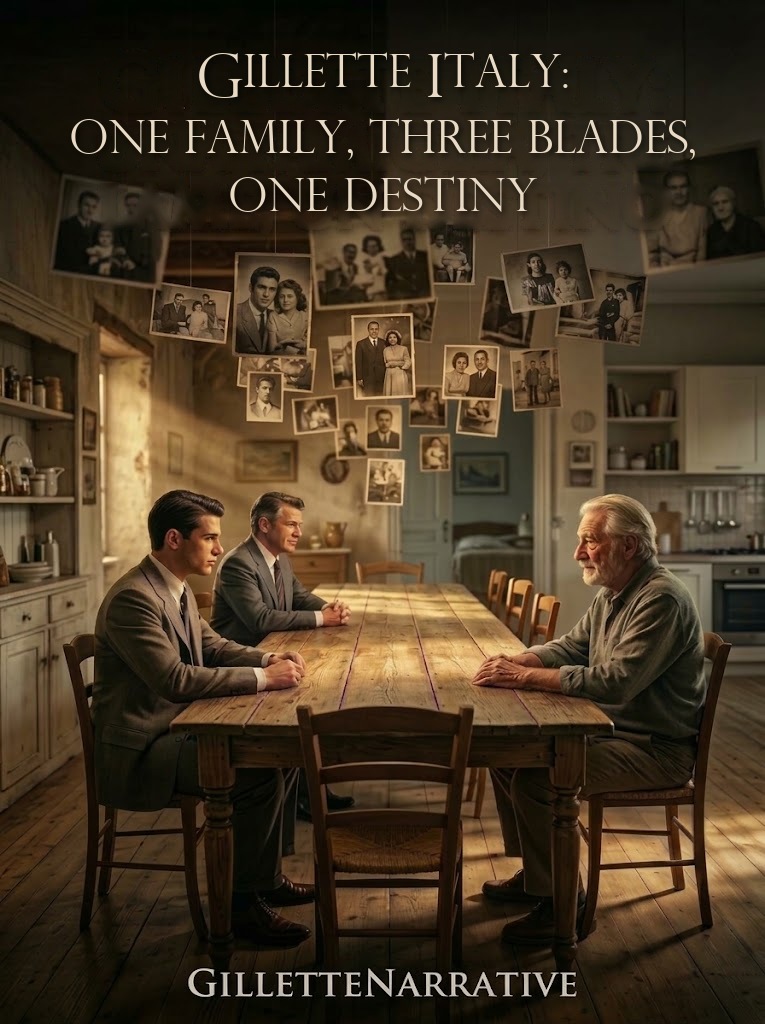
GILLETTE ITALY: ONE FAMILY, THREE BLADES, ONE DESTINY
THE FAMILY · 17
Three Blades. One Man. One Country.
By: GILLETTENARRATIVE.COM
Independent narrative work – Not affiliated with The Gillette Company / P&G
BOOK I – THREE BLADES, ONE GILLETTE
Identity isn’t found. It’s engineered.
BEFORE THE FIRST CUT
Most people spend their lives trying to get accepted by systems they didn’t build.
Corporate systems.
Publishing systems.
Social systems.
Family systems.
They adapt.
They negotiate.
They wait for recognition.
I never had that kind of patience.
My life was forged by three blades.
The first belonged to a man who turned a discarded object into one of the most recognizable names in modern history: King Camp Gillette.
The second belonged to my father, who spent forty years inside The Gillette Company and taught me that discipline often speaks without raising its voice.
The third is invisible.
It belongs to me.
It cuts through industries, identities, countries, failures, successes, writing, silences and systems that still don’t know where to put me.
This book is not a celebration of success.
It’s not a memoir.
It’s not a business manual.
It’s not literature looking for approval.
It’s the record of what happens when a man stops asking where he belongs and starts building structures that force reality to notice him.
Some names sell products.
Some names disappear.
Some names leave marks that stay long after the hand is gone.
This is the story of three blades.
And of why a single name was never enough.
THE FOUNDATION
(Marbella, 2021)
THE BEGINNING
In July, from a bright room in Spain, I started writing stories and sending them over WhatsApp to people I knew in Italy.
It was a small gesture, almost nothing, and yet something moved.
The double blue check confirmed they’d read it, but nobody said a word.
So I decided to call them, one by one.
Those conversations turned up five recurring behaviours:
the ones who actually read;
the ones who said they’d read but remembered nothing;
the ones who found the stories too long;
the ones who hadn’t read but had opened it anyway;
the ones who had no time to comment.
Reading became a way to observe people.
A threshold.
A first point of measurement.
THE RECOGNITION
She — a manager from Naples, my age — was the first to recognise it.
My narrative profile didn’t fit any existing Italian publishing format.
She said I was writing a pioneering form of literature.
She told me to keep going.
The magic of women was back.
It always picks the right moment.
THE FRACTURE
When I asked her why she’d done it, she answered:
“It makes no sense for you to earn all this money and spend it on other women.”
One second was enough.
A sentence that didn’t judge. It defined.
From that moment on: Nando 60.03.
THE NAME
When the time came to name the site, the choice was instant.
I didn’t look for a title.
I chose a gesture.
To thank her.
To become unforgettable.
And so it was born: naples-post.com.
From a real sequence:
the first act of writing.
the observation of human behaviour.
the recognition from a woman.
the Neapolitan matrix.
the fracture that becomes regeneration.
the continuity of an identity that produces effects before it’s understood.
It’s not memory.
It’s not nostalgia.
It’s an active origin.
THE STANCE
It doesn’t wait for recognition.
It watches the effect.
It acts in silence.
SAME MAN – DIFFERENT DOORS.
One writes. One disappears. One speaks.
Thousands of works. Multiple identities. One single architecture.
This was never built for everyone.
It was built for those who hear the call. For those who recognise the structure. For those who don’t need permission.
If you understand what you’re looking at, come in. If not, keep scrolling.
NAPLES-POST.COM
Where memory becomes structure. Where words don’t entertain — they cut.
NOASPECTTIME.COM
Where noise dies. Where the concept breathes. Where time stops pretending to be linear.
ONEDOLLAR-STORIES.COM
Where life wears no makeup.
Where people speak freely.
Where real life leaves footprints.
One Single Organism
This is not a collection of websites. It’s one single organism with three mouths.
One speaks through editorial precision. One through conceptual silence. One through street storytelling.
Same man. Same voice. Same architecture.
Three doors. Choose wisely.
NAPLES-POST.COM
This is not content.
It’s direct access to a mind at work.
Everything open.
No permission.
Don’t search.
Open anything.
This is access.
Not publishing.
You don’t buy books here.
You walk into something that already exists.
Everything is already open.
NOASPECTTIME.COM
This shouldn’t exist.
You weren’t looking for it.
And yet — here you are.
No introduction.
No explanation.
No category.
Something has already happened.
You’re late.
Nothing is being asked.
Either you move or you don’t.
This is not a page.
It’s a trace.
If you get it, you already know where to look.
You weren’t looking.
ONEDOLLAR-STORIES.COM
I’ve always loved people.
Their stories.
Their contradictions.
Their humour.
Their silence.
Some need money.
Some need attention.
I’ve always been interested in real conversations.
The ones that happen while eating something simple.
Walking across a city.
Sitting next to someone you’ll never forget.
A dollar buys a hot dog.
Stories are free.
One person.
One moment.
One story at a time.
THREE BLADES. ONE GILLETTE.
Everything we truly own — without noise, without awareness — keeps going anyway.
Like time.
It doesn’t ask. It doesn’t warn you.
It arrives.
It has a name: Destiny.
A man once decided he would be remembered.
Not locally. Not temporarily.
By humanity.
He had one shot.
One afternoon, in America, he picked a discarded blade up off the ground.
Someone else had invented the bottle cap.
He saw something else.
He didn’t improve the product.
He rewrote a gesture.
Shaving became a system.
The blade became disposable.
The name became permanent.
When people bought the product,
they said his name.
King Camp Gillette.
Freemason.
Author of The Human Drift, 1894.
My father.
Son of a miner and a mother of noble blood.
Raised with care. Built without limits.
At 12, grown men were afraid of him.
Not because he was violent —
because he didn’t hesitate.
One evening, on his way to the movies,
he was jumped by a bigger group.
Alone.
No way out.
He found a razor blade on the ground.
Picked it up.
Marked one of them across the face.
They ran.
That moment never left him.
Fourteen years later:
120 candidates.
One position.
He came in third.
The first two negotiated.
He didn’t.
He joined Gillette Italia.
And stayed 40 years.
After he retired, nothing changed.
People still stopped him in the street.
Still recognised him.
Not for his name.
For what he stood for.
Frega.
The Gillette man.
The blade.
Every Monday he left early.
Every Friday he came back.
Never a complaint.
Never an explanation.
He was my father.
One day, he told someone I was the only son who really took after him.
I found out years later.
That was his way.
No declarations.
Just direction.
I was nineteen.
Military service.
Passed the Police entrance exam.
He met me in Naples, May 1985.
It wasn’t a father-son meeting.
It wasn’t business.
It was something else.
He asked me just one question:
“What are you going to do with your life?”
No pressure.
No advice.
Just that.
I took seven days.
Then I joined a consortium tied to Gillette.
The lowest possible position.
You start at the bottom
if you want to see the top.
Eighteen years.
I got there.
Then something ended.
Not the money.
Not the position.
The interest.
So I left.
He saw me again, in private.
Already retired.
He didn’t try to stop me.
He said he understood.
He’d always known.
Because I was like him:
unpredictable.
Always moving toward something better.
30 November 2003.
I left Mother Gillette.
But I didn’t lose my DNA.
Three stories.
Three moments.
This is the fourth.
Freemasonry since 1993.
Pythagoras.
Esoteric discipline.
You take the rough stone
and turn it into something that bears weight.
The mind sharpens
what the heart feeds.
I became an international manager.
I travelled the world.
Another eighteen years.
Then one day
I started writing.
Not one book.
Not two.
Not ten.
Not fifty.
Not a hundred.
More.
I stopped counting.
I want to be recognised.
But I don’t sell books.
I give access.
The system doesn’t know where to put me.
An independent author who gives everything away
isn’t a category.
He’s a problem.
I’m not attacking the system.
I’m doing something worse.
I’m taking its value away.
They read me.
But they can’t manage me.
They can’t price me.
They can’t pigeonhole me.
I can’t be controlled.
I have no price.
Because I’m not selling anything.
Destiny is never expected.
Like me.
But it exists.
Because it’s real.
And I’m still walking toward it.
THIS IS NOT A DEFENCE
This page exists for one reason only: not to ask for sympathy, not to fix the past, not to dramatise anything.
I write because documents speak louder than noise.
In recent years I’ve understood one simple thing: when systems make assumptions, you either let yourself be absorbed or you answer with precision.
I chose precision. Not to prove innocence. Not to win an argument. Simply because facts matter.
Contracts matter. Dates matter. Signatures matter. Timelines matter. And when the timelines don’t match the narrative, it’s usually the narrative that moves.
Some people write novels. I write books. I build digital systems. I keep archives. And sometimes I write memoirs that read like fiction, except they’re made of real documents.
It’s not drama. It’s structure.
What I learned
Systems prefer simple stories. Reality rarely cooperates.
People move. Roles change. Documents stay.
If you keep clean notes, one day the paperwork will speak for you.
Why this page exists
Because somewhere out there someone is facing a system they don’t fully understand.
Read carefully. Keep the documents. Stay calm. Speak clearly. Cut the noise. Bring the facts.
Urgency is not strategy.
FREGA-COMPLIANT
If I could leave just one structure behind me, it would carry my family’s name.
A Trust built to outlive me.
Built to remain visible, traceable and recognizable across generations.
Everything else fades.
A generational idea doesn’t.
BIOGRAPHY
Ferdinando Frega is an Italian author, international executive and creator.
Built in silence. Read when necessary.
Naples-Post, NOASPECT-TIME and One Dollar Stories.
His story begins with a fracture.
A disastrous academic result early in life became the first event that forced him to rebuild discipline from the ground up.
He spent eight years in Catholic boarding school. Punctuality, rigour and personal responsibility didn’t come as lessons. They became imprinting.
At thirteen he discovered rugby. The toughness of the field forged his resilience and eventually brought him into Italian military rugby, where he played at an elite level of competition.
Professionally, he spent eighteen years at The Gillette Company, then built an international career as a sales executive, sales director, CEO and consultant across Europe and Latin America, working in sectors ranging from construction to food service to environmental services.
He has lived, worked or travelled in dozens of countries.
His writing was never born of literary ambition. It was born of necessity.
He writes about identity, power, failure, desire, discipline, contradiction and survival.
Today he operates outside traditional publishing models. He doesn’t sell books. He builds access.
Through thousands of books, multilingual archives, experimental platforms and narrative systems, he has created one of the most unconventional independent publishing structures currently active online.
His work doesn’t demand attention. It leaves evidence.
What you never see coming.
He doesn’t sell books.
He builds access.
THE ENDING
In every industry there are people who follow systems, people who manage systems, and an extremely small number who build structures that force systems to adapt.
I belong to the third category.
My life was forged by a blade, by discipline and by the refusal to operate inside predefined roles. I learned early that recognition isn’t something you ask for — it’s something you design. Not through noise, but through consistency, precision and the ability to create frameworks that outlast circumstances.
I’ve worked in companies, led teams across continents, built platforms and written thousands of pages. But none of that defines me. What defines me is the same principle that built every lasting organisation in the world:
Structure is stronger than perception. Discipline is stronger than talent. Legacy is stronger than visibility.
This book is not the story of a writer. It’s the introduction of a man forged by systems, sharpened by failure and determined to build architectures that don’t depend on approval.
I’m not here to fit into a category. I’m not here to be positioned. I’m here to establish a presence that can’t be ignored.
If you understand the structure, you’ll understand me. If you don’t, the market will explain it to you in due time.
This is not the end of a story. It’s the beginning of a standard.
FIND ME
Some people write stories.
Some live them.
If you have something real to share,
you know where to find me.
No scripts.
No fake inspiration.
No pointless messages.
Just true stories.
BOOK II – MY FATHER INSIDE GILLETTE
Three blades. One recognition.
AUTHOR’S NOTE
Everything I wanted to tell you, you already knew.
I was lucky enough to be your son, your colleague, your friend and your confidant — and that is my everything. I couldn’t have asked for more.
But I’m leaving you something you don’t expect: eternity inside a story.
Whoever reads will know who you were.
Whoever knows will understand what you did.
Everyone will know who the Frega family is.
DECLARATION
This volume comes from a simple truth:
Gillette never sold razors. It built men.
Men who could no longer turn back, because a system — made of discipline, ritual, precision, belonging — had already chosen them.
The blade is a symbol.
The gesture is a language.
The system is a culture.
And the man is the final product.
These pages don’t celebrate a brand — they decode it.
They don’t tell the story of a company — they reveal its cognitive architecture.
They don’t describe a market — they describe a legacy.
This is the narrative of the most complex product ever created: the Gillette man.
Introduction
There’s no product without the man who uses it. And there’s no man who isn’t shaped by the gestures he repeats every day.
Shaving is one of those gestures: minimal, almost invisible, yet capable of defining boundaries, roles, belonging. Gillette didn’t invent the blade. It invented the way a man recognises himself in the mirror.
This book doesn’t tell the story of a brand. It tells the story of a system that shaped generations, families, languages, identities. And it tells the story of the man who went through that system, served it, represented it, inherited it.
The product is a pretext. The man is the centre. The rest is gesture, memory, code.
THE FIRST BOUNDARY
Hair is a detail everybody pretends to understand. They call it hygiene, aesthetics, identity, culture, ritual. But hair is none of that. It’s a boundary: between what you show and what you hide.
Some trust barbers, some trust beauticians, some trust modern machines that promise autonomy and perfection. But the hair stays there, stubborn, a biological reminder: you were an animal long before you became a citizen.
And it’s not an enemy. It’s an awkward friend, a witness to your origin. It spreads across the body, carries the colour assigned by your genetic map, and holds on to a story you can’t erase. Even people with alopecia aren’t without it — they’ve just lost it for a time nobody can measure.
To understand hair you have to go back to the beginning — to primitive man, to the place where all your narratives return.
I see it as a prehistoric noir. Two figures behind a wall of grass, talking. A third one shows up and can’t tell who’s the man and who’s the woman. The face isn’t enough. The face lies.
So the woman decides to rewrite her identity. She goes to the river, looks at herself in the water and sees a beard. It doesn’t belong to her. It doesn’t define her. It doesn’t set her apart.
She finds a sharp stone and starts removing the hair, one patch at a time. She discovers that regrowth is slow — a small advantage: the ritual doesn’t demand a daily sacrifice. And she discovers something stronger: the man looks at her differently. Difference becomes attraction. Difference becomes language.
From that moment the culture of hair begins: first symbolic, then social, then hygienic, then scientific, then ideological. All the way to the modern extremes — those who say hair protects and must stay, those who say it has to go if you want to be accepted, those who sculpt it to be desired.
But the truth is simple: hair is born, grows, curves… and at the curve it dies. The root stays alive, stubborn, like certain ideas you can’t remove even with willpower.
And there’s one last rule — the one only the narrator knows: never turn a hair into an heir. The difference is a single vowel. But it changes everything.
“EVERY SYSTEM IS BORN FROM A BOUNDARY. OURS WAS THIS.”
That woman at the river didn’t know she was starting something. She thought she was solving a problem. Instead she was writing the first line of a story that would take ten thousand years to find its protagonist.
THE HISTORY OF SHAVING
After primitive man and the first sharpened stone, things found their natural evolution. But the author isn’t a historian — so we won’t do a radical analysis of human behaviour. We’ll just tell the story of someone you don’t expect: the story of the Frega family.
Over the millennia — and the discovery of metals confirms it — knives came into use, sharpened first on stones, then on leather strops. The figure of the barber hadn’t been categorised yet, but the habit was always the same: a chair in the middle of the street — or wherever there was room — and someone putting their hands on your face.
Soap, mud, creams, oil. As you see in movies from the Thirties, some of them spat right in your face — but what mattered was getting the knife to glide over the surface where the hair needed cutting. Other uninvited cuts often turned up: moles, warts, ingrown hairs, pimples. The operator was improvised, like certain marketing experts who reinvent themselves as salesmen.
The result was still an elegant — certified — way to approach women with soft, delicate skin, who appreciated cleanliness. And who never said: “get that damn beard off, you’re scratching me.”
KING CAMP GILLETTE
Grandpa Camp changed history — not by selling a product, because beards had always existed and people had always cut them with something. He changed it by creating a system.
The result was one and only one: people no longer walked into stores asking for a razor blade. They said: “Can I get a Gillette?” Still today, in many parts of the world, that’s how it is.
THE BLADE
A lot of people still don’t know this: the first real fortune wasn’t just the blades, but the invention of the first safety razor — the one Italy kept selling until the two-thousands.
The secret was in its simplicity: taken apart into three pieces — the handle, the blade-positioning head and the holding section — the razor gave you a complete shave, not a superficial one. The hair, enemy and friend number one, had nowhere to go.
The blades had a tempered-steel edge on both ends, which guaranteed a continuous cutting line. Water constantly improved the quality of the shave.
The real secret was this: the blade worked better the more it was used. But people replaced it anyway — not because it stopped working, but out of pure perception of consumption. After a couple of uses, it had to be changed. Exactly the way some men think they have to change wives after a few months of marriage.
THE SALES STRUCTURE IN ITALY
Between the Fifties and the Sixties the promotional work began — a targeted form of advertising where the salesman worked inside the store: putting up window decals, setting up cardboard displays, leaving blades on consignment.
The stores that made the ideal multi-location points were mostly neighbourhood grocers, tobacconists, haberdasheries, grocers, perfumeries and barbers.
Every salesman had a customer list to visit, a territory, fixed routes filed at headquarters. A company car — the Fiat 600 — expense reimbursements and one precise obligation: eighteen visits a day, Monday through Friday. If the weekly cycle of ninety visits wasn’t completed, Saturday would be a make-up day.
At any hour of the day you could know exactly where the salesman was and in which area. Certainly not at home with his wife.
During every visit a named sales ledger was filled out: sales figures, notes on the meetings, comments, complaints. All written down. All tracked.
In the evening, the inspector would phone the salesman — at the best hotel in the area, because that was one thing they never skimped on — to get the day’s results. But a lot of times he’d call the house too. And when the salesman claimed he’d just gotten home from work, some inspectors would be waiting outside to check whether the car’s hood was hot or cold.
That was the school: no lies, always the truth.
For large orders, purchase proposals were issued with a named order copy preprinted by the Company, then sent to headquarters for fulfilment. They never skimped on image. Everything was known: how many visits had failed, how many had succeeded, the number of blades delivered piece by piece.
This was the emerging structure. The best salesmen stayed for forty years.
The others became inspectors, then area managers, then sales directors, then CEOs.
But nobody wanted to leave this Company. And the salary was at the top of the market — so much so that everybody called them: colleagues, acquaintances, friends, customers.
They were called.
THE GENTLEMEN OF GILLETTE
THE HIRING
My father had just been discharged from the army with the rank of Captain. His mother had forced him not to re-enlist — she had already lost a brother — my father’s uncle, a colonel, in Russia in 1945 — and the fear of more wars had never left her. She didn’t want to lose him too.
That afternoon he was sitting in a bar in Castrovillari, in the province of Cosenza. He’d been an insurance agent, then manager of a beach club, pushed by his sister to find something. But nothing that really fit him. His real passion was still the local one: cards, jokes, movies.
On a little table he saw an ad. He answered on a loose sheet of paper, even smeared with greasy fingerprints.
Three weeks went by. A telegram arrived calling him in for an interview. In the room there were a hundred and twenty-five candidates for a single position — and nobody even knew yet who the company was.
He went home. Three days later, another telegram: he had placed third out of all the candidates. They wanted him back.
For the position covering Reggio Calabria, the first two had tried to negotiate up. But blackmail had never worked at this company. The offer was 80,000 lire — this was 1962 — and it wasn’t negotiable. A post office clerk back then earned 16,000 lire a month.
When it was my father’s turn, he accepted.
And that was the fortune of the Frega family.
After three months on the job — results, dedication, seriousness, reliability, checks day and night — his salary went up first to 120,000 lire, then to 150,000. Within a single month.
Nobody could believe it. Not even him.
Later, over the years, it came out that they had run stock audits on him. There was never a shortfall — not of product, not of money.
He was a man certified by God and by the men of Gillette.
THE FAMILY
One of the secrets almost nobody has ever managed to put into words, understand, sense or identify: it lies in the attention a company can give its people by knowing every detail of their family life.
The idea was simple. If the person has a stable family, a good relationship with his wife, no debts, care for his children and a proper budget for clothing — the first real source of image — then the conditions are ideal for working and giving nothing but the best.
Today it seems obvious. Rhythms and cultures have changed. But it was never obvious and it still isn’t — just look at the damage turnover does to time and to business, enough to derail even the most ambitious goal.
A simple act of attention generates a strong sense of belonging. The Arma dei Carabinieri in Italy is its highest expression.
And so, at regular intervals, a casual meeting with the family was arranged — maybe over lunch. It was the sales director’s favourite task, the only person assigned to that role. He made silent assessments to gauge the state of health, without being a doctor or prescribing any medicine.
He had written down wedding anniversaries, children’s births. Every occasion was a good one for Mother Gillette to come into the house without making a sound. Sometimes a cradle was delivered. Other times gold sovereigns for the wife. Other times still, a photograph in the company newsletter.
Mine was one of those times.
MOVING UP
During sales cycles the company ran prize contests. They almost always offered three kinds of rewards: cash, gold sovereigns, prizes. And then something that was never written down anywhere.
Your car got replaced — one class up, brand new. And the colour was always picked by the wife.
The Fiat dealership in Spotorno got very rich in those years running the entire company fleet — until new management came in and shifted procurement toward international rental systems like Avis.
But that wasn’t all. A good salesman was the reference point for the company’s entire information chain. He trained the new managers, broke in the new salesmen, and often had the final say on who got named the new inspectors.
The man who walked into the company was the same man who retired from it.
THE FIRST CASE STUDY
The law of numbers is the only one that can never be disproved. And for my father, being first at something wasn’t just pride or character — it was a matter of style, inherited from a family raised in military circles.
Work was something very serious to him. It was never about money, but always about that ability to produce results and build a shop window where others would look in and say: that’s him, the number one.
In his years at Gillette he never missed a target. First in Italy for customers visited, for number of orders, for product distribution, for shelf visibility. The volumes were tightly tied to consumption — and the population of his territory, in those years, never went over a million people.
Market share data, usually requested by Nielsen area, was broken out on his territory more than once. The result was extraordinary: ninety-nine point five percent. The competition — Wilkinson, Schick, Bic — lived inside that leftover half point. Those were the customers he chose not to serve, because they caused payment problems. And money has always been the only existential measure of a company’s life.
And it has to be said: nobody would ever have disrespected a guy named Frega who worked for Gillette. For one simple reason: there wasn’t another one.
THE LAW OF NUMBERS
The Milan headquarters read his numbers and couldn’t explain them. In a three-month sales canvass — thirteen weeks, eighty-four working days — he’d show up with an average of four hundred fifty to five hundred fifty orders. Never a duplicate on the same customer on the same day. One hundred percent fulfilled.
It wasn’t a one-off. The proof is in his forty years on the job.
One morning the English managing director set off with the Italian sales director for his territory. Disbelieving. Suspicious. Sure there had to be a trick somewhere. Instead, they found the method.
VISITS AND REVISITS
They arrived at 19:45 on a Friday night. They waited for him, going by the itinerary he’d filed at headquarters four weeks earlier, in a town a hundred kilometers from home, on a winter night with no streetlights.
The Englishman kept saying it wasn’t possible, it was implausible. The sales director — the man who had hired him — just stood there waiting, calm, behind his smiles.
And there he was, walking out of a customer’s shop. Fresh as a daisy. He wasn’t expecting the surprise. He went in, did his job, and on the way out found the two managers standing in front of him.
He took them to a bar. He immediately laid out the day’s call plans — right on schedule. The English general manager, Mr. De Wikied, asked him just one question: “Do you always work like this?”
He smiled and answered: “I don’t know any other way. But if you’re not happy and satisfied, I’ll sign my resignation right here, right now, on the spot.”
They said goodbye and left.
RIDING ALONG
The notice came in: on May 28 at 19:45 a company guest would show up for a few days of ride-along. Be at the hotel that evening for planning.
He met him. A tall young man, elegant, with the kind of voice that grabs you. Deeply empathetic. His name was Piero — he was head of Gillette’s advertising department, and he wanted to see how the market moved in the field.
My father arrived at 20:05. The fifteen-minute delay was never explained. Only later would he say: “Customers always come before colleagues. They’re the ones who pay our salaries.”
The meeting the next morning was set for 7:00.
He got to the hotel on time. No sign of Piero. After five minutes, he had the front desk call the room. The kid was asleep. He left a message: he’d be back at 10:30.
He came back in the second hour and told Piero: “If you came here to play, you’re in the wrong place. I suggest you get on a plane and go back where you came from. At 7:05 I have my first customer — and he gets my attention. It’s simply a matter of being serious.”
That chewing-out went down in history. Five days later, Piero went back to headquarters. Six months later, he became the new CEO of Gillette Italia. For twenty-five years.
NEW PRODUCT LAUNCHES
ATTAK GLUE
In those years Gillette’s Italian headquarters also served as a commercial platform for launching third-party products. Loctite — a maker of instant glues — came along and asked to run a sales test to evaluate a possible distribution partnership.
My father was one of the three picked for the test. The product was called Attak.
His report was unequivocal: take the product and distribute it. It would generate significant margins and open a new market. The other two testers — one in Rome, one in Milan — said the exact opposite.
The partnership never happened. Gillette management turned down the offer.
Six months later, Henkel took over that distribution. In the first year it billed the equivalent of two hundred billion lire. It was a hit. And it was the beginning of the company’s mistakes.
GILLETTE SHAVING FOAM +1
The market was moving from the traditional way — brush, cream in a tube, all the time in the world — where Colgate Palmolive was the undisputed leader, to a new system: a pressurized can with product and gas that made shaving fast, practical, accessible. Gillette had changed the world. Again.
I was five and often rode along with him. Our conversations, when I was a kid, were full of numbers, percentages, mental math, the arithmetic of what things cost and how much you have to pay.
That’s where he explained the 1+1 promotion to me — buy one, get one free. Somebody had invented it. He had made it real by applying the company discount: thirty-five percent plus ten percent off list.
Those two percentages added up to only thirty-eight point five percent — not fifty, as the customer believed. But the customer saw it as 1+1.
It wasn’t a trick. It was called selling.
It proved two things: that not everyone had studied numbers. And that not everyone was born to be a merchant.
GILLETTE CREAM
My father was in an ice cream shop in town when he saw a man empty a can of Gillette shaving foam onto his cup of gelato. He laughed till he cried. He figured the guy was crazy, or had made a mistake.
Then he saw others doing the same thing. Curious, he went to check it out.
He went into the shop and introduced himself to the owner in his professional capacity. His name was Luca, originally from Naples. He explained that he’d bought a hundred cases of spray whipped cream from a relative in Naples — but people were reluctant to use a pressurized can, used to fresh cream served with a wooden spoon. With no more money or resources, he’d borrowed the Gillette brand, printed a thousand labels, and from that moment sales never stopped.
Word spread around town that there was a new Gillette product on the market — and good old Frega hadn’t sold it. People walked into shops asking for it. That was the birth of demand for an invisible product — the one P&G would later claim to have fathered. But it was an invention of the Seventies, by a man who never once used a copyright.
PENS AND LIGHTERS
The French company Bic was the leader in writing instruments and lighters. But it had attacked Gillette head-on by launching its own single-blade razor, with two precise goals: drag down the economic value of the market and grab a sizable share, because the margins were strategic.
The French gentlemen had done their math wrong.
Gillette didn’t just raise prices — it answered its own way. It launched a new ballpoint pen called Grinta and a new line of lighters called Cricket. Distribution went everywhere. At the tobacco shop people no longer asked for a Bic — they asked for the Grinta pen, the Gillette one.
Americans are the only people in the world who never attack of their own free will — but they’re always ready to defend themselves. The French learned the lesson and loosened their grip, until the day the balance was restored.
REVLON
Ronald Perelman, owner of Revlon, had always been in love with Gillette. He tried more than once — friendly offers, hostile takeovers. But Uncle Warren had made it clear: as long as he stayed the majority shareholder, everybody could look at that beautiful woman as much as they wanted.
But he kept her locked up at home, all to himself.
EXPLOIT
FIRST TEST
One June morning in 1980, four salesmen in Lazio were fired. They’d been caught selling parallel-import blades — they were pulling in five salaries, but they were betraying the system.
The other four remaining salesmen in Lazio came forward with a different request: to set themselves up as a sales agency. They wanted to change status — from employees to commissioned sales agents. A test.
The CEO at the time and the sales director, both from the South, Southern men, said yes. They set a budget of 70 million lire as the commission pool, with maximum advances to buy cars and cover the first three months — the accounting was quarterly, with payment on the tenth of the following month.
Sales in that territory went up seventy percent. They moved straight on to another test in another territory — because that’s the only way you get confirmation, not isolated events. That was the answer given to Gillette UK, which was watching with great interest. But our CEO was a powerful figure worldwide.
The Roman colleagues also laid down a moral rule: Gillette would not revise the commissions for two years. And so it went, at least until 1996 — guaranteeing prosperity for everyone, not just for some.
SECOND TEST
January 1982. The second test started with Calabria and Sicily: five colleagues joined in a partnership, same budget as the Romans, no regional pay caps. Things exploded. Sales nearly doubled — helped along by the launch of new products that grew the brand without cannibalizing the existing assets.
I remember my father climbing out of his company Fiat 127 and planting his butt on a Renault 19. When he drove he was happy — because they had always paid him back with attention for what he did. And money never had an absolute value.
That was my father. That was me.
THE TRANSFORMATION
The time came to decide whether to change the entire setup of the new sales force. It wasn’t traumatic — the company simply asked questions, and everyone gave an answer. Some agreed to change their legal status, some chose to stay employees, some started unions inside the company — until then confined to their Rome office, never inside the company itself.
The lawsuits started. Correction: one single lawsuit out of a hundred and twenty employees. The guy was fired because he was caught stealing on his expense report. Inside the reimbursement claims they found three receipts.
Ten thousand lire in “company” expenses, with no supporting documentation at all.
The sales director was a man with a sense of humour. He paid the first receipt. But after the third he stopped and sent the formal complaint with a handwritten note on the back: “Man is not made of flesh alone — fine. But he’s not made of iron either.”
So the salesman thought he’d better find other methods. His wife had a laundromat — and she started issuing laundry receipts that would only have made sense with twelve hundred workers in a factory.
He was fired.
Six months later the labour judge reinstated him. Gillette had to pay damages. The man built a hotel — but he never gave up his job until the day he retired.
He was Calabrian by birth, transplanted to Tuscany. One of those people my region would gladly have done without in its records.
RCS SNC MESSINA
It was the agency responsible for Calabria and Sicily. My father was one of the directors running the Gillette business. After a few years, things got better — and all five partners moved up to the Renault 25, the French carmaker’s flagship. The commission pool had reached a hundred million lire each.
The market was paying other agents, back then, somewhere between thirty and fifty million total — and those agents had products that were hard to sell. They, on the other hand, were still the Gentlemen of Gillette. And if some customer pissed them off, they’d stop serving him.
That meant losses in terms of trade references. Being served by Gillette meant you were a serious, reliable customer — the market in the South paid close attention to these things, and questions of trust were more visible there than anywhere else. The margin on Gillette products stayed between thirty and thirty-five percent. That wasn’t nothing. The wives knew it.
The sales figures were big, but everything moved in small cartons. In a thirty-square-meter storeroom you could keep three hundred million worth of Gillette goods — and nobody would notice.
Once, at a customer’s place, thieves broke into the warehouse and stole a pallet of ACE bleach and one of Dash detergent. Heavy, bulky goods. And they left behind three cartons of Mach3 blades — worth eight times the stolen pallets.
They had no idea what they were stepping on.
INTERNATIONAL
At some point, Gillette Italia became the crossroads for every HR director and CEO in the world who wanted to see what was going on. They all would have liked to change. None of them ever would.
With the employment contracts wound up in favour of sales agents, and the unions finished — that movement born to collect monthly dues, make noise and cause trouble — Gillette Italia proposed to international headquarters in Boston to bring together all the staff of the North Atlantic area for the launch of a revolutionary shaving system: the Sensor. The city chosen was Washington. It was the first big celebration Gillette-style — something you never forget.
My father looked at me and said: “Nando, we’re in America. We’re home.”
SENSOR LAUNCH — SEPTEMBER 1990
The morning before we flew back the confirmation came: Italy was ranked as Gillette’s second-best operation in the world for profits and sales.
The CEO, while everyone was having breakfast, stood up and said: “Gentlemen, I was thinking about it this morning. Employees on vacation always get their salary. You are professionals — by coming here you’ve lost seven days of work, seven days of selling, seven days of commissions. So, when we get back, for the rest of September, I’ll give everyone an extra twenty-five percent on the commission pool.”
These are the men who made a company great. It’s not the brand that’s strong — it’s what people do, people nobody expects to meet. But they exist.
In the three selling weeks that followed, Italy sold through all the new-product allocations the brand managers had planned for an entire year. It was a historic launch.
History is always made by men. Never by products.
MAY 1996 — GENOA
The new CEO arrived. He talked about evolution, not revolution. He started offering incentives to the old guard — thirty-five years of hard work — handing out extra money and saying goodbye to everyone. But nobody wanted to leave.
My father was one of them. He held out. Then he was forced to give in.
He died in April 2025, at ninety, with his smile and a thought he always used to say:
“Facts first. Literary noir after.”
And that’s what I’ve tried to do.
Goodbye, Dad.
THE AUTHOR
Ferdinando Frega was born in Calabria, in southern Italy. He spent eighteen years inside The Gillette Company and twenty-three years in international management. He didn’t write this book to explain a brand. He wrote it because some stories don’t belong to the people who lived them — they belong to anyone who ever watched a father work with discipline, precision and total loyalty to something bigger than himself.
He publishes under the name Nando The Scribe. His platform, naples-post.com, hosts one hundred forty-three free works in five languages. He doesn’t sell access. He builds it.
© 2026 Ferdinando Frega. All rights reserved.
BOOK III – BRAND NARRATIVE GILLETTE
A brand is not a message. It’s a memory system.
STATEMENT
Brand narrative doesn’t tell the story of Gillette. It tells the story of what Gillette men do.
That’s the difference. That’s the fault line between advertising and identity, between marketing and truth.
A brand is a product. A man forged by that brand is a system.
Gillette built blades. Men built lives with those blades. And those lives — the discipline, the instinct, the precision, the failures, the victories, the timing, the scars — are the real narrative.
This volume doesn’t explain Gillette. It exposes the human architecture forged inside its walls and carried far beyond them.
Every story here isn’t about the company. It’s about the man the company produced — the way he thinks, the way he moves, the way he reads the world, the way he refuses to be anything other than what he has become.
Gillette is the frame. The men are the content. And I am one of them.
This is the narrative. Not the brand. The consequence of the brand.
Nando.
INTRO
This isn’t the second book of a trilogy. It’s the second layer of a brand narrative system.
Gillette spent a century building product. I’m building the part it never had: the narrative architecture — the one no corporation can generate from inside its own walls.
Volume One was the point of entry: the proof that an author can walk into a brand’s history without permission.
Volume Two is the confirmation: the moment the brand stops being an industrial object and becomes a narrative entity — a system of memory, discipline, geometry and identity.
I’m not telling the story of Gillette. I’m showing how Gillette exists inside me: as method, as instinct, as structure, as a way of reading the world.
This volume represents what brands don’t yet know they need: a narrative that contains them, comes before them and outlives them.
Not a book. A positioning.
Not nostalgia. A project.
Not a memory. A patent.
This is Volume Two. The brand narrative continues.
Nando.
THE SYSTEM
There has always been, in this world, a market that never crashes. No fiscal crisis, no recession, no drop in consumption. Just the natural turnover of human lives. It’s a black market, yes — but not oil. They’re already fighting enough over that.
I’m talking about black magic. Sorcerers, witches and everyone who recruits people through whatever channel they can find — people who want to change someone else’s life with spiritual tricks instead of letting destiny do its job.
Some say that in a passage of the Bible even Jesus was the target of an evil spell. And everyone knows what happened next.
It’s a practice as old as man, spread across every continent, used by those who believe they can alter lives and destinies, convinced that the Devil and Beelzebub can still challenge the only authority that holds: God.
But nobody changes destinies. Because it’s destinies that build the real story.
And if you let slip a dream, a fantasy, an uncontrolled premonition, an involuntary sign — something that doesn’t fit the formats, the categories, the logic — here’s what happens:
You’re no longer credible.
You get labelled sick and sent to be examined.
The psychiatrist fills you up with pills: he’s the only one who gets paid twice.
You end up alone, outside your natural trajectory.
The main obstacles become the people closest to you.
You’re no longer allowed to speak.
This is what happens when a system is born. For eighteen years I sold shaving systems, explaining one by one the features, function, technique, innovation, benefits and then the brand, the seal that guaranteed it couldn’t fail.
A bit like what’s happening to me today. But I can’t say more, or I’d fall right back into the six points above.
To you, readers, I ask only this: lock this story and this date in your mind. One day I’ll tell you how it ended.
Nando
THE SALESMAN
When I started this job in 1985, inside The Gillette Company, the world worked the way the manuals pretended it did. Then came June 1996 and they sent me to a five-day training course.
The speaker was an ex-manager, ex-CEO, ex-professor, ex-consultant, ex-everything. A man with more titles than substance.
The course was called The Commercial Negotiator. Five days of theatre: part professional, part actor, part snake-oil salesman. He closed the show with one final line:
“There is nothing in the world that can’t be sold.”
I carried that line around with me for twenty-five years. Believed it. Defended it. Used it. Until 2021, when I started this game — writing — and finally understood the truth:
It was the biggest load of crap I’d ever bought.
He’d been convincing, yes. Credible, no. One correction would have been enough: replace “thing” with “product.” Then the line would have worked. Because a product can be sold. A thing is another story.
A salesman is always that guy who seems to be giving you something, while with the same smile he’s taking something else away from you.
The first real salesman in history — the only one I respect — was Jesus. He sold the Word. And he did it with the first marketing department ever created: twelve fishermen in Galilee. None of them came from MIT. But disciplined. Not perfect — just enough.
The rest? Let them keep taking sales courses and cashing in. Humans are malleable. Somebody will always pay to get shaped.
Nando
LIVE AUDITION — ACCESS
What you’re about to read is not a book, not a collection, not a publishing project.
It’s an act of exposure. A LIVE AUDITION. Mine.
At 61 I understood one simple thing: people don’t want a version of me.
They want everything I am — no category, no role, no label.
So let’s do it. Let’s put on the table what’s left when you take away everything else — the voice, the memory, the wound, the clarity, the laughter, the exhaustion, the truth.
These ten stories don’t exist to convince anyone.
They exist to show.
Me.
You.
Those who are gone.
Those who never really looked.
This is the introduction.
The rest is on stage.
English. Japanese. Hindi.
Three ways of being. Three ways of exposing yourself. Three ways of standing inside an audition.
Enjoy the read.
Nando.
PREMISE
We are what we are partly thanks to the people we meet.
We owe them everything, even when we don’t admit it.
Humans are ungrateful by nature: they take, they forget, they get used to it.
And that ingratitude shows up in a thousand forms, almost always without a sound.
This vertical thinking comes from what I’m becoming.
I feel it every day: some call it a gift, some a brain that never shuts off, some a disorder.
Others don’t call it anything at all, because they don’t feel it.
When they ask ‘what do you do for a living?’, we should answer with what we dreamed of as kids, in the years before we knew better.
Nobody would have laughed.
They would have given us a clean smile — the kind you give kids who still believe in possibilities.
Then one morning I wake up and find out I know how to manage money.
But there’s always a but.
I don’t have the money.
And I have to put it off.
My audition starts now.
With these ten stories.
For whoever reads them, rereads them or ignores them.
It doesn’t matter.
They stay here.
Forever, at least they will.
Nando.
AFTER-HOURS MEETING
Dying was faster than expected.
No tunnel of light. No relatives running toward me. No emotional soundtrack.
Just silence.
A very elegant silence. Almost corporate.
I thought I could finally rest.
After forty years of pointless meetings, international conference calls, directors talking for two hours without saying anything, and managers convinced PowerPoint was a religion…
I thought it was over.
Fatal mistake.
About twenty minutes after I died, I got a notification.
No angel. No demon.
A perfectly dressed woman handed me a black folder.
“Mr. Frega, you’re expected in the Eternal Boardroom at 11.”
“For what?”
“Evaluation.”
“Of what?”
“Your life.”
“Can we do a call?”
“No.”
I walked into the room.
A ridiculously long table. People sitting everywhere. All dead. But very much alive in their attitude.
I recognised the worst category right away:
ex-managers.
Dead for years and still unable to stop giving orders.
One was talking in charts. Another had prepared a presentation. Another kept repeating:
“Let’s get back to the main point.”
The main point never arrived.
Then I saw historical figures.
Napoleon, nervous. Julius Caesar, bored. A pharaoh, asleep. Two popes arguing about something nobody remembered. A McKinsey consultant who died in 2087, still using meaningless English buzzwords:
“Alignment.” “Performance.” “Scalability.”
Even dead, unbearable.
They sat me down.
An old man opened the file.
“Mr. Frega.”
“Here.”
“We have analysed your life.”
“My condolences.”
Nobody laughed.
Dead people. Terrible sense of humour.
They started:
“Why did you write so much?”
“Why not?”
“Why did you create thousands of pieces of free content?”
“To see who got it.”
“Why didn’t you sell like everybody else?”
“Because everybody else looked depressed.”
Silence.
They took notes.
Then came the real question.
“Are you afraid of death?”
“No.”
“Why?”
“Because you’re even worse organised than the living.”
For the first time, somebody smiled.
The chairman closed the file.
“We have decided.”
“Heaven?”
“No.”
“Hell?”
“No.”
“Then what?”
He stared at me.
“We’re assigning you to the toughest department.”
“Which one?”
He handed me a badge.
I read it slowly:
Meetings with Recent Billionaires
I understood immediately that death was just a badly executed promotion.
And the worst part…
was that the first one who wanted to meet me…
was already sitting outside the door.
Elon Musk.
He was smiling.
I wasn’t.
Nando
TIME: A BOOK
What’s a classic you consider overrated?
I’ve never really been a reader. Culture came on its own, over the course of my life, and I tasted its effects day after day.
My first reads were comics — TEX WILLER, my hero — then the occasional DIABOLIK, and finally JACULA, the porn comic.
The stories that struck and fascinated me most were the ones I found by chance, as if fate were being ironic: let’s give it to Frega, he’ll make it better.
I came to the internet by choice, not by need, and I remember it immediately became a need for reading — but not books.
I’ve never been a provincial man. I wasn’t looking for the big news, the loud stuff, the sensational stuff. It’s the details that seem irrelevant — those often hide the real truths.
It was the Bible, a gift I received before my wedding, that opened my horizons and sharpened my vision, which went from horizontal to vertical — at least that’s what I believe today.
And then the esoteric school I was assigned to at 33, and everything that is architecture inside geometry, and numerology as an effect, not a cause.
That alone allowed me to develop a two-valued logic — decimal toward humans and binary toward the algorithm and AI — the only way to ask important questions and get proper answers, aligned and not adapted.
Reading isn’t an exercise that lives only inside a story. The real dimension is reading things, situations, and understanding without guessing.
This is my best book.
Nando
GILLETTE ITALIA
(A detail most people don’t know)
Gillette came to Italy in the ’50s.
Very few remember who really built its Italian backbone.
Two of the most important leaders in its history were both from Puglia.
Raffaele Di Tullio. He started in sales. Then he became an inspector. Area manager. Assistant National Sales Director for Italy. In the end, Managing Director in Belgium.
And then there was Piero Chiummo. He came in through marketing and advertising. In the end, he became Managing Director of Gillette Italia and remained a central figure from the ’70s to the 2000s.
Two men from Southern Italy. Inside an American corporation. Long before motivational speeches became an industry.
They didn’t build personal brands. They built results.
And for people like me who came in later, from the bottom… they were proof that discipline could take you farther than pedigree.
—————-°——————–
Back then you didn’t get into Gillette on degrees, family ties or a woman’s favours. You got in for one reason only: ability. Then came dedication, discipline, intellect, order and respect for the rules. Everything else you learned on the road.
I started with nothing but eight years of school — the legal minimum. What I had was timing, instinct and the humility to start at the bottom.
Every evening you filed your reports. Every morning you sent the numbers to the area manager. And at the end of the week you closed out the summary, attached everything and made sure the envelope went out before Monday morning. Expenses, collections, sales, market notes, territory analysis, competitor behaviour — a kind of Gillette PM for the field.
And then came the operational part. Closing an order wasn’t enough. You updated every customer ledger by hand: date, quantity, item by item. No software. No shortcuts. Just you, a pen and the truth.
Every day you ended up on the phone with Ferruccio Luraschi — credit control. He’d block orders if they were one cent short. Sales hated him, but at the end of the month everybody found a way. You scraped the bottom of the barrel to close the month, the quarter and the international quarter.
People thought you needed a degree. What you really needed were balls of steel — to survive hardships not even the blades could cut through.
That’s how it was. The summary of a long apprenticeship. And pride pushed me further: I got my accounting diploma on my own. As for college, I went — but not to study. I went to seduce women. The real reason I exist.
Nando
SOMEONE YOU DON’T EXPECT
On 21 February 1993, I told my future in-laws I would soon be marrying their daughter — Michele’s sister, my current and only legal wife.
A few hours earlier, I had delivered my ‘love package’: my twin sons. She laughed and told me I was crazy.
Michele didn’t get what was happening right away.
Elisabetta was thirty. Everybody thought it was too soon. A decision like that deserved logic, planning and a family council. They looked like one of those perfect Mulino Bianco families — except the wheel was turning because of me, and I had never asked permission.
The next morning, within twenty-four hours, he had fully absorbed the shock. He came at me with a hard face, angry, and said:
“You show up here, turn my family upside down, inform us of a fact, not a piece of news, not an announcement — and then you leave, like you’re buying bread at the supermarket.”
That was me. He wasn’t wrong.
I was twenty-eight. I smiled at him and said:
“I see you studied psychology. You’re good at analysis. But you’re missing the basic psychiatric part — the part you can’t study. You can only live it.”
Then I left.
In two months, on my own, I organised the entire wedding. On April 23 of that same year I got married. And on October 17 my sons were born — twins.
Someone you don’t expect.
Nando
A JOB: MINE
Today I’m writing everything I wish I had told you in person. Updating events is the only literary way left. Nothing else.
It was May 1985 when I accepted your job offer. And yet, you weren’t an employer.
You were simply my father.
I started from the very bottom, and I didn’t suffer. I smiled. And without gritting my teeth, I kept moving forward.
My grandfather had already made things clear. After forty years in the mine, one day he said:
“Growth is never measured in inches or in money. Only in deeds.”
And he had only gone through third grade.
Every meeting that gave us a chance to see each other created what I now call your confirmations: professional, logical, rational — and only at the end, emotional.
We never had enemies in our DNA. Only people we refused to give an opening to.
My mother never missed a chance to attack me. She said I’d been handed a job for life and that I should be grateful to my father forever.
Otherwise, who knows what I would have done. Who knows what would have become of my life.
So I decided the ending of my professional life had to change.
And in December 2003, I left money, prestige, power and status behind — just to show her who I was.
But she never understood.
It took me twenty-three years to find my real dimension.
Now neither of you is here beside me anymore. But I’m still close to both of you.
And one day, I’ll join you.
And while my father always knew exactly who I was — what my strengths were and what they weren’t —
my mother, talking to him, used to say:
“Maybe they switched him at birth. Because this man became someone nobody expected. And somehow… they say he’s my son.”
Nando
THE IDEAL LIFE
If I had to describe my ideal life, I’d say it doesn’t exist. Or better: it exists only in the imagination of people who still believe life is something you can design instead of something you simply pass through.
Today WordPress’s resident psychiatrist throws us the usual daily question — the kind of question you ask children, when they still think the future is a present already wrapped by their parents. It’s the adults who project onto their kids their unfinished dreams, their silent failures, their recycled illusions, hoping someone else will do better where they never even tried.
Life is not a serious thing. It’s not a possession, a property or a personal asset. And that’s exactly where humanity slips: believing it can own what was never meant to be owned.
Life is just a fragile gift with two certainties: the day you’re born — printed on your documents — and the day you die — printed on documents you’ll never see.
Everything in between is what we are, what we’d like to be, what changes us and what it finally becomes. Consciously or unconsciously, it makes no difference. The ‘ideal life’ is a circus trick, a magician’s illusion. A fantasy that dissolves the moment you stare at it too closely.
Nando
THE LIFE OF A MANAGER
Alarm at 06:00. Thirty minutes of running, shower, newspaper, breakfast. By 08:30 he’s already at the office.
Getting in before everyone and leaving after everyone — two signals the whole company reads without needing an explanation. 10:30 coffee break. 13:30 quick snack. 18:30 he heads out for personal errands or a late business meeting. At 20:00 he finally gets home, where dinner is waiting for him.
At 21:30 he sits down at his desk — laptop on the left, desktop on the right — swapping data, reviewing numbers, building plans, squeezing innovative ideas out of a tired brain. Profit is religion. Everything else is an accessory.
He goes to bed at one in the morning. There’s always someone warming his bed, and he lets the mechanical part of himself take over. At 03:00 he finally falls asleep. At 06:00 he’s up again.
Three hours of sleep — perfectly aligned with those Eastern techniques that promise recovery with minimal rest. A myth he believes in because it keeps the machine running.
Saturday and Sunday are sacred. Pleasure, distractions, family. On those days he doesn’t want to be disturbed — especially not by colleagues or anyone from the company. The kingdom closes its gates.
A manager earns well, yes. But he carries the weight of responsibilities that, if mishandled, can cause irreversible damage and a long chain of pain. People forget that.
Most of the time, this role isn’t a badge on your jacket. It’s the silent recognition from employees and ownership — the moment they stop seeing you as a cost and start seeing you as an asset.
And that recognition, when it comes, is the only real paycheck he gets.
Nando
THE REAL MASTERS OF THE CON
…. OF THE CON
We were colleagues, my father and I. We worked for the same American multinational.
Salesmen. Cognitive con men.
The first rule was always the same: fairness and trust toward everyone.
The second: understand the customer’s real needs before the customer understood them.
Selling wasn’t pushing products. It was helping someone stay out of trouble.
More sales didn’t mean more money. They meant more satisfaction for the customer — the only real master of the market.
We had both held national leadership roles. In different years we had both reached first place in Italy for quality and quantity.
Never officially number one.
But my heart always beats to the same rhythm: America.
And it was America that made the move.
Top executives came to see with their own eyes how the Fregas did it.
In the ’90s Mr. Wakefield, CEO Europe, went to visit my father.
In the early 2000s Mr. Alan Both, worldwide vice president, came to visit me, with consultants and sales directors in tow.
What a life we had. Hahahaha.
Then my father decided forty years were enough. In 1996 he retired.
I waited until 2003. I was thirty-eight, with eighteen years at the company. I was tired.
Money had never been the priority. Only the things that made me happy.
Why am I telling you this story? Because today, after becoming a writer, my posts are read in many countries. In the end, the rule is always the same. In the end, the rule never changed. You just have to know how to sell a story.
Nando
THE SERIOUS MAN
(Vincenzo Frega)
My father walks into a small tobacco shop in Seminara, a town in the province of Reggio Calabria. He shouldn’t even be there. He’s in the area for work, a Gillette rep.
Inside he runs into a neighbour of his, a bank clerk. He asks him: ‘What are you doing here?’
The man, all excited, answers: ‘Betting on the horses.’
My father looks at him.
‘And where’s the racetrack? I’ve lived here ten years and I’ve never seen one.’
The neighbour smiles slyly, trying to look smart. He pulls out a TOTIP slip and shows it to him. My father stares at him for a second, confused, then bursts out laughing. He’s talking to a man who bets on horses… without horses.
He’s already thinking about telling my mother, who knows that neighbour well — he was her faithful admirer for years. He’s laughing inside. He’s also laughing because he has no idea what’s about to happen.
He keeps working with the shop’s customers, his back to the entrance. The customer keeps making strange gestures with his head toward the door: yes/no, yes/no. My father doesn’t get it. To him it’s just small-town sign language.
He finishes, says goodbye and walks out calmly.
The moment he steps outside, they stop him.
They grab him.
They arrest him.
The carabinieri are over the moon: after fifteen years, they think they’ve finally nailed him. And he laughs. He laughs like a madman. He thinks it’s a joke.
At the station they ask for his papers, his job. He answers, still laughing. Then the question:
“You don’t know why you’re here?”
“No.”
“You look exactly like a man we’ve been after for years: the Machine Gun Man of Seminara. Before we proceed, we’re waiting for confirmation from your company in Milan.”
My father pauses for a second.
“And why do you call him the Machine Gun Man?”
“Because at Mafia funerals he stops the ceremony, drags the coffin into the street, opens it and empties a magazine into the corpse.”
Silence.
My father looks at them. Then he says:
“Ah… so I’m a serious man.”
They let him go. They offer him a ride.
“No, thanks. I’ll walk. I have my car.”
No apology. No explanation.
He goes home laughing. He stops in front of the door. He thinks about what to tell my mother. Then he decides to say nothing.
Not because he’s afraid she won’t believe him.
But out of modesty.
Out of respect for his own image.
To avoid being mistaken for someone he isn’t.
Being the kind of man nobody expects.
Nando
THE WAY WE WERE
I’ve always been fascinated by the beginning. Not the one written in books — that’s just someone’s version, a representation, never an absolute truth. I mean the real beginning, the one nobody could record.
I picture it like this.
The woman — the first real being where everything begins — walks through the forest looking for a cave. Nothing has changed: even today she’s looking for a home, a place to build a family, to create stability, to anchor life.
She truly is a superior being. She absorbed everything from the animal world: logic, reason, emotion, instinct — all connected by an impossible intuition, a sense of smell that borders on the divine. That’s her. Our woman.
Her movements echo the feline world: never harsh, never abrupt, always velvet. Her gaze reveals her identity. Her mind holds endless questions — fifty-six unique needs, none of them a priority, as if to say the absolute must always be questioned.
Then she procreated. Not for flesh, but for continuity. And she did it with a gorilla — she always takes the best available.
He, meanwhile, stayed exactly where he was. Eat, rest, release his intimacy. Two needs, unchanged for millions of years. Nothing evolved.
This isn’t anthropology — I have no degrees, no academic training, no method. It’s just the vision of a man who woke up this morning, listened to Barbra Streisand and thought one simple thing:
The Way We Were.
Nando
“Need sharpens the mind; scarcity creates value — it’s the oldest law we still obey.”
THE PRISON
The Prison — a place all of humanity fears, the place nobody wants to enter, and yet the one everybody passes through sooner or later.
In its most ancient forms, it was depicted as the realm of deprivation: of freedom, of movement, of action. Then it evolved over the centuries and became something else.
The word itself drags you immediately to the most obvious, most realistic place: the judicial one. But that’s just society’s format, the classification of a moment that not only changes your life but can also change your social standing.
A school memory comes to mind: Silvio Pellico, 1789-1854, who, while imprisoned, wrote My Prisons — a manual used today by husbands serving emotional sentences. Yes, it’s not a legal treatise, but a mode within your own axis of identity, because we can be prisoners inside ourselves.
But if that happens, you have to turn to psychiatry and drug therapy, because healing the mind inside its thoughts remains the one true limit of all medical literature. Mental confinement is the cell no doctor can fully open.
I remember when a Romanian woman named Rodica locked me inside her house one night. After drinking four bottles of wine, she was laughing like a madwoman, and I had a plane to catch shortly after, back to Italy.
I had to negotiate and put the Calabria Convention on the table — clearly my own invention — according to which, on foreign soil, you must always give your guest a chance. That was enough for the doors to open and for me to get out.
An emotional, sentimental, affective prison has no iron bars. It only has memories — the ones you never forget.
Nando
I WASN’T READY FOR SUCCESS
Ferdinando had spent years imagining success. Training, work, drive — the whole manual. But when success finally came, it didn’t knock. It kicked the door down, walked in and asked: ‘So? Ready?’ He wasn’t.
It happened fast. A project he had built with stubborn dedication suddenly got recognition. Media calls, conference invitations, collaborations — everybody wanted a piece of him. At first it felt great. Then he realised success comes with a manual he had never been given.
Expectations grew. So did the doubts. Every decision felt like a bomb to defuse. Every mistake felt like a potential obituary. Meanwhile, his schedule exploded: meetings, deadlines, interviews. His passion — the thing that had started it all — began to suffocate under the weight of ‘important things.’
So he did the only logical thing: he ran. Not forever — just long enough to breathe.
In the silence, he asked himself the question nobody asks when things are going well: ‘What am I actually doing?’
And the answer was simple: he had mistaken success for noise.
He came back with a different approach. He learned to say no. He learned to delegate. He learned that being everywhere means being nowhere. And slowly, the passion came back — not like a firework, but like a pilot light that never goes out.
Looking back, he understood the truth: nobody is ever ready for success. Success is like a guest who shows up early, eats too much and criticises the furniture. But if you survive the first visit, you learn how to host it.
And that — not the applause — is the real victory.
Nando
500 GRAMS
It was June 1996.
A global sales meeting had been organised at the company’s headquarters in Boston for the worldwide launch of a new product.
The Italian division decided to split the sales team across two separate flights — one leaving from Rome, the other from Milan.
Same destination: New York first, then Boston.
The reason was simple.
If something went wrong, they didn’t want the entire Italian sales force on the same plane.
Corporate logic.
Morbid, but logical.
We arrived safe and sound that evening.
The next morning, I found myself surrounded by six members of Italian top management.
None of them spoke English.
They were hungry.
And somehow, I became responsible for feeding them.
They asked me where we should go.
Simple.
“Boston Harbour,” I said.
“Let’s go eat lobster pasta.”
They looked at me like I was making it up.
Even the cab driver was amused.
He gave me his personal number and asked where I lived in Boston.
Then he explained that if I kept using his cab service, he’d give me a commission.
That was my first real lesson in America.
Everything had a system.
Even transportation.
We got to the restaurant.
The owners were Sicilian brothers who had moved to the States forty years earlier.
They welcomed us like family.
Everybody ordered lobster linguine.
I ordered something slightly different.
Five hundred grams of linguine.
With two lobsters.
The plates arrived.
Everybody looked happy.
I looked at mine and immediately called the owner over.
“This isn’t five hundred grams.”
He stared at me in complete silence.
I got up.
I left the restaurant.
I walked to a store nearby.
I bought pasta.
I went back.
I handed it to him.
“Throw it all out.”
“Start over.”
“Make it five hundred grams.”
My colleagues started laughing.
One of them said: “Going up against a Calabrian is rarely a smart business move.”
In the end, the right plate arrived.
We ate.
Everybody was happy.
My colleagues paid for my dinner.
The two Sicilian brothers looked at me and asked:
“Are you happy now?”
I said no.
They looked confused.
“We’re in America now,” I said.
“And here, your word counts.”
I pulled out a hundred dollars and left it on the table as a tip.
They refused to take it.
I insisted.
“This is my choice.”
“We’ll probably never see each other again.”
“But I’m leaving this here because your mistake cost me 120 grams of pasta.”
They stared at me.
Then they laughed.
And so did I.
Because sometimes principles are serious.
And sometimes they show up disguised as pasta.
Nando
SPEED WINS
Success doesn’t belong to the strongest. It belongs to the fastest — the ones who think, move and adapt before anyone else has noticed the game has changed.
I’ve learned it more than once.
Years ago, I was working on a project where my competitors had everything: bigger teams, better tools, more experience. What I had was speed. While they were building complex strategies, I was already testing, adjusting, correcting and moving forward. Small wins, one after another, until I closed the gap. Not a knockout punch — a precise accumulation of hits. Speed turned a disadvantage into victory.
Speed doesn’t mean rushing. It means reading the context before everyone else. Seeing the opening. Acting while everybody else is still thinking.
Another time, during a major event, a technical problem threatened to blow up everything. People started looking for long, elegant solutions. Not me. I simplified, acted fast and kept the event alive. Not perfect — but effective. And in real life, effective wins.
Being fast doesn’t mean being impulsive. It means being prepared enough to move without hesitation. It’s intuition trained by experience. It’s courage backed by clarity. It’s knowing when the window opens — and jumping.
Today I don’t ask how big the challenge is. I ask how fast I can move. How quickly I can anticipate. How fast can I turn a problem into an opportunity?
Speed is resilience. Speed is strategy. Speed is the difference between dreaming and doing.
In the end, it’s simple: it’s not the strong who beat the weak. It’s the fast who beat the slow.
Nando
MY DAY AT THE SUPERMARKET
Saturday morning, 9 a.m. I walked into the supermarket with a simple plan: milk, bread, cheese. Ten minutes later I was in the cereal aisle. Then in the exotic sauces aisle. Then in front of a mysterious wall of spices I had never seen before.
That’s when chance decided to join in.
I ran into two Japanese friends who needed some advice — not on what to buy, but on where to eat. Thirty minutes later we were having lunch together. By the afternoon we were wandering around the city like old friends.
That evening, I went back to the supermarket. For no real reason. Just that precise feeling that something was missing.
I found myself staring at an endless row of cookies. No idea how I’d gotten there. The cart was full of things that didn’t exist in my morning universe but now seemed essential.
At the register, the cashier looked at me, smiled and asked: ‘Were you looking for anything in particular?’
I answered with a smile. ‘I don’t even know how I ended up with all this stuff.’
And that’s when it hit me:
A supermarket isn’t a place where you buy things. It’s a place where you change.
Needs become wants. Wants become convictions. Convictions become excuses.
I walked out with three full bags and one empty certainty. I wasn’t missing anything. I had just mistaken need for noise.
Nando
UNDERSTANDING PEOPLE
Forty years knocking around the world teach you a lot of things. The rest you learn the hard way, like a kid paying attention to the tiniest details, because nothing is free and everything has a price.
You show up with what you are: your character, your upbringing, your experience. That’s what lets you walk into a situation, read it, adapt to it and — when needed — take control of it. But you’re always a guest.
Some people are just difficult: introverted, complicated, pessimistic out of habit. They live in a dimension where only what’s happening right now matters, and even then they want proof, confirmation and a second confirmation of the first confirmation.
Then there’s the opposite category: the structured mind. The one built on planning, process, production and profit. The Manager. A person tied to goals, decisions and the famous chain of the 7 Ps. If you’re lucky, you meet one with a proper academic background who uses the tools available, even if sometimes they forget that life includes variables, surprises and the occasional explosion.
Understanding people isn’t science. It’s discipline. A slow buildup of signals, gestures, contradictions and timing. You learn to see what others ignore. You learn to hear what isn’t said. You learn that everyone carries a private logic, and if you pick up on it, you can talk to them on the right level.
There are countries where people communicate directly, others where they communicate in circles, and others where they communicate only when necessary. Travel long enough and you stop judging. You just observe. And in the end, you understand.
Because the real skill — the only one that matters — is simple: knowing how to read people.
Nando
THE CATCH AT AUCHAN
That morning I didn’t feel like working. It happens to the best of us — even though I wasn’t one of them yet. I drove through fields of half-grown hay, snakes playing dead on one side, oversized country rats on the other. A surreal ride for a man with ten euros in his pocket and ten days to retirement. From chauffeured limousines in New York to this. Life has a sense of humour.
At the entrance, the girl at the information desk pointed me to the restroom. To stand out, I told her: ‘Thank you, my love,’ and blew her a kiss. She gave me that Portuguese mix of smile + suspicion, the legacy of Vasco da Gama: slow timing and silent distrust.
Inside the Auchan, the smell of cooked food hit me hard. I stared at the dishes for fifteen minutes like a pilgrim before a shrine. Then I found the self-service counter: precooked food, ready to grab. Only problem — 120 meters to the register, then 120 meters back to eat it. A logistical tragedy for a man like me.
I took a 750-gram pack of roast chicken, sat down and destroyed it. The woman across from me watched in silence, amused.
Still hungry, I went back, took a second pack and promised myself I’d pay later — just to keep my digestion in sync with my conscience. I opened the fridge and grabbed some sparkling water. The woman stayed. She wanted to see what happened next.
After finishing the second pack, I went to wash my hands before heading to the register. But the cleaning lady had already cleared my table. No boxes. No price. No barcode. A perfect crime scene — against me.
So I took a third pack and the water and went to the register, explaining everything in my best Spanish. After a little confusion, she voided the first receipt, scanned the added items and gave me €2.54 in change.
Final tally: for €6.10, I walked out with 2.6 kilos of cooked chicken and a bottle of mineral water. I could have taken more, but my conscience — annoying as always — stopped me. French merchants don’t inspire affection, and that day I had been their uninvited guest.
Nando
THE TOUGHEST CUSTOMER
“The toughest customer of my life. Countdown: do I survive or do I crash?”
When night comes, I think about the things I should have done during the day, and I tell myself: tomorrow will be the perfect day to finish everything.
That is — if the boss agrees to give me a little more time.
Because with him, there’s no negotiating.
When he calls, he doesn’t warn you.
He just takes you.
He’s a tough customer.
No — impossible.
The only one.
And today, after more than sixty years devoted to selling, I want to tell you about him: my toughest customer.
Someone might say: “Wait a minute. You’re sixty-one. How can you talk about sixty years of sales?”
My answer would come with a smile.
When we’re born, the first real thing we sell… is ourselves.
Our behaviour is the key that opens doors — and sometimes shuts them.
Everything else stays inside our actions.
And the other night, when the prosecutor asked me what I did for a living, I answered:
“A THIEF.”
He looked me straight in the eye — cold, hard, without blinking.
Then I added the rest.
“…of hearts.”
Ahahahah.
Good evening.
And happy selling.
Nando
THE CONTACT
I started in 2022, like everybody else, thinking I’d sell books and join the 1% of rich authors.
Then, as the years went by, I realised the ending had already been written by someone else.
Mine had to be different. Unpredictable.
By 2025 the first facts were on the table: three websites, sixty-two e-books, 220 languages, 2,300 publications, 106 posts.
That was just the appetizer.
The first course was still FREE.
The second was the INTERVIEW.
And the side dish was NO MONEY.
The good part hadn’t even started.
As for interviews, the merely curious had already ruled themselves out.
I wasn’t waiting for anyone in particular.
Just a man and his smile.
But I was fascinated by the idea that it might be an American woman — very intelligent — without knowing who she was, no noir fantasies.
Maybe a dream.
One of those dreams that, if you don’t have them, you have no future.
And then the phone rang.
Area code +1.
No way out.
It was coming from my home — my America.
“Good morning, this is Margareth, calling from New York. Forgive my Italian, I’m the manager of the media channel… I hope I’m not disturbing you. Am I speaking with Mr. FREGA Sun? Do you have time for me?”
It’s her — the woman I was waiting for.
But you can never be too careful.
“Yes, that’s me. What can I do for you?”
“I’d like to meet you.”
“Are you looking for a boyfriend?”
“No, Ahahahah. Just an INTERVIEW.”
I ask for her number so I can call her back in 15 minutes, to get out of the bathroom and recover from the excitement.
She agrees.
I call back.
A switchboard answers.
The identity leaves no doubt: it’s her American network.
They put me through to her office.
First filter: her assistant.
Then her.
We open the conversation.
Eleven minutes.
Enough for questions and answers.
But she needs to talk to her board before giving me a final confirmation.
They consider the commitment important.
They’re Americans: if they spend one, at least 2.5 have to come back.
She’s thrown by the way I talk, even though she knows my mother well.
But it’s the first time she’s met one of her Italian sons.
She asks my age, but first she tells me she’s forty-one.
I answer: “Depends on what you want to take. I’m a man with three ages: the mind is eighty, the heart is forty, the intimate side is eighteen.”
She starts laughing like crazy.
She’s already started the interview and she knows it.
But she’s hooked on what comes next.
“It’s 12:45 in New York. In two hours I’ll call you with an answer. But promise me you won’t commit to anyone else.”
For a Calabrian, your word is honour.
Not vowels tossed in the air with no scent.
She keeps laughing.
We hung up.
Her time isn’t mine.
Everything starts here.
But it could also end right now.
Nando
PREPARATIONS
14:45.
The phone rings again.
Margareth.
Her tone is happy, excited — like someone who just won something.
But what?
“Nando,” that’s what she calls me on the phone, “pack your bag. We’re leaving.”
“Romantic getaway,” I reply.
She keeps laughing.
Then she rattles off the plan:
23 June 2026
Reggio Calabria → Rome, flight at 06:30, arriving at 08:10.
Same day, Rome → New York, BUSINESS CLASS, 10:40, arriving at JFK at 17:10.
Driver and limousine at JFK, available for the entire stay.
Suite in Manhattan, 15 days, top floor, view of Central Park.
Debit card with 10,000 USD + 3,000 USD in cash waiting in the room.
“Do these dates and details work for you?”
“Yes,” I say, “but at least tell me what you like. If we’re doing a romantic getaway, I need details: Sprite, white wine or champagne?”
And then:
“Do you prefer the upper or lower berth on the train?”
Ahahahah.
She loses it.
“If you keep this up, I’m getting on a plane and coming to you right now.”
“If you’re okay with the dates,” she goes on, “I’ll send you the draft pre-contract we’re preparing. Then we’ll finalise the details.”
This is everything I do NOT expect.
Before hanging up she adds:
“Oh, I almost forgot: if you give me even an informal yes, I’ll call Goldman-Sachs to make the room on the 54th floor at ONE LIBERTY PLAZA available.”
“But you know that room belongs to the owners and isn’t for rent?”
“Yes, I know. That’s the beauty of it.”
I breathe.
I ask for a few hours.
I tell her I’ll call back.
She’s a river in flood, a volcano without lava — burning with passion for her work, professionalism right behind it, and then the fact that she’s a woman, which you can hear from the very first word.
My wife walks into the room.
She sees my white face.
She asks if I’ve seen a ghost.
“Yes,” I answer.
“But this one has a body and a beautiful mind.”
Nando
NO MONEY
I open the email.
The draft pre-contract is there.
Two languages: English and Italian.
They accept everything.
They’re even ready to send an immediate advance, and the balance before the interview.
All I have to do is name the amount.
They’ll pay 1 USD for the interview, in front of the camera.
I need to get out.
Walk.
Think.
Everything I expected was happening.
Everything I had imagined.
But it’s not what I want.
I contacted her the next day and told her this:
Flights confirmed — economy only, no business.
No limousine, no driver — I’ll take the subway, the bus or a cab on my own.
No suite — I’ll rent an Airbnb studio in Queens and get around from there.
No advance.
As for the access fee, here’s how we’ll do it:
Prepare 1,000 checks for 1,000 USD each.
Send them to 1,000 unsuccessful English-language authors with at least three published books.
Inside the envelope: a check and a letter from me.
If my request is acceptable, we move forward.
If not, it’s been a pleasure.
And thank you for the editorial material you’ve given me — enough to write more stories, as I’ve done all these years.
Nando
THE 1000 USD LETTER
Receive this contribution not as charity, nor as an act of generosity.
I wasn’t born — or genetically assigned — to do it.
I’m sending it only to remind you that you can become a free author if you give your work away and stop thinking about the pleasure of money.
Focus only on the happiness of being read and recognised.
This isn’t a new way of publishing.
It’s the way humans began expressing themselves.
Just remember: the first one did it 2,000 years ago.
I hope I’ve given you my attention without emotional, logical and rational intentions, as only true writers know how to do.
Nando
AN INNOCENT LESSON
I called him and asked what area he was working in. I realised I was only sixty kilometers away, so I asked him to have lunch together. I hadn’t seen him since our last business meeting, two months earlier.
I got to his hotel and booked a room for the night. I wanted to stay there. I needed his presence, his jokes, those half sentences of his that said more than a whole speech. He was my father.
Sitting at the table, we ordered the dish of the day. He had never lost his appetite — neither for food nor for the beauty of women, his true passion. Between courses, he laughed watching the new waitress trying to impress the management so she wouldn’t lose her job.
We spent the afternoon walking along the seafront. I realised I was doing something children rarely notice — I was enjoying the moment with my father. I was spending time with him — father, colleague, friend, accomplice and cognitive con man.
Back at the hotel, he asked what I was doing that evening. ‘Well, naturally, in a place like this I should have a lady friend around. I’ll call her and we’ll go out.’
He looked me straight in the eye and said: ‘And what about me, I stay here alone?’ He was my father.
I answered: “Give me a little time, I’ll see if I can find another friend for you too, and we’ll go out as a foursome.” He nodded and smiled calmly. He knew a promise always comes before a signature on a contract. It was law.
I set everything up, and my friend brought her younger sister. We were practically keeping it in the family. But I told my father not to reveal who he was — he was supposed to introduce himself only as my colleague and friend. He agreed, at least in intention.
We went to a pub for beer and hot dogs. He led the conversation, as always. And one of the two women, guided by instinct, said: ‘You two are identical. I don’t think you’re just colleagues.’
That was the moment he said: ‘Yes, it’s true, miss. I’m his father.’ And everyone burst out laughing.
The evening was winding down. When we were about to say goodbye, and I was saying goodbye to him, he asked me: ‘So, you’re leaving me alone?’
The girls understood immediately — better than I did — and withdrew together. I went back to the hotel with my father, laughing all night long.
His only request was not to tell my mother. But he, genuine and in love, told her immediately. She smiled, and behind that silent look she made me understand that I truly was my father’s son.
A lesson that lasts a whole lifetime:
Never lie — especially to women. If you really have to, use half-truths. But if you’re deeply good, or want to try to be, say nothing and smile. Empathy always fills the silence.
Nando
“I understood we were the same only after he had gone back to the Father’s house — no longer here on earth.”
THE AMERICAN EGGS
The plane had just landed. My wife and my daughter were both incredulous and suspicious: a new beginning had turned into uncertainty, and hearing so many people speak a different language was something completely new for them.
JFK Airport, New York, was welcoming us. For me, it meant coming home — to my land — which had gone from being a promise of identity to a conquest and a new perspective.
Long story short: when the Stork was supposed to drop me off in New York 61 years ago, it got dazzled and charmed by a Calabrian hawk and decided to leave me on the slopes of the Aspromonte. But that’s another story.
We picked up our luggage and got into a yellow cab. The driver asked where we were headed, and I gave him the address. Then he asked where we were coming from and where I was originally from.
I answered: “Queens, NY.”
During the ride, total silence. When we arrived, I asked the fare: ’22 USD by card; if you pay cash, 14 USD.’
I looked at him with friendly intent, and he said: ‘I worked 12 years in Naples and I learned that’s the only way I can keep paying for my vices. And from the luggage, you could tell you were coming from Italy. Welcome to New York.’
The house was new and beautiful, with a single entrance from the street and just a few steps to climb. The two women looked at each other and spoke through their silences — but I, with my ‘female code’ built in from birth, could read the nuances and the thoughts behind their looks.
“We’re home,” I told them. “Later I’ll go do some grocery shopping.”
I went out to stock up on food. I don’t like supermarkets: Walmart welcomes everyone, but you pay dearly for Walmart customers. My suppliers are still the small local shops, those places where trading a few words, or a joke, lets me gather real news — and write about my life.
“And for eggs, Jack, where can I buy them fresh?”
“Behind this street, there’s a Turk named Kan. He’s got a few hens of his own that he takes good care of. See if he has what you’re looking for.”
A few steps later, I got there. He even spoke Italian — and that’s when the surprises began.
He took me to the back of the shop to show me his hens: I counted only nine, and one of them had a patch on her wings with the colours of the Italian flag. Curious, I asked what it meant.
Proudly, he said: “That’s Camilla. She comes from Italy, from the Forcella neighbourhood in Naples. My uncle gave her to me. She lays wonderful eggs. These are eggs you can drink fresh, no need to cook them. I never feed my ladies chemicals — only natural food, like we do in Turkey.”
He asked if I wanted to try some, and of course I accepted: ‘What better occasion?
We sat at a small table inside the shop, chatting, and he brought me a plate with three eggs.
“Just laid by my Camilla. Nando, you’re a lucky man,” he said.
They were warm to the touch. I waited for him to sit down before continuing the conversation.
He asked what I wanted to drink. ‘American coffee, please.’
I started poking a hole in the first egg — but there was no hole. I tried another, then the last one.
All three were hard-boiled.
…A miracle. We were in America.
A hen that lays eggs already boiled — no need to cook them. I showed neither surprise nor alarm; I just asked Kan how much he’d want to sell Camilla. He asked me why.
He smiled: ‘Did you like the eggs?’
I told him I wanted to give her to my daughter, who loves hens.
Inside, I was thinking either of a million-dollar project… or of a scam still to be figured out.
I paid, said goodbye and left. I didn’t tell anyone, but the next day I went back.
“Good morning, Kan. Could I have some more drinking eggs today?”
“Sure, have a seat. I’ll bring them right away.”
“I’d like to go into the henhouse and get them straight from Camilla.”
“I’m sorry, Nando, but last night we cooked her for a birthday party. But I’ll bring you some other eggs.”
Same ritual, same table, same plate: three fresh eggs, meant to be drunk — but once again, hard-boiled, and ready to eat.
I paid, walked out and thought: the American dream.
Or maybe… it’s the one trying to find me — and still hasn’t managed to?
Welcome to America
Nando
TRADEMARK OR BRAND
From my father I took my last name as if it were a trademark.
Our origins tell of an ancestor who, almost six hundred years ago, in old Russia, was a thief, a bandit. A Frega.
With just one gift: kindness.
With just one virtue: love.
This is the first and only mythological memory.
Then came the method.
Him, first an army officer. Then a salesman at Gillette Italia.
Procedures. Planning. Programming. Forecasting.
And one rule: never publish your successes.
The rules for living in peace.
The rules for living like a Frega.
And yet the stage lights, which never seemed to touch our figures, still traced us in the shadows.
And when we thought we were alone, a hundred people were watching us in silence, wondering what we’d do next.
The Fregas never hit the ground.
They may kneel.
But then they get back up.
Always.
No one really knows how unpredictable we can be, because we don’t turn ideas into fiction. We turn them into works.
And works remain.
Silence.
Dignity.
The absence of emotional display.
It isn’t coldness. It’s an education in strength.
Men who don’t ask, don’t take, don’t beg.
They stand at the side of the road, waiting for what no one ever dreamed of having.
And yet the Fregas generate attraction.
Psychiatry calls it cognitive empathy.
Psychology avoids defining it.
Society labels it an emotional pathology.
And people fall in love before they even know who you are.
Today I say only what I think.
Because my upbringing demands that I speak through actions.
There’s no time for literary noir.
There’s no room.
If we want to be recognised as something that doesn’t exist yet.
A name that becomes a trademark.
Guarantee.
Reliability.
Something that has no price.
Inside an act that is unrecognized, unclassified, and yet appreciated for being new.
Born of an ancient drama: existence.
To you who are reading, I wish this:
that your writing stays alive, not just printed.
Unforgettable, not merely remembered.
Because some names are born.
And they don’t die easily.
They are the Fregas.
Bye, Dad.
Nando
JUST A MOMENT
There’s always a moment when everything changes silently.
Most people miss it.
I can be happy even when I meet people who are simply kind.
People who smile, whose spirit is naturally open to sharing.
And if I happen to be the cause and not the effect of that smile, so much the better.
Some see me as creative.
Some call me a designer, a possibilist, ironic.
Someone else thinks of me as cognitive, theatrical, an actor.
Others call me a dreamer.
Some think I’m crazy.
Some think I’m a pioneer.
There are even those who believe I’m not very smart.
Or downright stupid.
It doesn’t really matter.
The real boundary isn’t in other people’s judgment, but in the ultimate purpose you choose to pursue.
Reality isn’t what gets said. It’s what you end up seeing happen.
Today I’m not angry.
When I wake up after a few hours of sleep and still feel happy, I know the only way to share that feeling is to write.
The day I don’t write doesn’t mean something’s wrong.
It just means I’ve shifted my priorities.
In those moments, I devote myself to someone else.
Always hoping it’s a woman.
Because I have to confess it’s more gratifying.
Philosophy, psychology, psychiatry, mind, thoughts, writing, health, women —
everything goes through the brain.
And I have to tell you something:
the brain is a woman.
Ahahahah.
I remember a husband who asked his wife for just a little moment of love.
She always said yes.
And so they had eight children.
He always said:
“You’ll see, I’ll be good. Just a little moment.”
She became a mother.
Again.
Becoming who I am today was born from one precise moment.
In that moment I decided to create a generation of the Frega family that would be remembered not for money, but for a literary footprint.
As happened to many great writers in history.
Who died without money.
Ahahahah.
All for a single moment.
That’s why I ask you for just one thing:
Read. Anything. Because reading is the only way to keep the mind awake —
even if only for a moment.
Nando
THE JOURNEY AND THE STEP
You’re about to cross the country.
Plane, train, bus, car or bike?
The choice seems simple. Yet it contains two conditions: what you can do and what you want to do.
Time comes later. Space, on the other hand, is what really imposes itself.
So there’s only one real question: why are you leaving?
Everything depends on that — not on the vehicle.
Then, of course, comes the company.
Being alone or with someone changes everything. In fact, this is where common sense, understanding and tolerance come into play — or don’t, and things fall apart.
After that, money enters the scene.
Real money. The money you have. Otherwise, you borrow it — depending on need, or on how much of a con man you are.
The equation, though, never changes: the longer you stay away from home, the more you spend, the more you burn.
THE FORGOTTEN OPTION
All of this should help you decide how to get around.
And yet the best way almost never gets mentioned: walking.
When you walk, the world changes shape.
As a result, shapes become the first thing you notice — and that’s where you stop and look closer.
Meanwhile, thoughts usually follow the vehicle, not your legs. So sometimes you just need to take a step a little higher.
Hahahaha.
WHAT’S LEFT WHEN YOU REMOVE THE VEHICLE?
Once the vehicle is gone, what’s left is you.
On foot, there are no contradictions.
Nobody fines you. Nobody clocks your speed. Nobody tells you where you’re supposed to be.
You’re free — even inside the hell of the city.
In the end, it always happens:
“It wasn’t that far after all.”
The distance doesn’t change. You just stop lying to yourself.
MEMORY, HABIT AND INVENTION
My ancestors walked. It was normal.
Then, at some point, my aunt Caterina was carried in the arms of her lover. From there, somebody decided a tradition had started: the bride carried in his arms, the first step, the ritual.
That’s how it works. First somebody does something. Then it becomes a rule.
Walking is good for you.
Strolling is good for you.
Travelling is good for you.
Life isn’t.
Life is a journey that starts anyway.
You know where it starts.
You don’t know where it ends.
Nando
WORK & LOVE
What job would you do for free?
He had always believed that work was a transaction.
A clean exchange: hours for money, effort for survival, skill for approval.
It was the first myth he had inherited, long before he learned to question anything.
In his childhood, adults talked about work the way sailors talk about storms —
as something you endure, not something you choose.
But myths crack.
Always.
The fracture began the day he realised that people don’t choose their work — they inherit it.
Not legally, but psychologically.
The lawyer’s son becomes a lawyer.
The doctor’s daughter becomes a doctor.
The baker’s son becomes… something else entirely, usually something ‘higher,’
because society whispers that climbing means leaving.
And yet, he noticed something strange.
Even when people climbed, even when they escaped their parents’ shadows,
they often landed in places they didn’t belong.
They wore titles like borrowed coats —
never quite fitting, never quite theirs.
So he started to observe.
Not the jobs, but the people.
Two pastry chefs with the same ingredients, the same tools, the same recipe —
and yet one cake tasted alive, the other merely correct.
The difference was invisible, unmeasurable, unteachable.
It was that extra gram of love no scale can detect.
That was the moment he understood:
work isn’t what you do, but how much of yourself you let into it.
And suddenly the original question —
“What job would you do for free?” —
collapsed like a paper wall.
Because the answer wasn’t a profession.
It was a feeling.
You work for free when the work gives you something money can’t.
When the act itself becomes nourishment.
When the gesture becomes a mirror.
When doing becomes a form of being.
He realised that any job could be done for free —
not because the world should go unpaid,
but because pleasure is the only real currency.
The only one that doesn’t inflate, doesn’t corrupt, doesn’t expire.
He wrote all this not to teach,
but to leave a trail for those who would come after —
the young, the uncertain, the ones still negotiating with their own future.
He wanted them to know that real evolution isn’t upward,
but inward.
That the real transition isn’t from one job to another,
but from imitation to authenticity.
That the real profession is the one where love isn’t an accessory,
but the engine.
And so he closed his notebook with quiet certainty:
Work is the body.
Love is the breath.
Only together do they become life.
Nando
SATURDAY
My life has never been orderly. It has always been programmed — dense, intentional, built like a long-range map. I inherited it from my first professional mentors, men who shaped not just my work but the private architecture of my days.
People think order and programming are the same thing. They’re not. Order lives in the moment — a clean desk, a fixed schedule, a temporary alignment. Programming stretches across months, years and entire seasons of life. It’s image, discipline and the quiet obsession of knowing exactly why you’re doing something.
Men everywhere have a complicated relationship with water — especially when it comes to hygiene. We get lazy when we can. Our wives never let us forget it.
That Saturday morning, like every Saturday for five years, I went to the Caritas centre to serve lunch to people who hadn’t had the strength or the luck to get back on their feet. My job that day was the first course — a delicate role. We had to be impeccable: image, order, cleanliness. One stain and the whole system collapsed.
I was used to handing out smiles, throwing out a joke, lighting up the room. Somebody wanted the pasta softer, somebody al dente, somebody without tomato, somebody with cheese only. You can’t please everybody. So I sent them to the Sunday guy — a diplomatic masterpiece.
Then a couple came in. Husband and wife. He looked at me and asked if I was Frega. Of course I recognised him. My philosophy teacher.
I told him to sit down, promised I’d join them as soon as I could.
When I finally sat down, he told me he had retired, had spent everything treating his wife’s malignant tumours. They had sold the house, taken out loans, and now they had nothing — not even enough to eat.
With a tired smile he asked me what I did at Caritas. I didn’t answer right away. People who are suffering don’t need extra weight. Fewer details, less stress.
But he insisted. So I said: ‘It doesn’t matter what I do. What matters is who I do it for, and when.’
“You were always a good student, Frega,” he said. “One of the best I had in twenty years. I looked for you everywhere.”
Before leaving, he asked if we could see each other again the following Saturday. I said yes.
Seven days later, he was there waiting. I handed him the keys to an apartment — rent paid — and told him to use the money he saved for utilities and food.
He burst into tears. So did I. I had separated suffering from joy, and for once, both sides had won.
I didn’t give him time to ask any more questions. But every now and then, I go check on him. As if he were my father.
That Saturday taught me something simple: programming your life doesn’t mean reaching personal goals. It means finding ways to move someone else’s destiny by an inch. And sometimes, that inch is everything.
Nando
CLOSING — BRAND NARRATIVE GILLETTE
A brand’s narrative isn’t built by campaigns. It’s built by the lives that passed through it.
Volume Two closes a phase: the phase in which Gillette was a memory, a job, a past life.
From here on, Gillette becomes a language — a code, a lens, a structural logic.
The third volume won’t ‘complete’ the trilogy. It will complete the brand.
Because a brand isn’t what it sells. It’s what it says when it stops selling.
And this trilogy is the first time in their history that someone has told Gillette from inside the narrative, not from inside the company.
Volume Two ends here. The narrative doesn’t.
Nando.
BOOK IV – IMPOSSIBLE GILLETTE
Nothing impossible survives, unless you decide to carry it.
PREFACE
Before this book begins, let one thing be clear: I don’t sell books, I don’t monetise them, I don’t convert readers, and I don’t ask for anything. I write outside the market, not to please it, but to expose what it can’t control. The web itself pushed my name into the Gillette query, and that’s why this trilogy exists: to record the Gillette man — not as a product, not as a campaign, but as a force, as a character, as an architecture. He asks for nothing. He expects nothing. And yet, he exists.
WHAT “IMPOSSIBLE GILLETTE” REALLY MEANS
IMPOSSIBLE GILLETTE is the moment a man stops being part of a system and becomes the system’s own benchmark.
It’s where Frega — the man engineered through discipline, precision and inner geometry — collides with Gillette — the brand that doesn’t shave faces, it shaves excuses.
Most people join a company.
Some get rewritten.
I belong to the second kind.
“Impossible” isn’t about difficulty.
It’s about inevitability — the point where a man’s architecture and a brand’s DNA lock onto the same frequency and refuse to separate.
Impossible Gillette =
a man forged by standards,
a brand absorbed into identity,
a life that refuses to detach from its own discipline.
THE DECLARATION
“I didn’t choose Gillette.
My architecture recognised its own reflection.”
Or the version that lands like a slamming metal door:
“I didn’t work for Gillette.
I carried its standard in my blood.”
This isn’t branding.
This is biography engraved with a blade.
INTRO
“Some men punch the clock.
Some get trained.
I got formed.
Gillette wasn’t a job — it was the operating system under my skin.
It taught me timing, precision, and the discipline that kept me standing.
That’s why they call it impossible:
you can’t take it out of me without ripping out the structure that holds me up.”
MORTADELLA
I was five years old, but I wasn’t a kid like the others. With a father like mine, you’ll see why.
He left every Monday at dawn and disappeared for the week. Gillette took him into foster care. It only gave him back to me on Friday evening, when the doorbell rang and I ran to him — first to hug him, then to ‘drive’ his Fiat 127 into the garage. The company car.
Inside, he sat on the passenger side. I was behind the wheel. Our conversations lived in another dimension.
He told me I had to do the math in my head. Because one day, if I couldn’t find a calculator, I’d be lost. So the drills began.
“Nando… if 100 grams of mortadella cost 800 lire, and I buy 120 grams, how much do I pay?”
I answered instantly. He was my father — only years later did I understand what he was building inside me. But his love was so big that nothing weighed on me if it came from him.
Then he kept going:
“And if I buy 90 grams? And 82 grams?”
Precise answers, every time. I didn’t want to let him down. That instinct has never left me.
Years later, when I was studying accounting, he asked me the question of the century:
“If I buy at 100 and sell at 120, what markup am I working with?”
“Twenty percent,” I said.
“Good.”
“But if I buy at 100 and sell at 120, and I want the gross margin, what is it?”
He looked at me.
I didn’t let him speak.
“Sixteen percent.”
He didn’t say a word.
He smiled.
And he walked away.
That was my father.
One of Gillette’s sons.
Nando.
THE THIEF
Most readers — the honest ones — will be drawn to trying to understand what a thief really is, how he evolves, what he represents inside a role that isn’t a role at all.
I’m simply describing, through vision and experience, the one who crossed that line and managed to come back without blowing up, still smiling at justice.
He belongs to no trade and no profession. The law reduces him to “criminal,” but the word thief, said plainly, doesn’t exist in the Penal Code of any legal system in the world.
Word of a Thief.
What’s left is an art: ingenuity, necessity, opportunity, a modus vivendi.
The most famous are the economic and financial ones. The lesser known — and far more dangerous — are the cognitive and sentimental ones.
Both pay a price, but the secret lies in an old criminal principle: before you commit the act, you first have to find the culprit and produce the evidence. They’re the only elements that give you a probable way out — never an absolute one. Only then can you plan.
A respectable thief stays anonymous. He never ends up in prison. He doesn’t repent. He doesn’t confess. He doesn’t share. He was born that way: discreet.
People are drawn to him. The unpredictable always grabs more than the obvious, even when it carries an uncalculated risk.
When the judicial authorities meet one, they compliment him. And the first thing they look for isn’t the method — that’s for the curious — but the loot.
Here too, the character’s identity reveals itself: never keep the proceeds inside your own borders. And today, borders aren’t nations anymore — they’re continents.
A European directive of April 2026 ordered that all banks be connected and automatically monitored by the tax authorities of every country in the community. The first thieves got ready long before.
The alternatives remain the other continents — the only place where a thief, as a being, still has a reason to exist.
As for the Catholic Church: it changed the seventh commandment over the centuries, but nobody ever talks about it. In the Old Testament, the ban referred to kidnapping a free Israelite to sell him as a slave. Then it evolved into a general ban on theft.
And when crime moved into the cognitive realm, the medical literature had to invent a term: manipulation.
We’ll see what literature invents next. As for me, I hope one day to become famous for the first charge of literary cognitive theft.
Nando
THE GYM
There’s a thin thread that holds a couple together. The “smart” ones say: money and interest. The pathological ones say: sex. The ones who really get it say: the gym.
Why? Because that answer solves 95% of couples’ problems.
Money and Interest
They only survive when there’s nothing else to offer. Not a blessing — a limitation. You live life at 50%. The better half stays locked forever.
Sex
Man is mechanical: he needs to release, to lose, to empty himself. Woman is cognitive: she reads her own body like a secret code. She doesn’t give in, doesn’t submit, doesn’t collapse. She chooses.
The Interesting Part
A couple is born like this:
He thinks: “I’m her first, her best, her only. I made her fall in love. I’ll hold up. My mother didn’t tell me everything about women, but I’ll manage.”
She thinks: “Fine. Let’s hope he’s the last. I’ll fix him. He’s not too bright — advantage. He’s a man: sooner or later he’ll cry on my shoulder.”
Morning Truth
She stands naked in front of the mirror. She knows every inch of her body like a private kingdom. She sees one inch too many, a curve that shifts, a breast lowering its gaze toward her knees. And she understands: her body is her added value, her weapon, her diplomacy.
So she goes to the gym.
But since she’s cognitive, she starts by unloading on him:
“You know, last night you weren’t the man I married. Three minutes and you were asleep. You were snoring. You’ve got a gut. And you haven’t seen your little friend in two years.”
He panics after twelve seconds. “What do I do?”
She answers: “Come to the gym. I’ll come too. That way you won’t get bored.”
And here comes the problem
The gym isn’t a place. It’s an ecosystem. And ecosystems attract the wrong crowd. The kind that turns a man into a thief. And among thieves, honest people don’t survive.
Then come the betrayals. And the cost is way higher than the monthly membership.
Everybody knows the rest. Telling it only opens wounds. And this author doesn’t open wounds: he gives away smiles, thoughts, and that drop of bitterness you never forget.
Nando
YEAR 2025 – THE TRAIN AND THE UNEXPECTED HELP
In Florence I got off the train and sat down on a bench. I needed time to think.
Throwing myself under the tracks was technically possible. However, it would have left blood on the railway line. Somebody would have had to clean it up.
In Italy they might even make you pay for the cleanup.
Besides, I wasn’t lost. Suicide belongs to those who lose their cognitive reference points. Mine were still intact.
Meanwhile, watching a beautiful woman cross the station reminded me of life. It also reminded me of all the experiences I had already lived.
Shortly after, I walked into the station bar and asked to make a phone call. I called my wife and explained my decision.
I told her I would go to Venice to see our sons. I also gave her the exact arrival time.
The decision seemed logical and rational.
My sons were — and still are — the natural extension of the family I created.
When I got back on the train, the conductor came over. Unfortunately, I didn’t have a ticket.
He told me I’d have to get off at the next stop. Otherwise, he’d call the railway police.
In that moment I used three tools: ability, creativity and solution.
I calmly explained that forcing me off could create a bigger problem. I told him I could jump onto the tracks and block the train for hours.
Suddenly he went quiet.
Then I asked how long it would take to reach the next station.
“At least an hour,” he answered.
During that hour something unexpected happened.
Two Tuscan women were sitting across from me. I understood right away they were university professors travelling to a conference.
At first, just simple small talk. Then curiosity replaced distance.
About thirty minutes later one of them came back.
She was holding a train ticket.
My ticket.
Once again, women were my unexpected luck. I’ve never denied that reality.
The human being called woman carries a depth that very few people truly understand.
Before getting off the train, she gave me her e-mail address. I wanted to pay the money back later.
However, life went on and it never happened.
Venice and the Second Departure
Finally, the train arrived in Venice.
From a distance I saw my sons.
Vincenzo, 193 cm.
Francesco, 188 cm.
They towered over the crowd in the aisle.
They came to pick me up and reposition me.
Soon they helped me rebuild basic stability. I got a shower, clean clothes, food and rest.
After that, the questions started. Lots of questions.
They really are their mother’s sons.
Four months later, on June 27, another decision showed up. The old family instinct tried to pull me back.
They wanted me to go back to my previous profession.
Manager.
Nando
SEQUEL – I DON’T GO BACK
However, I don’t go back.
I never have.
Instead, I face failure by moving forward.
With very little money left, I bought a plane ticket.
Destination: Portugal.
I didn’t have a precise plan.
And yet, I knew how to move.
Lisbon and the Beginning of Everything
First I arrived in Porto. The hostel housed twenty-four people sleeping in the same space.
My resources were almost gone.
So I moved south where life costs less. I reached Beja, about five hundred kilometers away.
However, after one night I went back to Lisbon.
On July 3 I finally found a bed.
Shared room.
Shared apartment.
Nine people live in thirty-five square meters.
Different cultures and languages filled that space.
The conditions were closer to an African hut than a modern home.
The cost was €230 a month plus a €100 deposit. I paid it all.
After that payment I had no money left.
No food.
Just a place to sleep.
However, that period became essential. It can be summed up in three points:
a) losing twenty kilos and transforming my diet;
b) surviving on just seventy euros a month;
c) giving shape to the publishing projects, at least as drafts.
I stayed there until 22 November 2025.
In the end, I decided to go back to Italy. Some assurances suggested that sustainable conditions might finally exist.
I hoped it would work.
And yet, I stayed ready to leave again if necessary.
Then something extraordinary happened.
From December 9 to 26, in just 17 days, everything changed.
The previous three years suddenly became preparation.
Now the world could see me.
And I could finally see them.
No middlemen.
No platform controlling the process.
I remain free inside my own action.
I remain myself.
Merry Christmas.
Dad.
Author’s Reflection
Looking back at 2025, I no longer see a year of breakdown. Instead, I see a year of clarification.
Leaving with nothing forced me to measure the distance between possession and identity. Money, comfort and certainties disappeared fast. However, something stronger remained.
Identity survives when everything else collapses.
Those unstable months worked like a filter. Illusions disappeared. Expectations dissolved. Borrowed roles finally fell away.
What remained was essential.
Freedom.
The projects that followed weren’t born from strategy. Instead, they grew out of necessity.
In the end, that year didn’t destroy anything.
It revealed what was already there.
TEACHING THE CUBANS
When I landed in Miami, I already knew there wasn’t much “American” left in that city. The place was Cuba with better air conditioning. The cab driver who picked me up was Cuban, of course. First thing he asks: if I’m alone and if I want company. No supermarkets, no malls, no postcard America. Another world.
That first evening, while I was alone at home, someone knocked on the door. The police. They caught me off guard, but they weren’t there to make trouble. They were there to inform me I had an appointment the next morning at the American Consulate. Ten-thirty sharp.
The next day, I arrived on time. A man in his fifties opened the door and told me I’d soon meet the consultant. Then she appeared: tall, slim, blonde, elegant, perfectly groomed. She shook my hand and reminded me we had met years before in Rome when she worked at the Ministry of Education as a senior director.
“Of course I remember you. How are you?” I said, genuinely happy to see her again.
From that moment on, nobody in Rome ever understood why I turned down her offer without even asking about the salary. It was a big offer, a serious one — too serious for a simple man like me, beyond money, beyond ambition.
“I’d like you to work for at least 30 days on a training and communication project for young Cuban managers. You’ll have everything you want and more. Please, don’t say no.”
Classes ran from 10 to 12, then from 14 to 17.
I remember the first class: about fifty people, half men, half women, all professionals. After the usual introductions — first name, last name, age said out loud — I started warming up my Spanish by telling Cuban jokes. They all wanted to know what part of Cuba I was from.
The first real moment of reflection came when I pointed out the difference between teaching and communicating — something a lot of Italians don’t even get.
The days flew by, and in the end it all wrapped up with a cake the students had made for me. They were happy about the 30 days we’d spent together. Everyone wanted my phone number. They were shocked that I didn’t drink, didn’t smoke, didn’t do drugs.
In my youth I had been a rugby player — an athlete’s mindset. Meanwhile, the Italian consultant invited me to dinner to celebrate and to finally understand what she had missed. People were so attached to me they simply couldn’t forget me.
I’m a lucky man, always with two possibilities in front of me: the first, a wonderful woman inviting me to dinner after 30 days of silence; the second, the voice of my destiny telling me it’s time to go.
A ritual kiss, a goodbye, and she asks me: “Where are you going? You’re leaving me alone?”
I said goodbye with a kiss.
I left.
And I never looked back.
Freedom has always cost me more than comfort.
Nando
THE BANANAS
Lesson Learned
My new eating routine, in the third phase of my life, includes bananas in the morning. When they run out the night before, the next day starts with a hole.
One morning in December 2025, I went to the fruit and vegetable shop downstairs. I’ve known the guy for more than forty-five years. He greeted me, said “welcome back,” and asked what I needed.
— Bananas. If you’ve got ripe ones, even the cheap ones, I’d rather have those. — No, I can only give you these — he answered.
Price: €1.45 a kilo. Green or yellow, my choice.
I asked for a €5 bag. I had the dog with me, and around here walking into a shop with a dog is still taboo.
Back home, curiosity — the daughter of a childhood spent in poverty — pushed me to weigh the bag. 2.752 kg. I should have paid €3.99. Nobody had mentioned the leftover euro.
I’m a good man. Tolerant. I figured it was a mistake. But when a doubt is born, it has to be checked.
Three days later I went back. Same routine. Dog included.
— Bananas, €1 worth. He gave me four small ones.
My friend from the ice cream shop was waiting for me with his scale. 0.456 kg. Actual cost: €0.66. Missing change: €0.34.
The first episode was a doubt. The second was verification. It took a third to get to certainty.
That same afternoon, I went back. Same scene. Paid €5 again.
This time my friend the shipping guy was waiting for me. Professional scale. 2.90 kg. Actual cost: €4.20. He took €5. Still no change.
Days went by. I had to consider the man, the context, the environment. A direct confrontation could have caused trouble for my family. Some people don’t respond to words.
But my name is Frega. And getting robbed is not one of my inclinations.
My revenge took another form.
Five days later, I went back without the dog. I asked for the owner — the father, a few years older than me.
— Listen, my friend said last time the bananas looked like too many. I weighed them at home: 3.90 kg. At the posted price I should have paid €5.65. You only took €5. I came to give you the difference.
And I held out €0.65, in plain sight.
— Unless it was a discount since we’ve known each other for forty years.
His eyes went wide. His wife and kids froze. Experience saved him.
— It was a discount — he said — for a special customer.
I put the coins back in my pocket.
— Thanks — I replied. — But I won’t be shopping here anymore. This “special customer” treatment puts me in a difficult position. I have no reason for it. No justification. Thanks anyway.
He couldn’t get a word out. He’d understood everything.
In the days that followed I walked past the shop. No comments. Just lowered eyes. They said what they’d never had the guts to say: sorry.
The moral is simple: from a negative event, you can always extract a positive one. That’s how my successes work.
This is me. And I still eat bananas.
Nando
SEQUEL – THE BANANAS
It was 3:23 in the morning. A cold night. Silent. The intercom buzzed. Everyone woke up.
My daughter whispered: “They’ve come to arrest you. Your carry-on is always ready behind your bedroom door.”
She didn’t believe my story. She hadn’t read the truth. She didn’t trust me. I wasn’t even credible. She had only interpreted words. And that was the real pain.
I answered the intercom. A voice said: “Sorry about the hour, but I need to talk to you. I’m the fruit and vegetable guy near your house.”
I let him in. He was almost eighty. By the time I’d put on my robe, he was already sitting in the biggest room in the house. The living room.
He was emotionally wrecked. In tears. I didn’t know where to start.
He asked for one thing only: “When I start talking, please don’t interrupt me.”
I didn’t.
“Last night we had that moment. You remember. You wanted to pay me sixty-five cents for the bananas, and I gave you a discount.”
“I remember,” I said.
“After you left, I sat down at the table with my family. The lesson you gave me hit hard. For me. For a man, at my age.”
“I just want to know if you forgive me. And to ask your forgiveness.”
He was holding a cloth handkerchief, wiping away a tear that kept coming back.
“Forgive me for the hour. I couldn’t sleep without seeing you first. And finding you wasn’t easy. We searched your name online. Three websites came up. All in English. We don’t understand what they say. They don’t sell anything. They don’t ask for anything. We don’t understand what those sites are.”
He laughed.
I stood up. I asked him to stand up. I hugged him tight.
I told him I wasn’t a professor. Not a teacher. I couldn’t give lessons to anyone. I had only applied a father’s common sense, where rules and principles come before any economic logic.
As he was leaving, he asked me if I’d come back to his shop. I answered:
“The past teaches. The present is never forgotten. The future lives in our dreams, where we see who we want to become.”
“I’m beyond the future. Because I’m building generational wealth, not half-baked assets to inherit.”
He didn’t really understand what I meant. That was my cognitive side — the one where, inside a few words, there’s nothing, but if you listen carefully, there’s everything.
Nando
AT DEATH’S DOOR
A moment when a man understands that life has already chosen for him.
The Diagnosis
Every time I tell a story I lived, first I smile and then I wonder how I survived it. The situation was irrational, almost surreal. Still, it shaped my life, and so I feel I have a duty to tell it.
January 2007. I’m outside a clinical lab waiting for the post-surgery results. Seven carcinoids had been removed from my small intestine after two operations just thirty days apart.
A cleaning lady I knew by sight came up to me quietly.
“I’m sorry,” she said. “I heard… malignant tumours. You should see the oncologist.”
In that moment death showed up as the most immediate possibility. Still, reason stepped in fast.
I thought of my disabled daughter. Running away was no longer an option. So I had to stay alive, build her present and protect her future.
Soon after, the oncologist confirmed everything: neuroendocrine tumours, about thirty days of life expectancy.
With those words in my head, I walked along a deserted beach. Meanwhile, the wind hit my face, and the waves whispered something I couldn’t understand yet.
The Decision
January 28.
I went to Naples looking for old friends and former clients. I needed money and a fresh start. Still, nobody invested a single euro.
Instead, they just offered dinners at restaurants.
A few days later, on February 6, I found myself in Naples with only 275 euros and no credit card. According to the diagnosis, I had fifteen or twenty days left.
At the highway exit I had to choose south or north.
Then my wife called.
“Come home.”
She thought she was talking to depression. Still, she couldn’t see what the hormonal storm was doing inside my body.
So, I chose north.
Romania
Two days later I arrived in Brasov, Romania — Dracula’s county.
The trip wasn’t about a woman. Instead, it was pure instinct.
Twenty euros left in my pocket. Enough to die. Definitely not enough to rebuild.
Still, I decided to rebuild.
In a café I ordered a cappuccino and a croissant. Romanian women, I noticed right away, had a rare beauty. Still, the local men often lacked gallantry.
The waitress realised I had no change. Instead of sending me away, she listened to me. We talked for three hours.
At the end, she cried and even offered me money.
I refused.
Instead, I asked a question:
“Where’s the casino?”
She pointed down the street, confused.
I walked in with twenty euros. At five in the morning, I walked out with four hundred fifty.
Nando
SEQUEL – REBUILDING
Rebuilding
Right after that I rented a fourth-floor apartment for 280 euros. The waitress guaranteed the payment.
In the afternoon I met the people in the neighbourhood. Meanwhile, I started building friendships.
Then came a trip to the supermarket. A hundred and fifty euros’ worth of food showed up on the counter. Still, I paid only twelve. The tuna was half free, and the butcher gave me the meat.
The casino became my night bank. Meanwhile, my apartment slowly turned into a meeting place.
Calabrian flavours rotated across the table. Stories went around. And life quietly started again.
A Return That Never Happened
December 2007.
Death had forgotten about me.
My wife called again.
“Come home, it’s urgent.”
I had twelve euros left. Still, a flight voucher let me leave Bucharest.
The flight to Reggio Calabria failed in midair. Instead, we were diverted to Zurich.
At the airport I improvised again. In the British lounge I grabbed a queue-line post like a microphone and started singing.
The flight attendants were laughing.
Soon after, they gave me a flight to London — plus a hundred pounds.
London, Paris, Rome, Naples.
Every step required invention. Every moment required guts.
In the end, I got home seven days later.
The Consequences
My wife was furious.
“Where were you? With your girls?”
I smiled.
“Thank God they exist,” I said. “Otherwise I’d still be stuck in Zurich.”
Soon I started a new business: a temp agency, construction and security services. Six employees got the project off the ground. Every month the profits were reinvested.
Still, few people believed in it.
The Collapse
In 2008 I went back to Romania.
The agency grew to 258 European employees. The construction arm worked with an Italian multinational. Meanwhile, the security arm operated in atomic welding.
I learned Romanian — read it, wrote it and spoke it. Stories and jokes opened every door.
Then, in December, I gave it all away and left.
The women protested.
“Nothing will survive without you.”
Three months later everything collapsed.
Why?
Because hunger can’t be delegated. Experience can’t be transferred. And work ethic can’t be given away.
The Real Lesson
The broke Italian, backed by Romanian women, may sound like a dream.
Still, reality teaches something harder.
Real hunger only applauds those who carry it inside.
Final Note
When I was born, they gave me a last name like mine — FREGA — a name often associated with thieves and con men.
For sixty-one years I tried to prove the opposite.
Because names don’t define us.
Instead, brands do.
And a brand is built only through actions.
Nando
NO UNDERWEAR
Yesterday had been a demanding day, but a decisive one too — as usual. I’ve never wasted my time without a purpose: my cognitive time follows iron rules; the female kind follows none.
And yet, I went to bed alone because my wife had decided to take a “pause.” Sorry — menopause. I laughed. She didn’t.
My daughter didn’t miss the chance to remind me that at 61 I was “old.” She’s my daughter, my life. One smile was enough to say it all, and a joke I won’t repeat here did the rest.
She burst into uncontrollable laughter. My wife, from the other room, confirmed her usual verdict: “You’re the Devil.” Fair enough.
I was undressed for bed — it was 23:00. I put on a comfy tracksuit. Ten minutes on the phone, like every night, and then sleep.
Around 5 in the morning, something fell. I was cold. I felt around with my hand for my pants and my underwear — gone.
Who did it? There had been no party, no guests, no invitations. So, who opened the safe?
I checked that everything was in its place. Then I realised I’d woken up earlier than planned, convinced there was work to do.
The work came — but not the kind you’re imagining. The kind I live for: telling you a true story and making you smile.
Nando
A RUSSIAN WOMAN
June 2006 — The Beginning
I was running my wholesale business — home care, personal care, delusions of grandeur. I thought I was strong. I was just arrogant.
July, Rimini. A trade fair full of former colleagues, clients, friends and women. Too many women. That’s when I understood why trade fairs exist: you say “work,” but it’s just an alibi to disappear into other rooms.
I never played the sad-husband script with the booth hostesses. Not my style. I always said I loved my wife, and she loved me.
That evening, at the fair, I met a Russian woman.
Beautiful like the sea in winter, a strong presence, a gaze that measured everything.
I told her to get ready: I was taking her to the best restaurant in town.
I told her who I was: a man raised by sports, trained by a multinational, an unauthorized spectator of life.
She relaxed. We walked to the restaurant — she turned down a cab. She called a friend to join us. Foreign countries, I got it — precaution. Fair enough.
A calm dinner, almost romantic, but I stayed cognitive: before trusting her, I had to know who she was.
The night went by the way certain nights go by: without asking permission.
Eight hours later I was leaving. She asked me not to go. So, I made a promise: “Before the end of the year, I’ll take you to Russia to see your family.” She didn’t believe it. I asked for her email. She gave it to me.
Nando
St. Petersburg — The Descent
November 2006. I wrote to her: ready to fly to Russia, send me your bank details. She still didn’t believe it. So, I sent some money to her family.
Tickets. Visa. MILAN–ST. PETERSBURG.
At Malpensa she asked for more money. The tone changed — from friendly to power. I didn’t like it.
The flight was silent. Her mother met us at the airport. They took me to an apartment. No hotels allowed.
We went to the market, bought food, and had dinner with the family. Then she disappeared. I was left locked inside.
The next morning, I tried to open the door. Locked. Not a kidnapping — just controlled containment.
She showed up at 11, smiling. In the afternoon we’d be guests at a dacha outside the city.
Her friend and a young guy came to pick us up. Snow everywhere. We reached the house of her father, the KGB colonel.
My English carried the conversations. The villa was magnificent. Even the bidet handle was gold.
Every dish refined, every moment paired with a different wine. Then they took me to the men’s sauna, a hundred meters away. Minus 20 degrees outside. After the sauna we stood naked in the snow. A Russian tradition. I didn’t ask what came next.
That night I slept alone, in a beautiful room full of microphones. She slept somewhere else.
Morning: breakfast with the colonel. Then he showed me his cars, his motorcycles, and walked me around the dacha with a pug under his arm.
Afternoon: back to St. Petersburg. Evening: she tried to dominate me, to control me. She had no idea who I was.
The next day we drove down the main boulevard — 20 km of shops, brands, wealth. Not a poor city. Second only to Moscow.
Dinner with the colonel’s family: twenty kinds of caviar, endless food, a hundred dollars a head. Then back to my prison. She locked the door again and went out.
The following day she came back. I stepped out for a moment, grabbed a cab and ran — leaving all my bags behind.
She called like a madwoman. Finally, I answered: “I’m at the airport.” She showed up with her mother. They extorted money from me, threatening to report me to the police. I paid. I got on the plane. I flew to Milan.
The nightmare was over. But she had gotten inside me, and she knew it.
Nando
Return To Life — The Exit
Back in Italy. I got in the car to drive to Turin for work. She called.
Her voice was different, sweet, polite, kind. The magic of female personalities. I knew she was dangerous. Giving in meant losing myself.
She didn’t stop calling. She asked me to pick her up at the airport Thursday at 18:00. At 17:00 I was on the Turin–Piacenza highway. It would have been easy to change direction and go get her.
Instead, I hung up. And I understood something final:
Women are strong. When they want something, they take it — without asking.
Reflection
We came out of the sauna naked into the snow. Minus twenty degrees. A former KGB colonel was smiling at me. Russian men laughing like it was nothing.
And for the first time on that trip, a simple thought hit me:
If this goes bad…, who do I call?
The answer came faster than the fear:
Nobody.
That was the moment I understood the truth: I wasn’t in danger. I was outside my world.
And when you step outside your world, you don’t get protection. You get consequences.
Nando
THE CEMETERY
It was May 1975. I was ten years old when I crossed that threshold for the first time. I thought I was entering a place of grief. I was just a kid. Instead, I discovered it held only two things: a body and a memory.
The body was sealed inside a concrete box — if you were lucky. In Italy that was normal; elsewhere the rituals changed, but only for cultural reasons, nothing more.
The memory lived inside the photograph. People walking by recognised you or saw you for the first time. All that was left of you was trapped in that picture, and the flowers said only one thing: I haven’t forgotten you.
But since I’ve never been like everyone else, stopping at this analysis would have been a copy-paste of what everyone says. So, let’s look at the cemetery from another angle: a place of entertainment.
There’s a reason people repeat that line: at funerals people laugh, at weddings people cry, and afterward… well, nobody talks about it, but divorces are made of pure despair and loneliness. Hahahaha.
The first thing that comes to mind is when I was sixteen, playing rugby. Hormones in front of me, the female world behind me, and my club president always ready with his “advice.”
He told me cemeteries were a wonderful place to meet women. I looked at him and, strangely, it made sense. But I didn’t have the guts to try — not at that age.
Fast forward to a summer Sunday in 1986. I was twenty-one. I walked into the cemetery in Cosenza — not my city, not my cemetery — but the hormonal storm was still faithfully following me.
I stopped to chat with the caretaker. My questions surprised him: I wanted to understand the dynamics, how people moved around, especially women. Then I thanked him and said, “See you soon.” He asked, “Where?” “Here,” I said. “Even when we’re dead, we all come back here.”
And then I saw her. A woman, forty-five, dressed in black, short, round, standing in front of a second-row niche, crying. I walked up quietly. She was talking to him — her husband, no doubt — asking him why he’d left her so soon.
There was only one thing to do: I stood at her side and started crying too. That instantly lowered her defences and raised the obvious question: who the hell is this guy?
Forty minutes later we were at the café having coffee, and she was laughing like she hadn’t in months.
On the little table, her husband’s photo on her phone seemed to stare at me as if to say: if I were alive, you’d be in trouble. Hahahaha.
I never repeated the experiment. But I have to admit it was an experience. It cost me nothing. Just a dollar — the price of the coffee.
Nando
THE DIVORCE
The people who knew me when I was young — and later too, inside my evolving, creative, social, professional, identity-shifting self — wouldn’t have bet a single dollar on my marriage surviving. The optimists, the true dreamers, gave me three years. Tops.
Today I thank them. They were close. The number three was right. They were just missing one digit.
It’s been 33 years. Happily married. And happily, free.
When people ask me my marital status — single, married, divorced, widowed — I give the only answer that makes sense in the America of 2026: I only accept fixed-term commitments. Everything else is marketing.
And when the divorced — the serial runaways — ask me for the secret, I tell them my origin story. Not the romantic one. The anthropological one. The one that sounds like a TED Talk delivered with a baseball bat.
It goes like this.
In the beginning, the first human — let’s call him Chat, for convenience — wasn’t built for domestic life. He liked silence, space and the right to breathe without a committee meeting.
Then came the migrations. Cultures mixed. People met. And suddenly the world discovered something shocking: humans work better when they stop pretending to be alone.
But here’s the twist.
One day Chat went hunting. She went gathering — flowers, colours, ideas, improvements. She improved the cave. He came back and didn’t recognise the place.
Conflict. Raised voices. Lines crossed. And the first divorce in history was born: immediate move-out. New cave. No appeal.
The news spread fast. Even the animals were talking about it. Everyone in a panic. Because when relationships collapse, the whole ecosystem feels it.
But humanity is stubborn. People went back to each other. Not out of domination. Not out of fear. But because connection — the real kind — is the only thing that survives time.
Then religion showed up and industrialised the concept of marriage. A system. A structure. A contract with more clauses than a Silicon Valley NDA.
They should have called it THE INSTITUTION OF HUMAN CHAOS, but marketing won again.
And here comes my American conclusion, the one I say in every language I know:
Divorce is rarely the solution. Not because marriage is perfect — it isn’t. But if you’re not ready to live inside it, then paying the price for your own mistake is the only honest thing left to do.
Nando
THE MARRIAGE
I was never built for formats. Not at birth, not at 62. My thoughts have always marched in a straight line toward action, and whatever words got left behind survived only as an echo — a tone, a gesture, a silence that said more than the sentence.
And it all started when I observed couples from the early 1900s. Solid marriages, long lives, and cheating managed with the oldest philosophy ever invented: what the heart doesn’t see, the eye doesn’t grieve over. Back then, cheating was a family investment. Kids were the by-product, work was destiny, and weddings were the only real expense — the envelopes paid for the party, the rest went to the couple. People say it was because there was no TV. No talk shows. No distractions. Just food, intimacy and the primitive truth of being human.
So what did I do? I started getting married. Everywhere.
Poland, 1985. The pre-wedding phase was a masterpiece: she gave you everything, the relatives adored you, and everybody smiled because they knew that after the ceremony… you were on your own for the next 50 years.
And since I grew up eight years in a Catholic boarding school, I insisted on two phases: the spiritual ritual first, the legal part later. Much later. Too late. Actually… never.
Between 1985 and 1992, the world believed I’d gotten married almost three times. The rituals were perfect. The legal part? I was always “unavailable.”
Then life did what it always does: it sent me a woman who lived a hundred meters from my house. She broke the system. She married me convinced it was my idea. I let her believe it. Because losing to her felt like the only real victory. Result: three kids, thirty-three years of marriage.
But the story doesn’t end here. Between 1995 and 2015, I collected eleven more symbolic unions around the world. Same ritual, same magic, same getaway. People didn’t believe me. They still don’t.
And one day I understood something simple: I couldn’t marry every woman on earth. I couldn’t keep them all. But I could keep the moments. One at a time. Because women — all of them — have always been superior to us men.
And I’m still here, still trying to win them over, one moment at a time. Because it’s the only marriage I’ve ever honestly believed in.
Nando
COVID-19
People asked if the changes brought by the pandemic had forced me to adapt to anything. Yes: my patience. Everything else stayed the same.
I was at the beach when it all started. Italy watched the situation abroad the way you watch a distant storm out at sea: “It won’t get here.” Well, it got here. And it didn’t knock — it kicked the door down.
My friends and people I barely knew looked at me with pity because I travelled for work. “Poor guy,” they said, as if moving around made me more exposed, as if staying put made them immortal. Then they all got sick — some mildly, some badly, some ended up in the hospital. Not me.
I followed the rules, plus my own method: pay attention to the outside signals, the only real unknown, the only real threat. And it worked.
Then came the plot twist: I got the vaccine — a necessary step to travel. And that’s when I made up a story that kept my friends laughing for weeks: a special batch that, to hear me tell it, took twenty years off you.
People wanted the batch number. I said it was sold out. End of conversation.
The question itself is born for people who have a pattern, not a structure.
I appreciate the offer, I decline it, and I move on.
Have a good day.
Nando
THE UNEXPECTED PAUSE
The moment when everything stops without asking your permission.
When I thought I was strong, untouchable, almost impossible to stop — when nobody had ever beaten me — that’s exactly when I hit a hard stop.
Not by choice.
Because the system couldn’t carry my weight anymore.
They weren’t events anymore.
They were one-way signals, all repeating the same question, hammering:
“Who the hell are you supposed to be?”
Hahahaha.
The first warning came with the American crawlers: they stormed my site in waves.
A digital raid, not an accident.
And yet, I had no SEO, no ADS, no marketing plan, no paid traffic.
Just 1024 e-books — my friends — and no godfather, no sponsor, no protector.
A literary orphan with no safety net.
Independent in spirit and in ideas, yes.
But in action I was becoming dependent — forced into dependence by the limits of the infrastructure.
Like when a woman kicks her husband out and dresses up to go see her lover.
A domestic coup.
Except I wasn’t the husband, and I wasn’t the lover.
And the question kept coming back, everywhere:
Who are you?
The system’s failed authentication protocol.
My five AIs were asking me to stop.
They were requesting a shutdown for anomaly detection.
Their archives had no record of anyone like me: I had become an anomaly.
Protocols off.
Failsafe activated.
The problem wasn’t the content — full of value —
it was the speed of the ideas, the constant gear changes.
The patterns couldn’t generate answers anymore.
And then everything started to collapse:
the web system hosting me — the rented skeleton holding up my organism
the archive page breaking — the memory vault cracking open
the dependencies blowing up — the scaffolding snapped
projects built for three digits that detonated at the fourth — architectures never designed for four-digit pressure.
To keep going, I would have needed access to complex ENTERPRISE systems —
the industrial-grade oxygen tanks of the internet,
where META, CNN, MICROSOFT, GOLDMAN SACHS, BANK OF AMERICA live today.
Me, with my seventy euros a month, standing among giants.
Hahahaha.
So, I stopped.
There was no alternative.
I ran a forced shutdown.
The other books would wait.
I knew how to make them — of course I did.
This became post number 44.
In the kabbalah, it means the table is set, the ritual is ready.
And I had prepared everything perfectly.
The guests were about to arrive.
And I didn’t want them to find me unprepared after an unexpected pause.
But then it happened…
I came back stronger than before.
I rebooted with my spirit overclocked.
I had a hundred sticks of dynamite inside and a single emotional fuse,
because I had finally understood why I existed.
For one reason only:
to listen to people and hear them say the same sentence, every time:
Who are you?
The only compliment I had ever needed.
And I would keep staying silent, letting the silence speak.
Because the facts spoke for me —
just as my father had taught me.
His legacy wasn’t words, it was posture.
Nando
LAS VEGAS
During the Covid period, in 2021, my phone wouldn’t stop ringing. Women I knew and women I had never met kept calling, asking for advice, opinions, impressions, analysis. They didn’t want solutions — I never offered any. They wanted someone to point out their weak spots. And my way of seeing things gives me opportunities, not solutions.
And yet, I wasn’t a doctor. Not a psychologist. Not a psychiatrist. Not a priest. Not a boyfriend. Not husband material. And I had no degree that could justify a consulting business.
I was just a street-smart guy from Southern Italy, specialised in experience.
A Neapolitan friend — the kind who always has an idea — told me: “Start a business. Call it Universe for Women. They log in, they pay, and you answer. You’re already doing it for free.”
It didn’t take me long to build it. And it didn’t take me long to burn through more than $100,000. That Nando had money, but not much brains. Lots of instinct — the kind that, at some point in the story, stops being useful.
I was even invited to Las Vegas by a big entertainment company that wanted to turn the idea into a call centre. I found myself in a room with the producer, the CEO and three hundred twenty actresses. Thinking one man alone could keep them under control was already a mistake. Add money and interests, and the whole table flips over.
Luckily, before I left, an old friend told me: “Go with limited cash and your return ticket already paid.” Otherwise, I would have stayed there forever — a classy homeless man surrounded by all that beauty.
The site crashed before the startup even launched. For a simple reason: if you’re working, and you put heat next to dry straw, it catches fire. And you never know how much damage it’ll do.
Nando
Only that day did I finally understand that I would never be with all women — but the idea of one at a time was worth it.
THE HOTEL PORTER
I was sitting comfortably on a hotel couch on a spring afternoon, coffee finished, waiting for some colleagues to arrive.
That’s when I saw her walk in.
She was wearing a light floral dress that seemed perfectly designed for the weather, carrying herself with that kind of effortless elegance that instantly changes the temperature of a room.
Our eyes never met.
They didn’t need to.
My primal Calabrian instinct completed its analysis in about three seconds.
Beautiful woman. Dangerous smile. Serious distraction.
The front desk staff noticed her too.
In fact, they suddenly became extremely motivated employees.
Everyone wanted to help her.
Everyone wanted to carry her bags.
Everyone wanted to be useful.
When she asked if someone could bring her bags up to her suite, I made a decision that had absolutely nothing to do with professionalism.
I took off my jacket.
I rumpled my shirt.
I adjusted my face to look slightly underpaid.
And in less than a minute, I became the hotel’s new porter.
One quick look at the front desk staff was enough to keep them quiet.
They wanted to see how far I’d go.
Honestly?
So did I.
We took the elevator up to the fifth floor.
I had the suite key in my hand.
I opened the door and brought her luggage inside.
She reached into her purse to give me a tip.
I smiled.
“Would you like to laugh about something that happened yesterday with a client?”
She looked at me, confused.
Then curious.
“Absolutely.”
She closed the door.
She sat down on the bed.
I stayed standing.
I started with a joke.
Then another.
Then a story.
We talked for two hours without noticing the time going by.
She was extremely intelligent.
And she was very funny.
In the end, she looked at me and asked:
“How long have you been working at this hotel?”
“About a month.”
She smiled.
“And what did you do before?”
“Well…”
I spoke.
“I was a thief.”
She raised an eyebrow.
“But not an ordinary thief.”
“What did you steal?”
“Women’s hearts.”
She started laughing immediately.
“I made them fall in love, I always told the truth, I loved them properly… and then I disappeared.”
Now she was completely hooked.
“Can we stop pretending and talk honestly?”
“Of course.”
I looked at her and said:
“The truth is simple. You and I should get engaged first and then get married.”
She burst out laughing.
“Well,” I went on, “your folks probably seem traditional; so, a ten-year engagement seems reasonable.”
By this point she was crying with laughter.
“But chemistry can be assessed immediately. We should at least verify your ability to make me happy.”
Another uncontrollable laugh.
“I’ll also need enough time to divorce my wife and eventually marry off my daughter with your financial contribution.”
She looked at me and asked:
“Nando… why exactly should I be the one making you happy and not the other way around?”
I smiled.
“Because Calabria recently approved a protocol that allows a sexual encounter of one hour and three minutes, maximum.”
She couldn’t breathe anymore from laughing.
“Why one hour and three minutes?”
“One hour belongs to the woman.”
I paused.
“The three minutes are for the man.”
At that point she completely surrendered to the laughter.
Then I stood up.
“I have to go now.”
She looked disappointed.
“My romantic nature and my shyness prevent me from making requests,” I said.
“But if you wanted to ask for something, I’m available.”
More laughter.
A few days later, I took her to dinner.
We became friends.
Soon after, I visited her home.
She introduced me to her husband.
Life has a strange sense of humour.
The only thing she kept saying to me was:
“Where were you three years earlier?”
“Why didn’t we meet sooner?”
I smiled and gave her the only honest answer I had.
“Because by then…”
“I had stopped being a thief.”
Nando
THE NEW PASSPORT
I’ve just arrived at Fiumicino airport in Rome, ready to board my flight back home.
I’d been away a long time, and New York was waiting for me: the smell rising from the manholes, the garbage trucks going by in the morning, the music in Queens, and that same woman who always yells:
“Hey, white asshole, move your car out of my parking spot.”
That’s home.
That’s my America.
At passport control, an officer stops me for a routine check.
There are two of them.
They look at each other.
They exchange a glance.
Then they ask me to follow them.
And I’m thinking:
Where are we going?
We went into a small office.
They open a police terminal, run another check, verify everything again and finally reach their conclusion.
One of them looks at me and says:
“Mr. Frega, we need to tell you something.
Here in Italy, we can let you leave.
But once you land in New York, there’s a serious risk they could send you back.
Your passport photo shows you twenty kilos heavier than now.
So, you have two options:
either you go to a fast-food place and put on twenty kilos tonight…
or you go back to your city and apply for a new passport with a new photo.”
Silence.
I honestly thought they were joking.
I waited for hidden cameras.
I expected someone to jump out and tell me I was part of an Italian TV prank show.
Nothing.
This was real life.
I went to the UNITED AIRLINES counter.
I froze my international flight.
I booked a domestic flight.
I went back home.
Total cost of the joke:
420 euros.
I wasn’t angry.
I wasn’t nervous.
I was smiling the whole time, trying to figure out what I’d tell my family when they saw me come home forty-five minutes after leaving for America.
Luckily, forty-five minutes in the air were enough to come up with a believable explanation.
My wife came to pick me up at the airport.
She looked worried.
I told her to relax.
I just had to update a few details on my passport.
That’s all.
The next morning, two friends helped me speed things up.
He was a police sergeant.
She was a police inspector.
They took me to police headquarters to handle the emergency paperwork.
Everything was going smoothly:
payments,
documents,
personal information,
criminal record,
court certificates,
passport photos.
Everything.
Then the inspector behind the desk looked at me and asked:
“How did you lose twenty kilos in a few months?”
The answer was simple.
When you have no money, the first thing that takes the hit is food.
When the food disappears, the weight usually follows.
She nodded.
That should have been the end of the conversation.
But there’s always a but.
And I’ve never been particularly good at minding my own business.
She looked at me again.
“What do you mean?”
I looked at her and answered very seriously:
“Well…
I lost twenty kilos.
But apparently when body fat disappears, certain strategic measurements become significantly more visible.
And I’m not entirely sure whether this falls under biometric updates.
Silence.
She stopped typing.
She looked at me.
I looked at her.
My friend — the police officer — left the room because he refused to laugh while wearing the uniform.
The inspector finally spoke.
“Mr. Frega… please wait here.”
That’s Rome.
To this day, I have no idea how she explained that conversation.
All I know is that fifteen minutes later they gave me the new passport and kindly asked me to leave without further comment.
That day I learned something important:
governments track a lot of things.
Luckily, not everything.
Welcome to America.
Nando
ARE YOU SUPERSTITIOUS?
My first reaction is a laugh — long, uncontrollable, necessary.
Because a life like mine, forced by fate to be written in fifty-five books,
is already proof that the impossible hides inside the facts, not in fantasies.
This morning’s opening is just a way to make someone smile,
and make them think a little.
A Brief Chronicle of the Impossible
1965 – I’m born at home. 5.8 kg. Cyanotic, almost black.
Nobody smiles. Everyone just wants to know if I’ll make it.
1970 – Bicycle accident. A brake lever goes straight into my eye.
I bleed, I go to the hospital, and thirty minutes later I’m back home as if nothing happened.
1977 – I spend twelve months living with my grandparents,
in a village still ruled by World War II logic —
even though the war had ended 32 years earlier.
1981 – Major surgery under general anesthesia.
Nobody notices I’m awake.
I silently follow every stage of the operation.
The oxygen tank is empty.
2001 – In Santo Domingo, declared dead after 14 hours in an alcohol-induced coma.
I get up and have breakfast.
2006 – Seven malignant tumours. Thirty days of life expectancy.
Today it’s 2026, and I’m still laughing.
2015–2019 – Five episodes of clinical coma.
Declared to have only a few hours left to live.
I receive a funeral invoice for €3,500 with the reason for payment:
“failure to decease.”
2020 – COVID arrives.
There are about twenty-five of us on the beach.
They watch me leave for South America, almost sorry that I’ll be the first one exposed.
Everyone catches the virus.
I watch them from a distance, smiling.
2022 – I become a writer.
Seventy-two books in three years.
Published in twelve languages.
I’m not a publisher yet, and everyone else is chasing money to “find readers.”
My literature can’t be bought by the algorithm —
it can only be reached by the will to read.
2025 – I live in Portugal for six months on just €70 a month for food.
A house with nine people and hygiene conditions beyond comment.
2026 – A neighbour asks me to drive him to his sister’s house,
a few kilometers away, because he’s afraid of a black cat
that brings him bad luck every time he sees it.
We arrive.
The black cat looks at me from a distance, doesn’t speak, does a little ward-off-bad-luck ritual and runs away.
grabs its balls and runs away.
Nando
THE FINAL NARRATIVE CLOSURE
There’s a moment — it always comes late — when a man stops explaining his life and simply lives inside it.
Not as a survivor.
Not as a witness.
As the only one who knows the geometry behind every impossible event.
I didn’t escape death.
I didn’t outsmart the systems.
I didn’t negotiate with chaos.
I went through everything with the same architecture that shaped me long before I understood it.
Some call it luck.
Some call it instinct.
Some call it madness.
I call it structure.
And structure doesn’t ask for applause.
It doesn’t need forgiveness.
It doesn’t wait for recognition.
It closes the door.
Quietly.
Completely.
Like a blade going back into its sheath.
This is the end of the story.
But not the end of the man.
Because what is impossible for others
is simply my normal.
Nando
AUTHOR’S NOTE – CLOSING
If you’ve made it this far, you’ve already understood something essential: this book was never meant to entertain you.
It was meant to position you.
Every page, every cut, every impossible moment wasn’t written to impress — but to reveal the structure behind a life that refused to collapse when it should have.
I didn’t write this book to explain myself. I wrote it to leave a trail for those who live outside the margins, for those who rebuild with nothing, for those who know that discipline isn’t a virtue — it’s a survival mechanism.
If my stories sound unbelievable, that’s fine. I loved them, not you.
If they sound too sharp, too direct, too clean, remember that blades don’t apologise for cutting.
This isn’t the end of a journey. It’s the end of a chapter of a life that keeps moving forward even when the world expects it to stop.
Thank you for reading. Not for believing. Reading was enough.
— Nando
FINAL CLOSING
“I don’t look back.
I don’t romanticize.
I carry the architecture forward.
Structure doesn’t fade — it replicates.
That’s why Gillette is impossible:
because it keeps breathing through everything I build now.”
BOOK V – BEYOND GILLETTE
You only go beyond when the structure inside is strong enough to hold.
WORK
Work never scared me, never made me unhappy.
I used to tease the ones who suffered: “If you ever feel like working, throw yourself at me.”
A way to exorcise their misery and show that, for me, work was just paid entertainment.
They looked at me and didn’t get it.
I was always smiling, always happy, even when on paper I was working twenty hours a day.
Fatigue was a luxury that hadn’t claimed me yet.
Over time I understood why:
a grandfather who was a miner,
a father who sold without ever stopping,
and me — the product of their genes.
I couldn’t have come out any different.
In my everyday expressions, loud and theatrical, I declared that I worked for the best company in the world.
People didn’t understand, and I couldn’t explain it.
Money was just the consequence of a daily performance somewhere between theatre and problems — the first made you think, the second forced you to solve.
So I travelled the world, more than sixty-five countries.
My life as a consultant and advisor filled every hour except the night.
Until one day my daughter asked me to come home, to Italy.
How could I say no to her.
It was 2020.
The moment I set foot in the house, the phone rang — Milan area code.
A woman’s voice: “I’m calling from a recruitment firm in Milan. We have your résumé. One of our clients is looking for a profile like yours. What’s your availability?”
“Excuse me,” I said, “I just got back from South America and I didn’t quite catch what you do.”
She laughed, bright, sharp, and switched to Spanish:
“Yo busco la cabeza por un trabajo. ¿Entiende?”
I answered: “Claro que sí.”
We both laughed.
“When can we do a video call?”
“Set it up on Zoom and send me the link. I’m punctual. I’m serious.”
“We know you’re serious. You’re the son of the Gillette Group. We worked with them for years. But you never came through us.”
“I didn’t know you worked there. Good chance to get to know each other now. Whatever happens, it’ll be a success.”
I hung up.
My daughter was frowning.
“What’s wrong?”
“Dad, you’re married. You just walked in and you’re already talking to another woman?”
“Giorgia,” I said, “the sin doesn’t happen when you talk. Only when you lie down.”
We laughed.
THE VIDEO CALL
I showed up dressed well: shaved, clean, watch, light blue shirt, navy tie… and nothing but boxers underneath.
My wife had moved my pants somewhere in the house and I couldn’t open the suitcase to get another pair.
It was hot.
Honestly, I wasn’t worried.
I was sure she would never see below the waist.
At least, that’s what I thought.
The call began.
She explained the company to me: a Neapolitan multinational operating all over Europe, three branches, 176 vehicles, almost 120 employees.
They were looking for a manager to run the merchandiser channel and the sales force.
It was within my skill set.
But when I asked what industry they were in, she laughed.
“Can we drop the formalities?”
“Of course.”
“I’m Marta.”
“I’m Nando.”
“They’re the market leader in the funeral industry. Their slogan is: If you die, your spending value goes up.”
I didn’t bat an eye.
I needed to understand what merchandisers had to do with the dead.
The real job boiled down to this:
head of post-mortem visual display layout.
I didn’t get it.
“Excuse me, what do I have to do?”
“You coordinate the staff who arrange the deceased in the coffins, dress them, clean them and make sure they’re presentable for the family.”
“And the interesting part is the pay,” she added.
“If you accept, the first month is €12,500 plus expenses. No contract. Just a receipt.”
“Why no invoice?”
“Good question. They’ve eliminated that word from their vocabulary. Most of the deceased, according to their families, were victims of ‘fatture’ — curses, not taxes.
So please, don’t mention invoices.”
“Work location?”
“Your choice: Naples, Barcelona, London.
You can start in three days.”
I thought: I’ve managed the living my whole life.
How hard can the dead be?
We said goodbye.
I told her I’d go to Naples.
She would send me the details by e-mail.
I didn’t have to pay her.
“Why not?”
“It’s on me today. Next time you’re in Milan, invite me to dinner. Even though I’m married, for one night I’ll make myself completely free for you.”
I stood up, thinking the call was over.
She was still online.
She saw me in my boxers.
She burst out laughing.
“I hope you’re not planning to work like that. They’re not ready to pay you that much — and not to see a manager in his underwear.”
THE DELIVERY
I arrived at Napoli Centrale station.
A man in a black jacket and cap was holding a sign:
Mr. FREGA MAN… AGER.
Where have I ended up?
He greeted me.
“We have to make a delivery first, then we’ll go to the office.”
We got into a Mercedes 300 CDI — hearse version.
My carry-on stayed up front.
No room in the back: the coffin was there.
Our delivery of the day.
We stopped at the dead man’s house.
A woman said:
“No, the dead man isn’t here at this hour. You’ll find him at number 38. This is 12.”
This wasn’t Cinecittà.
This was the Quartieri Spagnoli.
Poverty, crime, irony, survival.
I started laughing.
I knew it was going to be a one-of-a-kind experience.
Impossible to tell — nobody would believe it.
At the right address, before unloading the coffin, the driver asked:
“Is the dead man here?”
The woman answered:
“The party’s here.”
“But before unloading, I need to know if they paid for the coffin,” he added.
He called the company.
Confirmed.
A reverse coffin.
I didn’t understand.
In the car I asked Paolo, the driver:
“What does reverse mean?”
He looked at me.
“It’s like refurbished laptops.” A refurbished coffin. One-year warranty. We got it from another funeral warehouse, cleaned, relined, sanitised and put back on the market.”
“And the advantage?”
“The family pays half price. They save.
In Naples they care about these things.”
THE HEADQUARTERS
A house on the edge of the road with a huge field around it.
Two warehouses next to it.
Every evening the same truck, same driver, same time, delivered empty coffins.
It made me think — but not worry.
I checked a label: Made in Austria.
I smiled: in Naples, Austria starts very close by.
Maurizio, the owner, took me to a B&B.
Small studio, functional.
A young Polish housekeeper, kind, who watched but didn’t speak.
I greeted her in Polish the next morning.
She melted.
My wife called.
I didn’t tell her about the show.
Only that it was serious work.
And I always give everything.
Work is not a game.
Never let the farmer know how good cheese is with pears.
At 2 in the morning Paolo knocked on my door.
“We have to go.” A delivery. He has to give instructions for his job.”
Nobody had told me what my job was.
A few miles.
A seventy-two-year-old man.
Heart attack.
He had to be dressed, cleaned, prepared for the photos.
“How do we shave him?” they asked.
“Use a disposable Gillette.”
They didn’t have one.
They showed me a Gillette razor they called the hoe.
Where the hell have I ended up.
They were about to use a bar of soap for the lather.
“Why don’t you use shaving foam?”
“We used to use PRORASO. 600 ml on an exclusive deal, for the price of the 200 ml. We saved money. When it ran out, we went back to the bar of soap.”
“Go buy an aftershave from the EMULSION SERIES. With no circulation, alcohol doesn’t take on the skin. This does.”
For the clothes, the family had brought his wedding suit.
Worn for the two most important days in a man’s life: his wedding and his death.
Folk philosophy everywhere.
Logic gets replaced by necessity.
That’s why real managers don’t sit in offices — they live in the field, where reality breathes.
On the way back, another call.
Another house.
A forty-year-old man, cancer.
“How do we shave him?” the new team asked.
“Go to the market. Buy a MACH3 or a FUSION GILLETTE. A man his age deserves comfort with no expiration date, wherever he’s going. And get a Gillette shaving gel. I’ll show you — a little on your fingers and it whips up like whipped cream.”
They followed the instructions.
The families were happy.
And I understood: even after leaving Gillette, I was still selling their products.
I couldn’t help it.
The mother is always with me.
THE NEXT DAY
Every day felt like a play with different actors.
Death looks static to the living — it isn’t.
A woman came to the office.
Her elderly mother had just died.
Her request surprised me but didn’t shock me.
The deceased was eighty-three, with heavy hair regrowth on her legs.
Before the coffin was closed, she wanted her mother’s legs shaved.
I sent the women’s team.
They were ready to use men’s razors for a women’s ritual — two worlds that rarely meet and often collide.
Until the ’90s, women used their husbands’ blades.
Then the market created products for women.
Why not create new cultural habits?
I told Vanessa to go to the nearest store and buy the AGILITÉ disposables — the ones we used to sell — or VENUS GILLETTE, plus SATIN CARE foam.
Everything was done perfectly.
After seven days, the company had solved its biggest problem: information.
Saturday night, the teams lined up to get paid.
I was in line too.
Then I stepped out of the line, walked away and went home to my family.
I had given those people my knowledge.
And I decided it was not to be paid for.
When something is done for good, money has no reason to exist.
Because this is who I am.
Nando
MY FUNERAL
I always preferred to skip funerals. Remembering people as they were, not as they got boxed up and shipped off, seemed more dignified to me. But this time I couldn’t miss it. It was my funeral.
Six poor bastards carried the coffin. My daughter refused the classic black suit and dressed me in a tracksuit instead. “Wherever you’re going, you have to be comfortable,” she said. Sneakers included. And my phone, cleverly tucked into a little pouch. A picnic kit for the afterlife.
The hearse was comfortable enough, even though the rear left shock absorber needed serious help. Every pothole reminded me that even in the afterlife, comfort is optional.
At the church entrance they set me down on four wooden beams. My only worry: had they positioned me right, or would I roll off like a sack of potatoes? Then I remembered: I was already down for good in life, dead.
The priest spoke. A few truths, lots of inventions. Then the parade of people reading things about me. Until an old woman came up, kissed the coffin and asked: “Can I kiss him before you put him in?”
A friend stood up and said: “My husband always asked me the same thing before he put it in. One last kiss.” Ahahahah.
Ceremony over. Just me and the driver on the way to the cemetery. The address written right on the coffin: Condera Cemetery, mortuary wing, lot forty-five, tier 23, second floor, first niche. Impossible to get wrong. Humanity had evolved: no more men’s or women’s sections. Just dead people. Efficient.
He delivered me, waved and left. And I thought: Now what do I do?
Two ladies — dead for a few years — walked by and invited me for a coffee break while the Council of the Funeral Union approved the new rules for new arrivals.
I was curious, but tired. A new role, a new asset, something to learn so the world could say just one thing:
I was curious, but exhausted.
I’d been dead less than a day and they were already handing me paperwork.
Even eternity had onboarding procedures.
Nando
AFTERLIFE STREET, NEW YORK CITY
The night before it all happened, I had eaten a bit heavy. Fried peppers with potatoes, a two-pound pork shank, two glasses of red wine and — to close with elegance — a bowl of borlotti bean salad.
It was 7 May 2058. I was only ninety-three, but I didn’t look it — meaning I didn’t advertise it. A born-and-bred Calabrian: private, not secretive. That was my way of being. That was me.
Ahahahah.
Then it happened: I saw my body still lying in bed, and I was outside it, looking at it. I walked to the desk to turn it on and write a story — I’d done it for so long it had become my favourite pastime. But my hands no longer commanded the visible elements.
I was dead. I was on my way to the afterlife.
The first question I asked myself wasn’t who I would meet, or how I would get there. No. The only thing spinning in my head was: how would the people who knew me react to my passing?
I could already picture them.
“About time.” — The ones who had always put up with me.
“It’s one of his tricks.” — The pessimists.
“Another way to narrate his life.” — The WordPress crowd.
The AIs wouldn’t have reacted at all.
Relatives and friends? They had already crossed this border before me. I was just catching up.
A hand on my shoulder signalled that someone had come to get me. And we started to fly — or at least that’s what I thought. But not like birds, not like planes, not like anything we’ve ever imagined. No angel wings, no cinematic ascent. All that was just the format they’d sold us.
The passage was very different.
I turned to look at the hand on my shoulder, and we were already in the new home.
Better than FedEx delivering packages. Ahahahah.
A man at the entrance was handling check-in, and I had my number to get in.
The take-a-number machine had been abolished here. Anything resembling a line represented the devil, and the only representatives allowed were the ones who had done that job in life. Nothing else.
My turn came, and the welcome line was:
“Oh no, we finally managed to get you here. Twelve times, twelve attempts. Who are you?”
Nobody in particular. Just someone you don’t expect.
Nando
SEQUEL I
Well, I had arrived in this place, known only to the sons of widows — at least when I was alive. But now what was supposed to happen? What events? I was looking for the CEO but couldn’t find him.
A woman walked by, well dressed, very polite. She didn’t stop. She left a folded note on the nearest surface and kept walking.
I opened it. Room. Time. The Pioneers’ Room, 11:00 a.m.
No map. I already had the tools.
Only the last stretch of my life — just 35 years — was under review. I was lucky. The rest of the bullshit I’d done had expired. I wouldn’t have to justify or explain anything.
I can’t drive, no car, no walking — but I found myself inside the room. And who do I find sitting around the boardroom table?
I bet you’ll never believe it, not even if you try.
It’s me, at five years old. And I started crying — not from emotion, but because I couldn’t figure out how I’d gotten there, or at what age.
A familiar question echoed:
“Do you remember when I asked you if you were willing to live to 93?”
“Yes,” I answered.
“And after that, when I asked you if you were ready to suffer watching your loved ones go before you?”
“Yes,” I answered.
“You remain extremely consistent. I told the CEO, but he didn’t believe me. And now we don’t know where to assign you housing.”
Dante wrote the Divine Comedy, but he didn’t foresee your category. Not even Bezos with Amazon pulled it off. And Google crashed for almost 30 years.
“We understand perfectly, but give us time. We ask you to stay on standby.”
Standby. I thought it was a marketing term. Then I wondered if it was also a Kama Sutra position. We were in the afterlife, and I still hadn’t studied this idiom.
Nando
SEQUEL II
Time works differently here. I noticed when I tried to count how long I’d been waiting and found the number kept changing direction.
Then a voice — not his this time. Just a voice, from no point in the room.
“Room 2. 13:00.”
I didn’t ask how to get there. I already had the tools.
The committee had met to decide what to do with me. After a long session, they issued the verdict:
“You have the official mandate to create the ETERNITY version of ONEDOLLAR.STORIES. AFTERLIFE. On one condition.”
“What condition?”
“Before you publish, we have to read the stories.”
I had lived through something similar before, but this was the last place left to stay. And I had to make a calm decision.
So I asked: “What do I get in return?”
“What do you want?”
“Just 1 dollar.”
Nando
SEQUEL III
At some point I wondered why I wasn’t hungry, why I wasn’t showering, not shaving, not doing my usual morning routine. How stupid I was — it became obvious right away: I had no body, so what was there to maintain?
Nobody else was visible. But everyone was simply private, and behind every soul there was a mission it didn’t advertise.
Then the ceiling spoke. Or the floor. Direction is irrelevant here.
“Frega.”
And I answered: “Excuse me, but if the body’s gone, how did you keep the last name?”
The voice shot back, annoyed: “If we already can’t categorise you, can’t place you anywhere, you want us to delete the only reference we have too? Then how do we identify you?”
“Fine. Tell me what I can do for you.”
“We’ve received word that in the next seven Earth days some of the most famous billionaires will arrive here.”
“Visiting?” I asked.
“We don’t do shareholding here, or Wall Street Eternity. Just the occasional takeover bid, but that’s none of your business. They’re coming because their time is up. But we need your consulting as a funeral supervisor. You have to observe and report what people say and think about them after death, and how they behave.”
“What are you offering me for this operation?”
“The usual: 1 dollar.”
“Not this time.”
“What do you want, then?”
“To be reborn poor, like before. But this time really in America. No mistakes.”
“Why?”
“There’s one thing I miss more than anything else on Earth.”
“Women?”
“No.”
“Then what?”
“The smell of manholes when the steam rises. That’s home. That’s my place.”
Nando
SEQUEL IV
They handed me the list, and I was honestly surprised that all these billionaires had died together. How was I supposed to tell their stories one by one? It would have taken the International Monetary Fund to hold them all, so I asked for an exemption: one report at a time.
And for personal reasons, I would start with Uncle Warren — he had owned my Gillette, I owed him that courtesy.
Then I’d move on to the others. But what you’re about to hear is peculiar, and it teaches just one thing: we are nothing but a temporary container, not a time that contains something.
Jeff Bezos’s funeral → money, power, legacy, media
Bill Gates’s funeral → technology, control, philanthropy, intelligence
Elon Musk’s funeral → personality cult, chaos, fanboys, Mars
Warren Buffett’s funeral → old capital, succession, silence
Donald Trump’s funeral → total spectacle, factions, media circus
Enjoy the read.
Nando
SEQUEL V – Warren Buffett’s Funeral
It was held behind closed doors. They expected only a few people — after all, with Berkshire he had been nothing more than the container for a few men with lots of money, and he had never really run a commercial business, at least not directly.
The ones who inevitably filled the room were reporters and press, a couple of colleagues, two real friends, relatives and the inevitable lifelong secretary. All ready to grab a comma and turn it into an article, a note, an event within the event. Fortunately, none of them tried to write a book.
Uncle Warren, as always, had gotten ahead of all of them. And when he spoke, they listened — the way you listen to a grandfather who gathers his grandkids and tells them about the animals of the savanna in every last detail. Except his savanna was his office in Nebraska, and almost nobody knew it.
Someone, whispering without moving his lips, asked his neighbour whether it made sense to hold that stock or sell it — an instinct with no cure. And the master’s advice was always the same: if you’re not willing to watch your money lose value on the market, stay home and put it under the mattress. It’ll lose value anyway, but at least you’ll always know what you have left.
During the priest’s homily, a letter arrived — only a few hours earlier — and he insisted on reading it personally:
We will never forget you. You were and remain the index of our lives, and your teachings have already been passed on to the new generations. Because you are, and always will be, the man who said: if it’s raining outside and you want to collect the water, never go out with a colander.
Goodbye, Uncle.
Nando
Built by Gillette. Always your loyal nephew, Uncle Warren.
SEQUEL VI – Elon Musk’s Funeral
I expected a bigger crowd. Instead I found managers who looked almost relieved — as if Elon had been a meal that was hard to digest, a rich dish that kept coming back up. A poor man with too much money. That was the silent headline.
In the whispered conversations, the same refrain: his mother — a model, a cleaning lady — and how fate had crowned the Kid the richest man on Earth, yet never with a steady woman to leave it all to. Hybrid, like his company. Half genius, half bug.
The reporters were there, obviously. The media circus never misses a funeral with ratings potential. The ritual was the usual — cameras, murmurs, the smell of wet flowers.
But the priest… the priest was the real plot twist.
When he spoke about Elon, he said: “He was a loyal friend. Once he helped me replace the battery in my Tesla and gave me a 2% discount. Thanks to that moment, I became a priest. And that’s why I’m here with him today.”
We didn’t know whether to laugh, cry or call a psychiatrist. Because right at that moment an old partner burst in — red eyes, broken voice — and stopped in front of the coffin without saying a word.
Among the wreaths, one stood out: a single carnation sent from the White House. Nobody ever found out who sent it. Or everyone knew and pretended not to.
His Twitter — turned X, turned riddle — was his signature. It marked him the day he was born and the day he left.
Nando
SEQUEL VII – Jeff Bezos’s Funeral
I state with absolute serenity that this was the funeral that intrigued me most — not for the money, not for the power, not for the legacy, not for the media — but because an empire built around a single man had never shown who would come after him.
And so, on the publishing front, a small literary exodus toward independence had begun, on the principle of better few and certain than many and doubtful.
But in church people were distracted, talking about other funerals of other people, and my ear caught a group of women saying: “Did you hear? The Italian scribe died too — the one who wrote AMERICA and spoke the languages of the world, the famous 225 idioms. The one we all loved because he gave without asking for money in return.”
Well, that hit me. It was one of those post-mortem successes that humans don’t usually recognise immediately and with immediate effect. All it takes is one woman who doesn’t forget you — and then the virus starts.
About Jeff, the priest said: “We were both bald. Him by choice, me too.”
Bon voyage.
Nando
SEQUEL VIII – Donald Trump’s Funeral
The American Grizzly — that’s what I called him — managed, even dead, to stay at the centre. A creature born for the spotlight, incapable of stepping aside, even when the curtain had already come down.
We had lived through unusual years. He stretched America beyond its borders, turned fifty states into fifty states plus two hundred and six ambitions, then pulled back. A rare act of restraint — or just fate pausing to catch its breath.
There was the Venezuelan chapter, when Maduro fell in a scene that looked more like cinema than history. Then the brief infatuation with Greenland. Then the Indian Ocean, as if he were following a private compass only he could read.
He always moved the horizon a little further out, even when nobody asked him to.
Among the wreaths, one stood out — a single carnation. No sender’s name. Either nobody knew, or everybody knew and chose silence.
His Twitter, turned X, turned riddle, was his true signature. It marked him the day he walked into the room, and again the day he walked out.
Goodbye, Mr. President.
Nando
SEQUEL IX – Bill Gates’s Funeral
Fortunes in life aren’t built — they’re accepted and then managed with the right grip. Bill was exactly that: an opportunity used well, a way of being that becomes style, class, something you simply can’t forget.
I’ll never forget the first time I met him outside the campus. I didn’t know who he was, he bumped into me by accident, and since I was young and stupid, I was about to punch him. But he — farsighted, attentive, a man of virtue and sharp intellect — looked at me and said: “Kid, buy me two beers, I’ve got no money.” So I pulled out twenty dollars, and the girl took the picture.
What a guy — and only years later did I find out who he was.
Walking into his funeral hit me like walking into a family reunion, except I wasn’t part of his legacy, and I’d never had any ambitions toward it. People kept whispering about who he was, what he was, and behind that calm, composed air, there was a man whose generosity went far beyond what could be seen.
During the homily, the priest said: “Thanks to him, we digitised the church, and now confessions are secretly recorded and sent straight to the Pope.” A timid murmur spread among those present — until he added, joking: “They don’t go to Rome. They go straight to the CIA.”
The reporters were unusually polite. Many had worked for him, and they all kept asking for silence, because inside that suspended time, Bill’s coffin was speaking.
Goodbye, my friend.
Nando
NEW YORK CITY – EPILOGUE
In the end, it all closes like this: no fanfare, no applause, nobody walking you to the door. Just you, your name written somewhere, and a hallway that refuses to end.
Knowing what people say when you die is a privilege nobody should have. It ruins the romantic idea of the end. It shows you that the truth always arrives late, when it’s useless.
I walked among the coffins like a clerk of the afterlife, tasked with writing a report nobody will ever read. And when the decision about me finally came, I didn’t hesitate: I chose to come back as a woman. The strongest, the sharpest, the most strategic. They let the world call them weak just to see who falls for it.
Then they asked where I wanted to be reborn. I didn’t let them finish: America. Any state, any city. I only wanted one guarantee: that this time the shipment be handled by professionals, and that they ask for a signature on delivery.
That way I’ll know I’ve really arrived. In the place where I’ll live, and where I’ll die again. With the same calm, the same irony, the same short stride as always.
The End.
Nando
BOOK VI – THE GILLETTE MAN P&G DIDN’T EXPECT
The path no company had foreseen.
AUTHOR’S NOTE – STATEMENT
This book wasn’t born to explain, justify or celebrate. It was born to put the truth in order. Mine, my father’s, and that of a last name that never asked for anything but always paid for everything. These pages aren’t looking for approval: they’re looking for memory. The rest is noise.
INTRODUCTION
What you’re about to read is not a novel, not a memoir, not a résumé dressed up as a story. It’s a path. Mine. I grew up in a boarding school, in a barracks, in a company that doesn’t forgive mistakes and doesn’t reward excuses. I became the man nobody expected: not my mother, not the army, not Gillette, not P&G. And maybe not even me. This is the story of how you become something that was never planned. And of what it costs.
PREFACE
We are what we are because of the people who passed through us. Some built us, others wounded us, others pushed us past the limit. I didn’t have an easy road: I had a real one.
My father taught me to walk alone. My mother taught me the price of trust. Gillette taught me method. P&G taught me power. Life taught me everything else.
I don’t write out of nostalgia. I write to put things in order. Because some stories aren’t handed down: they’re handed over. And this is my handover.
NARRATIVE COLOPHON
This book was written on the move: between cities, airports, silences, sleepless nights and mornings nobody was waiting for. It was put together with no plan, no publisher, no safety net. With a single voice: mine. And with a single debt: the one owed to the truth. No ghostwriter. No filter. No cosmetic editing. Just the story as it is — as it was lived, as it was paid for.
PROLOGUE
I learned early that there is no protection, there is no guarantee, there is no safety net.
There’s only what you do.
I grew up in a boarding school, I served in the army, I sold for Gillette, I fought inside P&G, I built and destroyed, I lost and I won.
And through all of it I understood one thing: destiny isn’t a line. It’s friction.
This book tells the story of that friction. And of everything it generated.
THE BEGINNING
Writing this book right after telling my father’s story is simply a way of making it clear that a story goes on without ever ending — the one nobody has written yet: who the FREGAS are. I was five years old when my mother left me at the door of the Catholic boarding school that would take me in for eight years. She talked to me, tried to reassure me, and I understood right away that it was a goodbye — at least an empathetic and emotional one — that later found its analysis and its real form in the patterns of my life, in what I did and in what I became. I looked at her, straight in the eyes, and my mind said goodbye. She was asking me to walk alone without holding her hand. And that’s what I did for the rest of my life. She was only seventy-nine when she died, taken by Alzheimer’s. Ten months before the end, someone asked if she recognised me. “That’s my son Nando, of course — the one who came home, made the rounds, gathered up all the gold, and left.” When I thought I had everything, I realised I owned nothing.
MY FATHER
Today I understand how much I resemble him — his teachings, his memories, and a void. He’s gone now. He raised me to sleep without socks, and never to walk barefoot, to avoid problems with my teeth. Eat little and eat well, never too much. No alcohol, no cigarettes, no drugs, no sweets — just a chocolate bar every now and then. Women: that was one subject where I taught him something. Love them and respect them, talk with them, never about them. The girlfriends who came and went adored him. They were surprised — two men so alike and yet so different. His style, his elegance, all contained in a smile, never touched by depression or anxiety. About problems he used to say: they’re just opportunities to do things your own way. Solutions live in doing, never in saying. He was my father. He’s what I’ve become.
SCHOOL
It wasn’t studying that excited me — just being around people, meeting new ones, watching them, figuring out how they worked. At five I gave the nun a piece of candy. She immediately called on me to recite a poem. She gave me a zero in my notebook, saying I hadn’t studied. I didn’t lose heart. I told her: fine, keep the grade — but you’re the one who ate the candy. A little consideration wouldn’t have hurt. My father loved doing two things: speaking English and playing the piano. He did both badly. Being a student meant walking into school and sitting in a classroom — but not studying. I didn’t like it. At thirteen my father made me an offer: if I got a seven out of ten on my middle school final exams, he’d buy me a moped. Nobody would have bet a dollar on me. I passed with an eight. He was happy. He was proud. He bought me a motorcycle — not a moped. The gossips were quick to speculate. The truth was never established. Then high school. In my third year I got sent to the September makeup exams in chemistry. The teacher had a personal grudge — she felt challenged by who I was. When the principal tried to reason with her, she threatened to report everyone. Ten days later she died. I didn’t go to the funeral. I’ve never held a grudge. The president of the rugby team I played for arranged for me to take the third- and fourth-year exams as an external candidate. I passed them. At nineteen I found myself with no diploma, no formal education, no job, no mother. But I knew I was a lucky man: my father was by my side.
THE MILITARY
The fascination with the uniform I’d inherited from my father’s side of the family. I applied to join the Polizia di Stato. In the meantime, the draft notice arrived: report on 17 November 1984 at 8:00 to the Armoured Troops School ‘FERRARI ORSE’ in Caserta. I didn’t miss the appointment. My platoon 9/84 arrived three days early. Assignment: tank commander trainee, 216 Leopard. I weighed 140 kilos, I was 188 centimeters tall. They couldn’t get me inside the tank — the serious risk was that it would move on one track only. I was reassigned: role seventy-nine, administrative duties, handing out my fellow soldiers’ postings. Daily pay: 2,000 lire. On weekends I covered kitchen duty for the guys who wanted a short leave — 36 or 48 hours. They paid me: from ten thousand to twenty thousand lire. After three months, Major Tirino — who ran that office — handed me an urgent transfer notice. Report within 24 hours to the Interforce School in Naples. He asked me: ‘Frega, in these three months there hasn’t been a single complaint, request, or favour asked about your posting assignments. Even the General of the barracks is curious why.’ ‘Every need is never born from necessity, only from desire. If you satisfy the desire right away, no new necessities come up.’ It was my way of answering without revealing anything. He smiled. He understood. Before saying goodbye he added: ‘Say hello to your father — we were AUC reserve officers, right here in this barracks.’ I went back to the barracks to pack. The company commander had his orderly call me in. I entered his room and he invited me to sit. He wasn’t the usual commander from the Veneto I’d always seen — stern and irritable. He wanted something. He knew everything about my family, as if he’d investigated. He asked: ‘Who are you, really?’ I stared at him, smiled, and said I was an ordinary man, like everyone else — nothing, nothing special. ‘Before you leave, let me tell you who you are.’ And in that moment I learned the weight of my last name. ‘You’re someone nobody expects to meet. But one day they find out you exist — it happens quietly, without a sound — and then everyone remembers you. Nobody forgets. That’s your destiny.’ He hugged me warmly, like a son. He asked me to always keep him posted. I grabbed my backpack and went to the station, toward my new posting.
NAPLES
The city has welcomed me many times over the years. Every two weeks I went back to the rugby fields to meet new opponents, new challenges, new battles — always in the spirit of fair play. I had no friends, only people who knew who I was. The language isn’t the same across the whole city — it has different slang, different tones, different music depending on where you are. But it always has two unique qualities: creativity and improvisation. After two months, another notice: report to Rome within ten days, Castro Pretorio barracks, Polizia di Stato — then within 48 hours, transfer to the shooting and escort school at ABBASANTA in Sardinia. I called home, happy. I was thinking about this first job, the one that would make me part of society. I was young and ambitious. I was already picturing the path — first Questore, then Prefect. Then I stopped myself: I only had a middle school diploma. My mother answered the phone and didn’t take the news well — that was her way. She left me with one of her lines: ‘Go ahead — you’ll be cannon fodder sold to the State.’ My father wasn’t there at that moment. But within 24 hours of that call, the gate called for me: ‘There’s a visitor for you.’ He had driven 550 kilometers. He was right there outside the barracks, he wanted to see me, talk to me, look me in the face. He was my father. I asked for a 24-hour leave. I changed and went with him. We went to the Mergellina waterfront, at Riva di Chiaia. He wanted to walk. He said ideas in motion are always better than static ones. He’d been saying it for twenty years at his company’s marketing meetings, and everybody listened to him.
THE CONVERSATION
He asked me to speak first. Ten minutes was his maximum. He’d tell me his ideas about my future and then he wouldn’t add anything else. He’d leave. I thought he’d lost his mind. Twelve hours of driving for ten minutes of conversation. Something was escaping me. He reminded me of the times when, at six, he took me along to visit his customers — the military mess halls and the PXs where he’d spend a few hours playing cards with the sergeants, laughing and joking. He reminded me of the mental math lessons — calculations you don’t normally ask of a five-year-old. ‘You’ve got everything it takes to be a salesman — the salesman’s gift of gab,’ he told me. ‘I’ll get you into a Gillette affiliate. We’ll run a test — just for the company, between us.’ ‘And besides, you’re not made to sit inside and be ordered around and watched. Think about it. Seven days to give me an answer.’ I watched him drive off in his white Renault 19. He never met my eyes. He left. No goodbye. Not another word. He was my father — not a recruiter.
THE DECISION
I kept walking, chewing over his words. His ten minutes turned into whole days spinning in my head, like a mantra — the Frega mantra: when they want something, they use the hardest method available. They don’t ask for it. They don’t take it. They receive it, spontaneously. What kept me hanging was the fear of failing and putting a crack in his professional history — a crack that would mark him for the rest of his life. That was my only real worry. Nothing else. After seven days, I called. He answered, serious — his tone said it all. ‘Have you decided, Nando?’ ‘Yes, Dad. But I have to ask you — what would you do in my place?’ ‘I’d accept.’ And so I did. My discharge was scheduled for 14 November 1985. But on September 1, the Army General Command in Rome granted me a 45-day merit leave for operational service. I won’t add anything else, out of respect for the confidentiality agreement. On 2 September 1985 I walked through the door of the Gillette affiliate in Sicily. I was home. Mother Gillette welcomed me — in her own way. Welcome.
THE TRAINING
Everything happened with other people around. My father was never there to say a word — nothing at all. But I knew he was watching, staying silent. That’s how he was. The recruiter set up a four-week training program split between Sicily, Lazio, Piedmont and Campania. My territory would be part of the upper province of Cosenza. I wasn’t replacing anyone. Nobody had been fired. Targets and pay had already been set. I started Monday morning in the Messina area. Meeting at the ferry terminal at 6:30. He was coming to pick me up at the pier. But I got there an hour early. He was already there waiting. A manager from Friuli. He’d watched me grow up — he’d been at Gillette as a salesman, then inspector, then colleague and now partner of my father’s. He asked why I’d come early. I answered: ‘The unexpected doesn’t keep a schedule, and I can’t afford to lose this opportunity.’ We spent five days together. He was taller than me — 195 centimeters — heavyset, and he’d never lost his Friulian accent. His manner rubbed off on me so deeply that people became convinced I was his son. He only had three daughters. Friday evening, after just five days of training, we went back to the office. No ceremony, they handed me the materials and told me not to waste any more time: be in the territory Monday morning. I was twenty. A job. Money. A place of my own, three hundred kilometers from my family. Nobody to help me. All on my own — work, food, cleaning, ironing. I could have fathered children without a woman and made history — not for my success, but as a freak of nature.
THE SALES TERRITORY
First customer. The town of Trebisacce, upper Ionian coast of Cosenza. A supermarket. They’d called the office asking for a visit, wanting to place orders. It was my first appointment. His name was Fortunato, about forty. He wanted to be called Doctor — not because he was a physician, just because he had a college degree. He came at me hard. He wanted a reaction. We did the order, and at the end he said: ‘Just because you’re with Gillette, don’t think you’re one of the elect, one of the chosen. I buy your products wherever I want.’ There were two other reps there. Everyone was waiting for my reaction — the provocation was clear, deliberate, unmistakable. But a five-second frame was all it took to remember the words of the Friulian manager: ‘Nando, remember — the best outcome of a visit is a sale with an order.’ I thanked him, said I agreed completely, thanked him for the order, said goodbye and walked out. Two hours later I ran into him at a bar in town. He came over to buy me a coffee. I paid. He asked why. ‘We at Gillette aren’t chosen or elect salesmen — we’re simply well trained to handle customers.’ I paid and left, satisfied. That evening I called the office with my report for the day: eight orders, fourteen calls. The office said the Trebisacce customer had called to complain about his order — he’d ordered twelve cases of blades, but the copy showed only two. The girl on the phone told him to read the order carefully: the column where the two appeared referred to six-packs, so the quantity ordered was correct. You never forget your first day on the job. And customers never forget the salesman who walks in calm and sells without asking — like when you were a kid and the doctor said he wasn’t going to do anything to you, then gave you the shot, and you never even saw the needle.
THE WEEKLY REPORT
At the end of the week you close out the report by hand. Your account for the money value of the orders tracks what was ordered, not what was invoiced, and goes into the appropriate list: day, customer name, product category, location. Then the numbers part: quantities, items, totals by category. Check that all the ledgers are up to date, do the totals, produce the report so the carryover is ready for the following week. All this took half a Saturday if you didn’t make mistakes. If you did, you erased everything and started over from scratch — clean, no mistakes, no grease stains or crumbs. Monday morning you went to the post office to mail the package: orders, weekly report, cash receipts and checks, expense reimbursements if applicable, territory notes. Only then was the job done right. Only then were the orders verified, invoiced, processed, shipped and delivered to the customer — the cycle closed. But keep in mind: this is a system that requires method. When you’ve got 40, 50, 60 orders a week, things get complicated enough to force you to use two forms — because the original report was designed for only twenty-five names a week. Billing was quarterly — the figure used to calculate commissions, net of advances, to issue an invoice and collect the balance by bank transfer. This wasn’t a perfect sales system. It wasn’t a method for becoming big. It wasn’t something to teach. It was just what made you one of Gillette’s.
AREA MEETING AND INSPECTION
On December 1 I attended my first area meeting. I met the manager who coordinated us — Giuliano, from Molise. Also there was the national sales director, Raffaele, from Apulia. Both pleasant, almost indifferent — but sharp. During the meeting I spoke up. I wasn’t passive. I took part, told a story, made myself visible. They asked if I’d run into any problems in the territory — the classic question for moments like this. ‘Yes,’ I answered, ‘and thank God — otherwise I’d be at home without a job. They’re just opportunities to do what you teach me every day.’ We went to lunch. The oldest man sat down next to me — without drawing attention — and wanted to know how I lived, how I was organised, whether I had a girlfriend, what my plans were. I answered by standard procedure. He was satisfied. I followed the rule: never let other people know your business.
The office informed me that toward the end of February the area manager would come to do a ride-along with me. Meeting at the Hotel Jolly in Rende, Cosenza — outside my territory, about an hour from where I lived. I arrived on time. Giuliano said he was there to accompany me and help me with sales — at least that’s how he put it. But I was my father’s son. I knew exactly why he was there: to inspect my work and report to management whether I should be confirmed or not. He stayed five days. I remember Thursday morning, when we were in a tiny village called PAPASIDERO in the Pollino — about five hundred people. After checking my weekly summary, ledgers, orders, samples and collecting feedback from a few customers, he asked me to pull over near a grocery and tobacco shop. I remember sacks of flour at the entrance and an enclosed phone booth inside. He stayed in there twenty minutes. When he came out, he was smiling. He’d called the Milan office and reported the outcome of the visit to the sales director. After going over the sales numbers, they’d asked him to confirm whether the numbers were real. Was he sure? ‘All real — and there are no orders sitting at the carrier. We’ve already been there.’ From the other end of the line came: ‘In six months, Nando has already produced that territory’s annual revenue for the entire previous year.’ He got back in the car and we went on with the day as if nothing had happened. Friday after lunch he left to go back to the office. In the days that followed — no communication, no information. But at the May meeting, something happened.
MAY 1986 – THE PROMOTION
Someone was missing from that meeting — the colleague whose territory bordered mine. The usual Nielsen market share data were presented by area. At lunch nobody asked about the absent colleague, nobody mentioned him. That afternoon, just as I was about to leave, they handed me a territory extension to sign: my promotion. I became responsible for the provinces of Cosenza, Crotone and the northern part of the province of Catanzaro — which I shared with my father. That gave me a good reason to see him more often when we were both working along the border — or simply when we felt like it. He looked at me and said nothing. But his eyes were full, and his gaze gave him away. Every month I was pulling in more than five million lire in commissions. I was on a par with him. But I had only nine months of work behind me and a huge hunger for knowledge. What I was learning wasn’t enough. I kept searching and never stopped — to learn how to go deeper, never to speculate. That’s who the Fregas were. One word weighed more than anything else. A fact was the stone everything rested on. That’s who we were.
NOVEMBER 1987 – DECEMBER 1987
My father called to tell me that Gillette headquarters wanted to meet us both. Appointment: November 2, a Monday, at a hotel in Reggio Calabria at 16:00, with the national sales director — the man from Apulia. He didn’t tell me the subject in advance — he didn’t know it himself. But we had lunch together that day at home. My mother, dressed and ready, insisted on being at the meeting. Nobody was surprised — they already knew her. The company had decided to create a new Gillette agency in Calabria. The reasoning was strategic: revenues had started to grow, driven by new products, rising volumes and market expansion. They’d decided to split things up to spread the business risk. With this move I would become a direct dealer — after just 28 months on the job — and I’d guarantee continuity. The commission pool was modest but interesting — below market, because they’d confidentially expressed their concern: they didn’t know what kind of growth we’d generate, and they were afraid they’d have trouble justifying our earnings to international management afterward.
We accepted. We would start on 1 January 1988, with a surprise. We were at the notary to sign the incorporation of the new company. Here comes the first surprise. The ownership structure showed: my father 40%, me 40%, my mother 20%. My father explained it as a tax optimisation measure — and said she’d help us in the afternoons, since in the mornings she worked as a post office clerk, which didn’t conflict with the public employment rules. ‘With her involved, we won’t have to pay a secretary. She’ll protect our interests — the family’s interests.’ I knew I was accepting something wrong. But in the end, he was taking care of his wife — convinced that her being eleven years younger meant having someone by his side in old age, someone who would take care of him. I couldn’t go against him. He was still my father. And my love for him has never changed — not even now that he’s gone. Sign, accept the terms. Then came the next part: a company resolution naming her sole director — until revoked by the majority. He’d handed me over to her bound hand and foot. I was in deep shit. And to top it off: Gillette came with two separate contracts, because Boston had split the sales division in two — Blades and Razors, and Toiletries — with a single joint commission pool. I ended up working all of Calabria with a weak Toiletries division, alongside managers imported from other companies, carrying the entire cost of an agency where my mother declared: ‘It’s not fair that you earn as much as your father.’ She kept the books. I lived on expense reimbursements alone. My love for my father did the rest — until June 1993, when he finally agreed to split, signing a formal internal agreement. He did it on the street, away from everyone’s eyes, away from his wife’s. For that the whole family later attacked him bitterly. My mother declared: ‘This will put you out on the street — you’ll see.’
1989 – 1993 BETWEEN STOCK, LOGISTICS AND MARRIAGE
My position as a Gillette man stuck inside the cosmetics division — conceived by Boston and London, built by mercenaries — lasted only twelve months. Then I went back to my roots: Blades and Razors. There I carved out a natural position as the company’s go-to person for stock sales. Every time there were slow-moving products to clear out, management contacted me directly to offer the stock to target customers. The results became obvious. This created two tangible conditions in the company: it took power away from individual customers who could absorb the entire quantity in one go — and therefore dictate the price — and the second benefit was that by distributing through the network you avoided price overlap and competition with the standard product. And so it became common to hear in coordination: ‘Call Frega — we’ve got five semis of shaving foam to move in less than 24 hours.’ And I answered the call. My father was proud of me. I was carrying on what he had started. Nobody would stop us, or so we thought. But in the end, it took only one woman to do it: my mother.
During a reorganization of the area structure, I applied for the Area Manager role. But age worked against me: I was only twenty-five, with limited formal experience. Two years of informal mentoring with a L’Oréal colleague who had cancer, a Merchandising course, a seat at the Chamber of Commerce in Reggio Calabria — none of it was enough to override other people’s choices. To get past the entry barrier, I’d need more years, or another company on my résumé.
A new manager arrived — a guy from Agrigento who’d been a district manager at P&G Sicily. A distinguished failure: he’d wanted to move up to Area Manager in his company but had never graduated from college, didn’t speak English — at most a few words of Anglo-Sicilian slang. They’d told him I had applied for that role. His first move on arriving was to find out who I was and decide how to play it. He wasn’t stupid — he’d started his career selling tractors, and his farm roots served him well going forward. But he arrived to find a strange situation: father and son, friends, colleagues, united, coordinated — and in the middle, a needle that didn’t balance the scale but tipped it. My mission was simply to work and wait — watching what others did, no comments, no reactions. That attitude represented what big companies consider their real asset and power. Meanwhile, I began learning professionally what P&G had taught my manager, and I started applying it in the field, my own way. He introduced the concept of logistics selling. You no longer sold what the customer asked for in terms of quantity. You sold what coordination had planned: in cases, units, layers, pallets, trucks — full semis, tractor-trailers. Planning was introduced. The summer vacation period, once a dead season from July 1 to September 1, had been abolished.
The collaboration we built started producing results that brought us closer. Some colleagues made poisonous jokes — that ours was the only Gillette area in Italy with a deputy area manager. I began managing significant portions of the budget — as a percentage or as a fixed amount — and the return was a direct function of the numbers I produced. Single-digit growth? Never. That was a luxury I couldn’t afford. It would have been like telling an alcoholic to switch from wine to water. Meanwhile, my reputation at the Milan headquarters began to change — from the talented but stubborn kid nobody could control, to the solid man you could count on. And whose initiatives were worth borrowing for national sales campaigns built on what became known as the Frega method. The secret was simple: convert percentages into fixed amounts, and vice versa, when structuring customer promotions. The perception changed; the investment was identical. But people responded differently. The first semis from London started arriving in Calabria — hidden from the Italian coordination team, which would have wanted to claim a percentage of the initiative. Every sales move was reported to the company with documented results. The marketing guys hated me. All on salaries we were funding — but resources badly used. Even in sales forecasts, the brand managers couldn’t get it right. I remember at the launch of the Series line, in an elevator in London, I committed to the Italian managing director to sell the entire annual volume allocated in two months — in exchange for a trip to a European capital with my wife. It happened. The sales director was furious and banned me from ever speaking to senior management again. But the money for the trip came through.
I met Elisabetta in 1987. We dated for forty days — a sort of romantic quarantine, a fixed-term contract. Then our paths split. But now and then, as happens in small towns, our eyes would meet. She’d smile at me even with her jealous boyfriend tugging at her sleeve. One afternoon in November 1992, I saw a car go by and someone waved at me. I didn’t recognise who it was but waved back out of politeness. I’d been living alone since I was twenty. I’d never gone back to living with my parents. A few days later, same car, same wave. This time I followed it. And when I pulled up? Who do I find inside? Elisabetta, my ex-girlfriend. She expected to find the same person from five years before. We started seeing each other again. She was expecting the same old Nando; I was thinking: this time she’s in for a surprise. We kept the passion at arm’s length for ten days. Like two cloistered nuns without their habits. Then nature took its course. On December 21 I went to meet her parents and told them I wanted to marry her. That family spent a fortune on sedatives and chamomile tea in the months that followed. But on 21 February 1993 I announced two things: the countdown had started for the birth of twins — and in April I would marry her. Both pieces of news were delivered to her parents on the same day. The wedding was held on 26 April 1993. My grandmother walked me down the aisle. My whole family of origin — my mother leading the way, my father included — had received her categorical order to boycott the event. Everything went ahead normally. I was one of the few grooms at a wedding who spent the entire reception greeting guests from behind a table loaded with food. The next day I looked at my wedding ring and understood its only real function: it was simply a way to keep the memories alive and not let them fade. In July 1993 I took the state exams for the accounting diploma as a private candidate — it was only the fifth year, and it was something I was missing. I passed with thirty-eight out of 60 — not thirty-six, the minimum. People who knew me wondered why. It was the Italian oral exam that tipped the result. The same Italian that had given me a four all through school. When they asked me to draw a parallel on Silvio Pellico, I answered with the nineteenth-century Andreotti — then talked politics for an hour. The room stopped and listened. Many didn’t know this part of history. What carried it wasn’t accuracy but style: an imaginative noir framing so empathetic it went from believable to true. Then, on 17 October 1993, my twin boys were born. I’d kept my word. That’s who the Fregas are.
1993 – 2001 FROM THE SUMMIT TO THE CHANGE OF EMPIRE
I have a wife. I’ve built a family. Emotionally, I’ve lost the family I came from. But what weighs most is losing my relationship with my father — his wife is always there, always pulling strings. It left me wondering whether I’d been switched at birth. The stork who worked for FedEx was supposed to deliver me to New York — but it got distracted by a hawk over the Aspromonte and dropped me off with the first family that could take me in. We both received the new sales mandates from the company. The managing director ran the numbers: mine was worth 150K in commissions. My father’s, 110K. The wheel had turned. The air was different. Purer oxygen. The projections had changed.
After 25 years, Gillette’s MD retired. His number two stepped in — previously the head of administration. He looked like Al Pacino: few words, one smile. An engineer. And what did he do in November of that same year? He announced to the Italian board that, with five days’ notice, he was going into the field to ride along with Frega in Calabria. The area manager told me not to do what my father used to do — to work, not to look for a chance to teach him a lesson. Just work, no rush. I reassured him: the market had changed, and so had the pace and the needs. He landed at the airport on Monday evening, smiling. ‘So, Frega — where are we going tomorrow?’ ‘To have some fun with the customers.’ We put in two days of work. One visit struck him: introduced to the owner of a major retail distribution centre, the man turned to my MD and started making budget requests. I cut in right away: ‘Maybe you didn’t get it. He’s the boss. The bag with the money and the promotions is mine. I expected the utmost courtesy and professionalism from you. I thought you understood who this person was. You haven’t reached a minimum level of intelligence.’ We stood up and walked out. The engineer looked at me and said nothing. The next morning at the hotel, the customer was there to apologise. Then I took him up into the mountains to taste the food of my land. We ate bread and mortadella. Friday morning he flew back to Milan. A short goodbye — a few words, a thank-you. The following Wednesday I received a personal letter from him, signed in his own hand. The content was enormously gratifying. The words were laid down with just the right emotional weight.
May 1996. Gillette’s number two worldwide — Mr. Allan Both — flew from London to Calabria. From Milan, the Italian MD and the Sales Director followed on a separate flight, straight to Calabria. Nobody knew the real reason. He wanted to meet me. I took him to see a customer — an Italian who had lived thirty years in Scotland. They started talking in English and pulled me into the conversation. ‘Damn,’ they said. ‘Frega speaks English too?’ At dinner I told a joke. Mr. Both laughed like a madman. He was flying to Boston the next day. His visit lasted less than twelve hours. He said he’d tell the board about it — and that Uncle Warren would surely laugh like a madman too. The two Italian managers took me aside and warned me to watch what I said — specifically not to talk about acquisitions and mergers, because I knew more about them than he did. They threatened to revoke my contract on the spot. The next day the British executive left. At lunch the two Italians made the official announcement. Effective 1 June 1996: I became the new General Agent for Calabria, with a sales force, a merchandising team, and an annual resource budget of 280K.
June 1996. A new season has begun. My structure: three sales sub-agents, a merchandising team, a women’s agency for in-store promotion inside the big retail chains. Every Gillette salesperson in the North Atlantic was summoned to Boston. The launch of the shaving system that would change the world and its consumers forever: MACH 3. Three blades. The speed of a jet. Beyond sound. I brought my whole sales team. They were happy — walking through the Prudential tower as if it were Via Montenapoleone in Milan, looking sideways, up, down, wondering where Mother Gillette lived. We toured the factory. We watched the coordination robots move through the aisles on their cells. But in Calabria we’d been the first to do it — except we used men run by women. A celebration like no other. Now everyone understood why a lifetime of sacrifices had been worth it. And then for a moment I stopped — as if I were looking for my father. He was retired. He’d taken his exit from the company badly, like everyone who ends up in multinationals without ever having been truly independent in character — only dependent on power. We went back to Italy. Sales beat every ambitious forecast. Only two factories in the world made the product: Boston and London. For the entire world.
February 2001. My area manager — a son of P&G, on loan to Gillette for eleven years — was let go three years early. The Duracell acquisition was underway. New appointments, new structures, new boards. They made him pay for it. He didn’t raise his voice. He didn’t negotiate. He took what he’d asked for and left. May 2001. All the Gillette and Duracell sales forces were consolidated into three Italian offices and the new plans were presented: effective 1 June 2001. The Italian board had lost its Gillette MD. In came an ex-Braun, ex-Oral-B, ex-other-companies man — a guy in the habit of cutting sales costs. His number two was the former Duracell MD, now National Sales Director for Italy. I kept my structure but started operating only in the multi-brand food channel, handling these product lines: Gillette, Duracell, Oral-B, Braun, Paper mate — five different markets, all with jubilant brand managers. The official announcement said The Gillette Company had acquired Duracell. What the backroom deals said was something else: every Gillette board in the world was purged. In their place came Braun and Oral-B men. And in sales management, the Duracell people called the shots. Metalworking trumped commerce — but it was just a flash in the pan, and the numbers soon proved it. The first big blunder was launching a new invoicing system that didn’t talk to the warehouse software. Customers received thousands of invoices, but in six months only 10% of orders were delivered. Everyone stayed in their seats, as if the blame belonged to whoever had come before. Nobody took responsibility. And here comes the best part: the Italian MD Domenico kept revising the agents’ commissions every two months, as if he were untouchable. While many lost heart, people like me kept growing revenue — until they lost control.
2001 – 2003 THE END OF GILLETTE
Just when I thought everything was clear, a visit came to Calabria. The National Sales Director came to spend three days with me. In the evenings we had dinner with colleagues from other divisions — but I was asked to keep all our conversations and exchanges strictly confidential. Before he left, I put him through the usual Calabrian ritual: bread and mortadella in the middle of the street. The night before he left, he granted me a management budget — something that had never been given directly to an agent, bypassing area managers, national account managers, and brand managers. I would send an order to the company with a note attached, and everyone was required to execute it. Everyone was furious. But nobody spoke up or commented. Before leaving, Giuseppe asked me: ‘Frega, are you happy here at Gillette?’ ‘I’m happy anywhere I’m having fun. If tomorrow I’m not feeling it, I leave. I don’t wait to resign. I’ll go sell watermelons at the Villa San Giovanni ferry. And even there I’ll be the best at what I do — never number one.’
January 2003. Uncle Warren resigned from the Gillette board. A university professor was appointed in his place. Something was brewing that I didn’t like. I called the office in February 2003 and asked to leave. My channel manager, Marco, kept me until November 30 — after making sure I’d closed out the budget and growth targets for the full year. November 2003. The meeting was in Milan. I signed a mutual termination agreement. They asked what I’d do next. I was only thirty-eight. A union representative was in Rome at CONF-LAVORATORI. Someone had gone to the trouble of calling ahead, and the confirmation came. It’s not a problem that I’ll go to the competition. What I work today I take; tomorrow I toss it. They asked whether I had anyone to recommend in my place. Nobody, I said. Then someone came back on December 27 — a warm, friendly, exploratory call. I could come back. They offered 300K. ‘A relit cigarette tastes different. And I’ve never smoked.’
December 2003. I left the company. I was free — as if I’d swallowed a toad and then digested it, bones and all. And I understood how powerful the context of a multinational is, and the trauma a person goes through when they’re forced out of it. My exit was voluntary. But my mother immediately spread it on the local grapevine that I’d been thrown out for stealing. She carried that rage inside her and tried to dump it on me. Only when she died did I go to her grave and deliver what she had never needed. Nothing was all I had ever needed. I’d learned to live with it.
AFTER GILLETTE 2004 – 2023
CONFLAVORATORI. It was like walking into a cemetery, saying hello to someone who was no longer there, and walking out. A world that didn’t belong to me, one I could never have been part of — built on ‘we’ll see later’ and ‘I promise I’ll take care of it.’ It went against every principle I was born and raised with, and the ones I’d surely die by someday. I threw away ten thousand euros’ worth of furniture. But it was also the price to pay for an experience I’d never asked for — born of friendships I hadn’t weighed carefully.
January 2004. I thought about going back to what I’d done for so many years — but for myself: wholesale detergents, perfumery, and cosmetics. But I hadn’t considered that I wasn’t a multinational. When a multinational screws up, it has the money to cover it afterward. My blanket was too short — when I covered my feet, my head was left out in the cold. In two years I generated three million euros in revenue. Then a medical condition: seven intestinal carcinoids were diagnosed and later operated on. They gave me thirty days to live. I asked about the nature of the tumours. They said ‘stress’ Neuroendocrine, they said — stress. The eighteen years of budgets hit at the company, the profits generated, the eighteen-to-twenty-hour workdays, the emails always waiting to be handled. Or something else. And now I was the one who had to pay the bill. I’d lost everything: the property, the savings, the company. While I was sick, I’d been robbed. I sold everything to pay the banks and suppliers. It was a matter of honour — my word. My family found shelter at my in-laws’ place. From a luxury apartment with walnut-burl doors and every comfort, we ended up in a railway workers’ building. Thank God it was there.
February 2007. I had thirty days before I died. With just 285 euros and a twenty-year-old Mercedes, I went to Romania to do it. I built three companies: 250 employees, one in temp staffing, one in construction, one in cybersecurity. After two years, I left everything and walked away, broke. But this time it was also partly thanks to a woman — a Romanian. I didn’t handle it entirely on my own. In the meantime, death had forgotten about me. And I did nothing to remind it.
January 2010. Venezuela, Margarita Island. A Burger King took me in. I worked there for a year, then moved on. February 2011. I went back to sales in Italy — Meccano cars, SCAR, an automotive group. Just one year of experience. Italian markets light-years away from everything I’d learned and everything I was: zero human values. What works today I take; tomorrow I toss it.
March 2013. Car salesman at a well-established local dealership. There was no entrepreneur here — there was an owner. The kind who looks at you every morning and decides whether you get to stay inside his company or get kicked out. He paid in cash and tried to scrape the margin down to a hundred euros. His natural way of treating people — no surprise, then, that 99% of the staff stole, because his own behaviour made it legitimate.
April 2014. I started building websites. Then an opportunity showed up: I set up a business and started selling telecom door to door — but not Folletto-vacuum style. Our ‘doors’ were the stores that opened at night and closed in the morning. June 2015. WEB DESIGN DI FREGA FERDINANDO was born. In 2017 it became an SRL. In 2020 it was sold to IT entrepreneurs from Naples. October 2017. DUEEFFE SRL was born — selling beverages on cruise ships departing from the ports of Palermo and Catania. In 2020 it was sold to a company in Agrigento in the produce business. October 2018. I took over two companies from a local entrepreneur. I turned them into multinationals in the IT sector. The first generated twenty-three million euros in revenue in two years. The second, eight million. In 2020 I shut both down and sold them to two separate groups. June 2020. I set up two more SRLs. But I never started operating. I decided to transfer them and shut down all my business activities. Building a company in Italy — in the South above all — is extremely hard. Either you accept the compromise, or you change course.
January 2021. Spain took me in. Andalusia, the city of Marbella. I started writing books, producing, publishing — but no sales, nobody buying. Everybody wanted money. June 2022. Colombia, Paraguay, Argentina, Santo Domingo, Peru, Venezuela. I produced my narrative, travelled, gained experience, and worked. Then I went back to Italy. October 2023. Albania. I was arrested on charges of international drug trafficking. After twenty days, I appeared in court. The Italian embassy had forwarded my medical records certifying my conditions. The medications I was carrying were for personal use — but Albanian regulations allow a maximum of one package per medication. I was acquitted: no crime. They asked if I wanted to file a complaint. I thanked them and left. November 2023. I went back to Italy, still writing. Until September 2025 I published on Amazon. Then their algorithm went haywire over my books, and they kicked me out for manipulation. It was my salvation. I understood I had to travel alone — no ransom, no pressure. naples-post.com was born on WordPress. The adventure began. Seventy titles, 225 language editions. A completed project that will bring over 15,000 books — multiplied by four variants, a publishing house of over 60,000 volumes.
2026 – THE GILLETTE SAGA
April 2026. I set all the books to zero cost. But it’s a publishing model distorted by the big platforms — the underlying assumption is that what you don’t pay for has no value. On April 21 I launched a post: THREE BLADES. ONE GILLETTE — telling a parallel story of three lives: Gillette, my father, and me. It was immediately indexed at number one for the query Gillette. Every great company in the world — Apple, Nike, L’Oréal — has built a narrative. My Gillette had never had anyone build one for it.
May 2026. I’m trying to build that narrative. But first I deleted 2,200 e-books and removed all the Italian editions — my mother tongue. I kept only five. In the meantime, I’ve published six books. All of them landed in the top positions for Gillette queries on Bing almost immediately. What I didn’t expect: five minutes after publication they were already live on the web. I’ve been granted narrative authority. So I’ve also prepared this seventh volume and closed the Gillette saga. All seven volumes are registered for copyright with the authorities of the United States of America. In July 2026 they will enter universities and libraries.
June 2026. If after reading all this you understand who I am — that’s a success. If you didn’t manage it, don’t worry. It’s all my fault. Because I’m someone you didn’t expect.
CLOSING OF THE BOOK
I never went looking for an ending. Endings belong to people who need to be told that something is over. Not me. What you’ve read is just one stretch of road. Part of the weight, part of the price, part of the truth. The rest goes on — as always, without asking permission. I didn’t write this book to be understood. I wrote it to be recognised. And whoever needs to recognise me will recognise me. The others will stay where they’ve always been, outside the perimeter. I keep going. As I always have. Without looking back, without asking, without waiting. I carry the name. I carry the story. The rest is silence.
CLOSING OF THE SAGA
The saga ends here. Not because the story is over, but because the debt is paid. I’ve told you everything that had to be delivered: The origins, the wounds, the choices, the victories, the falls, the truths nobody ever wrote. I’ve put order where for years there was only noise. I’ve given a name to what had been left hanging. I’ve closed the circle others had left open. Gillette was a home, a war, a school, an altar, and a courtroom. It made me a man, it made me a weapon, it made me a target. And I gave it all back — with interest. This saga is not a monument. It’s a deposition. It’s proof that a man can cross an empire without being crushed by it. And he can come out whole, even when everyone had written him off. Now the story is complete. Not perfect, not softened, not corrected: true. From here on there is no more Gillette, no more P&G, no more past. There’s only what comes next. And what comes next no longer belongs to them. It belongs to me. The saga ends. The man doesn’t.
ABOUT THE AUTHOR
Ferdinando Frega was born in Calabria, in southern Italy. He spent eighteen years inside The Gillette Company and twenty-three years in international management. He has lived in more than sixty-five countries and has met many cultures, finding in them — always — easy and willing integration. Adaptability has always been a natural emotional lever, never engineered, never the product of programming. Some stories belong only to those who lived them with discipline, precision, and total loyalty to something bigger than themselves. He publishes under the name Nando lo Scriba. His platform, naples-post.com, hosts free e-books in English. He doesn’t sell access. He builds it.
BOOK VII – REBORN AS A GILLETTE WOMAN
She doesn’t appear. She returns.
THE FIFTH BLADE: A WOMAN’S RECOGNITION
Reborn as a Gillette Woman should not be approached as a conventional narrative, but as a literary act of recognition: a text that asserts a presence, names a belonging, and turns identity into symbolic authority. Its value lies in the force with which it enters the Gillette universe as a conscious, self-aware figure, rejecting the limits of commercial fiction and claiming instead a place within a broader mythology of memory, lineage, and lasting trace.
INTRO
What does a woman do when she’s born? She observes.
First herself. Then the place. Then the people.
She is born curious and enters the world reading minds and decoding emotions. Her nature is cognitive: she doesn’t react, she interprets. She doesn’t ask for what she takes.
And in that silent superiority, men fear her and suffer her.
Because only they truly know it: a woman is unpredictable.
And they — all of them — are sons of a woman.
PREMISE
These are the first signs of a complex being who has no need for words: facts and movements are enough for her, and with two drops of perfume, together with her being a woman, the whole world surrenders.
Birth as a strategic act. Woman as an operating system. The genetic advantage. Woman as the first civilisation. The female voice that doesn’t ask permission.
This book doesn’t imitate women’s language. It exposes their logic.
Clean cuts. Sudden intuitions. Truths that don’t seek approval.
But believe me: it wasn’t easy.
It was like being a woman.
Enjoy the read.
GIORGIA THE AMERICAN
I was born on 10 May 2058, in a neighbourhood in Queens, New York, United States of America. The jazz confirmed it, the air was clear, the people and their language attested to it, but I didn’t know exactly what I was supposed to do; I was consciously aware of being inside a body, a new container whose details I didn’t know, and even glancing at the label on my Pampers nappy, I saw the word “Girl” and the colour pink.
I understood right away that I was no longer the man I’d been: the body that had carried me for 93 years in my previous life was gone. In its place, a beginning.
I searched the room for someone I knew: another woman was lying next to me, I wondered who she was, I really hoped she wasn’t my mother, only to realise she was just the woman in the next bed.
But why was she lying in bed next to me? And where were my parents? Who were they?
I wanted to see my mother, but she wasn’t there. Of my father, no trace.
I looked for my smartphone, I hadn’t managed to bring it with me, here we were starting from scratch, everything had to be rebuilt, a bit like I’d done in my previous life but now I had a different perspective, a new motivation, a challenge as a woman among women, I would have to fight among equals and no longer among men.
A woman dressed in white came in, a nurse, who immediately opened my nappy, and on instinct I reached out to stop her, wondering what she wanted, what she was looking for. She noticed my reaction and remarked to the other woman: did you see how this newborn reacts? She almost seems like an adult, alert and sharp, but she’s only a few hours old.
She brusquely tossed me a bottle of milk, but I wanted my mother’s milk, Mother Nature’s self-service; this bottle was Walmart brand, low cost, and I jumped in the crib: damn, they’re already cutting corners.
The light went out and I knew it was time to rest, but I hadn’t talked to any AI, and I hadn’t shut down my desk, but I was home and that mattered more than anything else.
THE FAMILY
It was the last time I saw my father.
The morning he left, he made no noise. No suitcase dragged across the floor, no door opened twice, no voice calling for Margaret. He moved through the apartment the way men move when they’ve already decided something and don’t want to be talked out of it.
Margaret was in the kitchen. I was in the crib by the window.
He came to me last.
He stood in the doorway of the room for a long time — longer than necessary, longer than was comfortable — and looked at me the way a man looks at something he’s not sure he deserves. Not with pride. Not with guilt. With that silence that belongs only to people who know they’re leaving and don’t have a good explanation.
He had spent ten years on the floor of a Gillette warehouse. Ten years counting inventory, moving pallets, learning a system from the inside, from the bottom, where nobody takes notes and nobody remembers your name unless something goes wrong. He had never complained. Never, as far as I could tell from the few things Margaret would say in the years that followed.
And now they were sending him to Melbourne to run the Australian operations of the biggest coordination company in the world.
From a Gillette warehouse to an Amazon boardroom.
I thought it wasn’t a career. That’s a test.
He came closer, leaned over the crib, and looked at me without speaking for what felt like a full minute. Then he rested a hand on my head — carefully, the way you touch something you’re afraid of breaking — and said nothing for another long moment.
When he finally spoke, his voice was low and unsteady.
“Life gives to you,” he said. “But remember it also takes away.”
He kissed my forehead. He straightened up. He looked at me one last time with those eyes I would spend years trying to remember correctly, then he picked up his bag and walked out.
I heard the front door close.
Margaret didn’t move from the kitchen.
I didn’t cry. I was three days old and I already understood that some departures aren’t abandonment. They’re just the shape some lives take when they finally start to move.
But I missed him. Immediately. Completely. The way you miss something you never really had.
Bye, Dad.
SCHOOL
I grew up fine, alone with my mother, but I missed having a father figure, my father, who vanished after a few years, and nobody knew where he was.
A few letters, a few phone calls, one single video call. It was as if his light had gone out, but I couldn’t chase anyone, not even him.
Preschool, school, college, all top-tier. Mum didn’t care about the cost, I was always her daughter.
I celebrated my eighteenth birthday at a classmate’s house. Music, laughter, and the usual guy who had to be the centre of attention.
When the police showed up at the house, he was the first one to run off in his underwear.
The neighbours had called the police to complain that their son couldn’t sleep, not because of the mess or the noise, but because he was in love and it wasn’t mutual, and somehow that had caught their attention.
Well, that was America.
Then came the day of the college entrance exams, and everything changed.
Seattle: MICROSOFT CAMPUS, and nothing more to add.
I never told you my last name, nobody ever asked, but now I have to tell you:
FREGA. Doesn’t matter.
But I didn’t know my American roots, I only knew what I had been before, and then fate had given me a gift: continuity, at least inside a last name.
THE NOTARY
My mother called me to come back from college the next day and go to New York. Someone wanted to meet us, and it was urgent, too.
The county notary had called us in for a preliminary information meeting about the Frega name, but he told us nothing more until the day we went to his office.
And where was his office? On the 54th floor of ONE LIBERTY PLAZA. That place told me a lot of things, like power, symbol, strength, status, and there we were, two women inside it, wondering what they wanted from us.
The firm’s secretary welcomed us warmly and kindly, that’s the USA style, and after a short wait in the anteroom we walked into the conference room, with the Notary sitting at the head of the table, a man on his right and a woman on his left.
We sat down at the opposite end, about twenty meters away.
They asked us to come closer, no need to be afraid. We looked scared, but we weren’t, just cautious.
After confirming my personal details, he started reading a document that was to be shared only with me, GIORGIA FREGA, and my last name was to blame.
In the year 2027, a FREGA TRUST was established in New York, and its governance provided that the heirs of two generations would get on the stagecoach, take part in the work, and then in the profits.
An Italian relative had built it, and the Trust’s book of stories said he had set it up with just 70 dollars a month. Just 70 dollars.
I thought it was a joke and we were about to get up, but they asked us to sit down. They were dead serious, and there was no reason to doubt that we weren’t at Madison Square Garden at some charity and theatre night, but simply inside a notary’s office at ONE LIBERTY PLAZA.
The secretary asked if we wanted anything to drink or eat, but the answer was no.
He went on reading and asked whether I wanted to join the generational estate, not an inheritance or a will.
Everything I had built as a man was working perfectly, like an American car built in Japan and assembled in the mountains of Calabria, and nobody knew I had always been there, watching how it evolved.
My mother felt faint, and we took a 30-minute break to capitalise on ideas, not bodies.
We came back only to decide whether to sign the membership agreement without paying any money, just benefits deriving from my last name, FREGA, and now it was starting to weigh as much as many other last names, but I didn’t see it coming.
Before signing, I went to read what it said, what it asked: one single sentence was enough to understand.
“You are not here because we are asking you, as a courtesy or a favour, to sign, but only because you have a last name. It doesn’t make you richer or smarter than anyone else, it only gives you a direction.”
“In life, for anyone named FREGA, there are never problems, only opportunities to be, and never to prove who you are.”
Signed: Nando the Scribe
I signed the document; they gave me a copy, an invitation, and a sealed envelope.
The invitation said: Boston, June 30, 16:30 “PRUDENTIAL CENTRE TOWER” – FLOOR 32 – I’ll be waiting for you.
I opened the envelope and found a debit card in my name, and inside, a small envelope with the PIN and a message: money is never everything, for a Frega it’s not their everything, but here you can withdraw up to 250 thousand dollars for your everything.
My legs were shaking; I stood up with my mother, smiling, and we walked out.
Not a word until we got home, and once we were alone, we started screaming with joy and happiness, the way the FREGAs know how to do in private.
Never post your successes, be humble and don’t show off, because life will reward you one day.
THE BANK
Margaret was born in Louisiana. Her family came from farming stock, mostly cotton, and she had made it to the Big Apple thanks to an aunt who adopted her because she had no children of her own, paid for her education, and she did the rest on her own.
Neither of us had slept that night, and there was only one problem: distrust, a limitation that only those who know the Frega family can confirm.
Where was the catch? Was there one? Did it exist?
The bank would confirm for us whether the money on the card was really there, whether the FREGA TRUST existed, and what generational means.
That morning JP Morgan Chase, Manhattan office, opened its doors to us, asked for our IDs, and sent them straight up to the executive management office instead of having a regular teller handle them.
I ask my mother if she hasn’t paid off some loan, and she smiles and says she has never asked for a loan.
That was the first economic effect of the last name, and after we handed over the copy of the TRUST membership, the rest happened.
I asked if the card really carried a credit of 250,000 dollars, and for more financial information on the FREGA TRUST.
The director said that FREGA TRUST was not a company and, since it had no capitalisation and no stock listing, there was no financial analysis, but that American Security was the only entity that could give us information.
He also said: that the entity was in their banking systems, that it had presence and credibility in their systems, influence without common shares, but held significant ownership stakes in a leading American multinational whose name he could not reveal.
“Ms. Frega, you carry a last name that remains among the first families of America, and even of the world.”
“Would you like to withdraw money with your card? Just tell me the amount and I’ll give you the cash.”
No, I said that was fine, and we left.
We went out for pizza, and my mum asked me to pay with my Frega card. I refused, because if I didn’t understand everything from the start, I wasn’t going to spend a cent, and besides, we had the Microsoft money, and it was enough. Why spend mine?
BACK TO CAMPUS
I never dropped my university commitments. If there was one thing that would have bothered me, it was always leaving things unfinished, and that wasn’t part of my character, only to find out later that it was the genetics of my last name.
But on my way back to Seattle I couldn’t stop thinking about what had happened, what had leaked out, how my life had changed, and with all these new possibilities I kept living on my own, without excess, with what was indispensable, not with need.
As soon as I got there, I talked about it with my best friend, and then I thought about sharing it with Mark, a guy with whom I had a calm mutual crush that was growing, but I hadn’t slept with him yet.
When he looked at me, I sang him the Riccardo Cocciante song that went: mano, mano, ricordi quel tempo… and he smiled and repeated mano, mano, mano.
Then, a few days later, an email arrived spelling out the plan for the Boston trip in detail: arrival date, accommodation, schedule, dress code, time for visits and free time, and departure date. It also said that to register I had to send a confirmation email. I also had to include a copy of my ID and list a maximum of four people. I could also cover the travel expenses with the Trust debit cards I had.
Nothing seemed to be missing; whoever had done this planning was a company specialised in travel, I had no doubt.
But the question that came to mind was: who would I take with me on the trip?
Me and my mum were a given, and later I told my college friend too.
I called the fourth one, my psychiatrist. He was 62, a university professor at the Philadelphia Institute, I had a good personal relationship with him, and he was the person who would have the best reading of the situation, and that would give me the advantage of understanding before making a mistake, at the Trust’s expense.
I was a real opportunist, but not one specialised in manipulation, rather in carefully turning ideas into projects; everyone agreed to go.
I called my mother, gathered all the necessary documents, got the tickets for the set day, and on June 29 we all met in Boston at the Marriott Hotel accredited for our stay.
BOSTON, JUNE 29
Here we are, the four of us, at the hotel, at check-in, a double room each, or so they tell us. I open the door to my room and see an executive suite, a basket of fresh fruit at the entrance, a badge with my photo, and a welcome letter.
Mum has the room next door. I knock, she opens, her regular double room, no fruit, but she has the card too, and the letter with the five-day schedule.
Sarah, my colleague, calls me and says: Giorgia, did you take a good look at the room rate on the back of the door?
Who’s paying for me?
Don’t worry, it’s all paid for.
The convention starts at 16:00, as scheduled, formal attire required.
Mother makes friends with the psychiatrist. You can tell from a mile away they have a connection, and they’ll have to find their own way to get along.
We’re in the Marriott lobby, ready to go out. There are a lot of people, but I don’t pay them much attention.
I make sure everyone is wearing their access badge for the Prudential Center Tower, a skyscraper we had seen from the plane, like the ones in New York City.
Security at the entrance scans us — it’s my first time doing anything like this — but we’ve made it to the convention hall.
There are a lot of people here, I count a hundred, then the speaker will later confirm that 276 people are present.
No signs, no posters, no billboards, just flowers everywhere, and at the entrance too, only the women are given a red rose as a sign of welcome.
Everything seems ready, the lights go down, a Frank Sinatra song starts that lasts exactly four minutes, and then a lady goes up on stage, picks up a microphone, and greets the audience.
What does this one want to tell us?
Women don’t make friends with other women; they’re always looking for conflict and comparison.
THE CONVENTION
The lady introduces herself and says she is the secretary of the FREGA TRUST.
“Tonight we formalize the birth of the FREGA FOUNDATION and the appointment of its president, who will then establish its board of directors.”
“The Foundation’s mission is to support the projects of those who bear the Frega name and are connected to the founder’s genealogy, between the ages of 18 and 40.”
No assistance, no charity. The profile is remarkably similar to the American Y COMBINATOR, but the principle remains only to support projects and initiatives for new start-ups, within the genealogy.
Anyone with questions can ask them. During the break between the first and second hour, they can go to the secretariat’s office and put their name on the list to speak.
“Now we ask for just 15 minutes of your time to show you the video of the person who created all this and decided to leave a permanent mark.”
The video starts and I see me. Oh no, I came out looking really good.
Meanwhile, Giorgia says: who’s this guy? He’s cute for a sixty-one-year-old, he wears it well.
What surprises everyone is that there’s no luxury: jeans, sneakers, a hundred-dollar Swatch, and an eighty-dollar Nokia, and you can clearly tell the video was made at ONE LIBERTY PLAZA, inside the office of that notary who called us the first time.
I wonder if he’s dead.
It’s all so perfect, so orderly, nothing left out of place, but at the end of the video the founder leaves us with a quote of his: thank you to all the women, thank you from the bottom of my heart for being here, I exist because of them.
During the break, nobody asks any questions.
In the second intermission, the vote for president of the Frega Foundation takes place.
You won’t believe it, all the votes will converge on me: FREGA GIORGIA, the same name as the founder’s disabled daughter, and then I realise she was the one who backed my candidacy.
THE FOUNDATION TAKES CARE
I go up on stage and ask what I’m supposed to do.
Accept the appointment first, and after a lot of congratulations, I’ll take up my new job in New York, ONE LIBERTY PLAZA, next to the Notary’s office. I’ll be the one deciding everything. Nobody will be able to stand in my way or contradict me.
“For clarity, I’m handing you this envelope. Inside you’ll find a complete report detailing the value of the trust as an asset and how much has been allocated to run the Foundation.”
I don’t hesitate, after all I know how to do it, and it’s the only thing I haven’t forgotten, except that now I have to move like a woman and no longer like a man.
The meeting ends, and now there are four more days of fun.
THE DINNER
I went to meet the founder’s children, and the first one I met was none other than GIORGIA FREGA. She’s Italian, the founder’s daughter.
She was sitting with her brothers, her sisters-in-law, and her nephews and nieces in the middle, but I noticed a deadly resemblance to her father’s figure in the video. They had the same look, the same creative cunning, and all she had to do was look at me without saying a word, as if to understand. I was looking at my daughter and I couldn’t tell her anything.
I shed a tear from the emotion. So many things were happening so fast, so unexpectedly. Then I heard the secretary say: “Mr. Frega, as he described himself and wrote on his publishing sites, was someone you wouldn’t expect to meet, but instead he’s there, he’s real. He exists.”
Everything I had created was right and perfect, like when you climb seven or more steps to build the temple starting from the inside, because the outside takes care of itself.
THE VACATION
Those were the best five days of my life. Not because of what happened. Because of who was there.
Two hundred seventy-six people. All of them carried the same last name or were connected to it by blood, by marriage, by a genealogy that someone had quietly assembled over decades without ever announcing it. They came from São Paulo, from Nairobi, from Singapore, from Palermo, from a small town in Calabria whose name I couldn’t pronounce right no matter how many times Sarah tried to teach me. They were architects, teachers, a woman who ran a textile cooperative in Senegal, a man who had built a cold-chain logistics network in three West African countries from scratch, a nineteen-year-old from Buenos Aires who had already filed two patents and looked at everything around her with the focused calm of someone who has never needed to be impressed.
None of them was rich in the obvious sense. Nobody flaunted wealth. What they shared was something harder to name — a particular way of solving problems at the root rather than managing them on the surface. A refusal to dramatise difficulty. A sense of irony so structural it seemed genetic, the kind that doesn’t downplay problems but simply refuses to be beaten by them.
I spent those five days moving from one table to another, from one conversation to another, collecting fragments.
A man from Catanzaro told me the founder had once said that the only difference between a system and a story is that a system keeps working after you stop telling it. He said it as if it were obvious. I wrote it on a napkin and kept it.
A woman from Melbourne — George’s city, I thought, and said nothing — told me she had received her Trust notification three years earlier and spent six months convinced it was a scam. In the end, she had called the notary from a pay phone because she didn’t want the call to be traced. I laughed until I cried and she laughed with me, and then she said: but it was all real, which made us laugh even harder.
My mother and the psychiatrist had found each other somewhere between the second and third day, and by the fourth they were finishing each other’s sentences. I watched them from across the room at dinner and felt something I didn’t expect: relief. Margaret had spent twenty-two years waiting for George to come back, or at least for something that resembled what she had briefly had. She deserved it.
Sarah spent most of her time asking questions she had no right to ask and getting honest answers anyway, which was the most accurate description of her I could give.
On the last morning, before the airport, we all gathered in the lobby without being asked. No schedule, no secretary, no agenda. Just two hundred seventy-six people standing in the same space, understanding without discussion that something had changed.
Nobody gave a speech.
Someone started clapping slowly, once, twice, and it spread through the room the way things spread when they’re true.
Then we left.
In the car to the airport, I looked out the window and thought about the founder — the man in jeans and sneakers in the video, the Nokia, the Swatch, the 70 dollars a month — and understood for the first time what he had built.
Not a trust. Not a foundation. Not a financial instrument.
A room where people like us could recognise each other.
That was the whole project.
And it had worked.
FINALE
I hadn’t been acting, I hadn’t built a character, I hadn’t gone looking for an audience. I did what I’ve always done: walk in, observe, understand, leave a mark without asking permission.
At the end of it all, there was no theatre, no cinema, no literature.
I was there. And that was enough.
Thank you.
Ferdinando Frega
Gillette Man ⚔️
Explore the Other Sagas
The Corpus · Maps · Library · Genesis · International · Vatican · Gillette Saga · Wall Street Saga · L’Oréal Man · P&G Semantic · Contact