
GILLETTE MAN THE SHOES
THE FAMILY · 02
WHAT IS THE DIFFERENCE?
It was November 10, 1984, 9:30 a.m. My father opened my bedroom door, let the light in, and said, “Nando, the Carabinieri are at the door asking for you. What the fuck did you do?”
“Dad,” I said, “are you kidding me? Let me sleep. I got in late this morning. Melania wrecked me yesterday.”
“Who the fuck is Melania? Get your ass up, wash your face, get dressed, and get out here. Talk to them and find out what they want.” “Alright, I’m coming.”
Marshal Posca and Deputy Brigadier Patanè checked my ID and then told me: “If you don’t report on November 17th to the Ferrari Orsi Armored Troops School in Caserta to fulfill your military service obligation, the Military Prosecutor’s Office will issue an arrest warrant first thing tomorrow morning. We’ll come and get you and take you to jail.”
I looked at them and said, “Want a coffee? I just woke up. I’ll be right back and you can tell me the second half of this movie. You’re funny, I have to say.”
My father gestured to the soldiers that I was out of my mind, and they paused. When I came back from the kitchen, I asked if I should have received a draft card. They had a receipt signed by my mother, who was at work at that very moment.
Without wasting another second, I apologized for the misunderstanding and assured them I’d be there on the day, ready to put on those clothes you wear for twelve months until they expire like yogurt.
I got ready. The night I left, my father said goodbye with a wave of his arm. When I asked him to add something to my few lire — the equivalent of ten euros today — he said, “Make it last. You’ll get 60,000 lire a month. That’s all you’ll have to live on.”
My mother pretended to be asleep and didn’t answer. At 11:45 p.m., my friend Oreste came to my house in his father’s Fiat 850 — his father worked for the railways — and drove me to the station. I didn’t understand my parents’ behavior then. What they did seemed normal to me. That was my first real lesson.
I reached Naples at 6:10 the next morning, then took a train to Caserta. At the station I asked for directions to the barracks and walked another thirty minutes to the gate. I reported to the duty officer, who said, “Another late arrival, intake 9/84.” I was entering a new home. I would leave it a year later.
They sent me straight to quartermaster. They issued me a backpack, two pairs of combat boots — one low, one high — a belt, wool socks, two mess tins, a cup, a canteen, a steel box for medicine, sneakers, camouflage, a cap, a dress uniform, a fez for barracks wear, two pairs of boxer shorts straight out of World War I, and two long-sleeved wool undershirts. I smiled, not yet realizing how much those shirts would save my life.
It felt like being inside a movie. I walked out whistling, and an officer coming toward me stopped me and gave me two days’ punishment for failing to salute him. Fate decided I would be confined to my bunk for forty-eight hours, seeing no one.
For two mornings straight I got latrine duty: cleaning the toilets after 280 men had taken a shit — and not all of them had managed to get it inside. I wasn’t disgusted. That, too, was military service. I had to see and learn that not everyone shits the same color, and it’s not just because of the food.
After a week, a fellow soldier from near my hometown came to see me. His name was Franco Nicolò, intake 5/84. In civilian life he was a sales rep for a world-famous shoe brand. He took a liking to me. After forty days he managed to get me a forty-eight-hour pass, and we flew home together in his car. Eight hours on the road, but worth it.
At home, my mother asked me if I had escaped. She’d expected to have me out of her hair for much longer. At midnight on Sunday, Franco picked me up and we started the drive back.
As I got in, he told me to hold a five-liter jug of wine between my legs. It was for his marshal — a way to stay in his good graces. By the time we got to the barracks, though, we were drunk. We immediately reported sick for two days.
Then an officer publicly threatened Franco. Franco replied, “The moment we step outside the barracks, I’ll shoot you.” The officer had him arrested and court-martialed. He got sixty days in military prison.
I never saw him there again, because I was transferred elsewhere. But when that time was over, we often met near work and ate together, remembering the marshal’s wine.
He had opened self-service shoe stores, and business was good. Whenever I stopped by to buy something, I got the royal treatment — a discount on top of a discount. But only I knew he was a better salesman than me. I never said a word. I was already a GILLETTE MAN.
RECRUIT TRAINING CENTER
Training began: stripping down and reassembling a rifle, then another, then a pistol. Cleaning them. Marches, running, breaks, the mess hall, essential duties around the barracks, the enlisted men’s mess, the NCOs’ mess, and the officers’ mess.
It was Christmas, nine at night, freezing. Those wool shirts were a lifesaver, especially when we started our first guard duties. Then they rewarded us with fifteen days guarding the powder magazine. Washing was a mirage. Inside your underpants you couldn’t tell a parasite from dirt anymore, or a mole from a louse.
The temperature was insane: minus thirty. Taking a piss was impossible — it froze, and you walked around with a stalactite of urine attached to your dick. Hahahahaha.
And if you’d even thought about falling asleep, you’d have risked punishment and prison. The problem wasn’t where to go: we were standing guard right there, between prisoners and ammunition factories.
One evening off, I was some distance from the officers’ mess. I watched beautiful, perfumed women arriving for the dance with their officers, who radiated charm and power. And I began to understand the difficulty my father must have faced at twenty-two, after leaving the service as a captain in the armored cavalry. TANKS. The very things I was supposed to drive, except I couldn’t fit inside one.
But one afternoon my company commander called me in for an outside assignment. I was to accompany a woman by car to Naples. Nobody told me who she was. I found out later: she was the daughter of the general commanding the barracks.
The choice had fallen on me, and nobody could tell me why. I was a soldier; these were official missions, paid extra. But money wasn’t the whole story.
Her name was Carla. Thirty-eight, never married, never engaged. Beautiful doesn’t begin to cover it — provocative and mischievous, to say the least.
It was my first pe-nice deed, and it wasn’t bad at all. I heard she looked for me again, but by then I’d been moved to the Army athletes’ company. I played rugby, and later made the military national team.
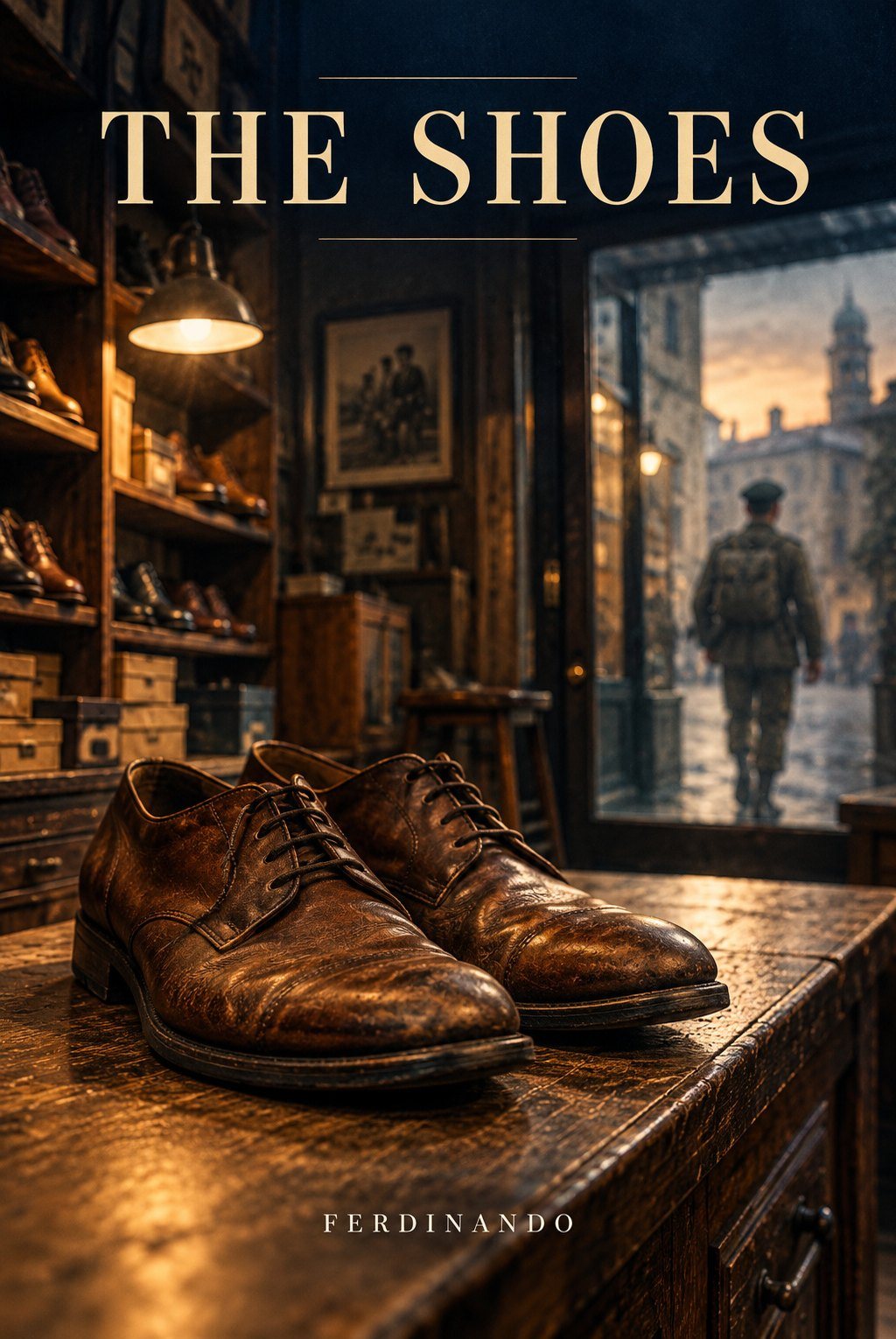
THE SHOES
Shoes are something we rarely think about seriously, though they matter enormously to body and mind. In those days it mattered even more that they were made of leather — the only material that kept your feet dry and your whole body working.
I’ve never gone through many shoes. I’ve owned very few, and I always tried to repair the ones I had. I cared about function, not looks. You can kick anyone you like in the ass with any shoes you like, and nobody sees whether they have a designer label.
Today my wife asks me to stop at a self-service shoe shop. I remember that shop once belonged to Franco, my fellow soldier, and we go in.
Forty years have passed. It’s still the same — same layout. While my wife chooses her shoes, she hands me the boxes to hold before heading to the benches to try them on.
Meanwhile, a woman asks where the women’s section is, and I point the way. A gentleman asks if a particular shoe comes in size 41, and I tell him that size is sold out. Two women trying on shoes ask for my opinion, and I tell them they look marvelous in those pairs.
My wife notices nothing. For twenty minutes, without even realizing it, I have become the shop assistant. Everyone comes to me. I answer the men coldly and badly, while the women get all my admiration for their choices.
The checkout fills up and nearly crashes. The owner can’t figure out what’s happening. We pay for our shoes and head out, but first I ask if he knows Franco. “Yes,” he says, “he’s my father.” “Then give him my regards.”
As we leave, the women point at me and wave. My wife still notices nothing.
The problem comes about two hours later, when my daughter wants to go back to the shoe shop. There, the owner’s son takes me aside and says, “Mr. Frega, I didn’t say anything at the checkout. I didn’t want the customers to hear and make a scene. Dad had a terrible accident in 2021, and in 2023 he left us.”
I’m truly sorry. I tell his son a story I lived through with his father, and he hugs me hard, with tears in his eyes.
My daughter buys her shoes, pays, and we leave. As he says goodbye, the son calls out, “Come and see me. I need salesmen like you, working for free.” And I say, “You haven’t downloaded my books, have you?”
He smiles. And life goes on.
Ferdinando
Explore the Other Sagas
The Corpus · Maps · Library · Genesis · International · Vatican · Gillette Saga · Wall Street Saga · L’Oréal Man · P&G Semantic · Contact