 THE BIC SAGAThe takeover that never happened.

 THE WILKINSON SAGAThe steel aunt.
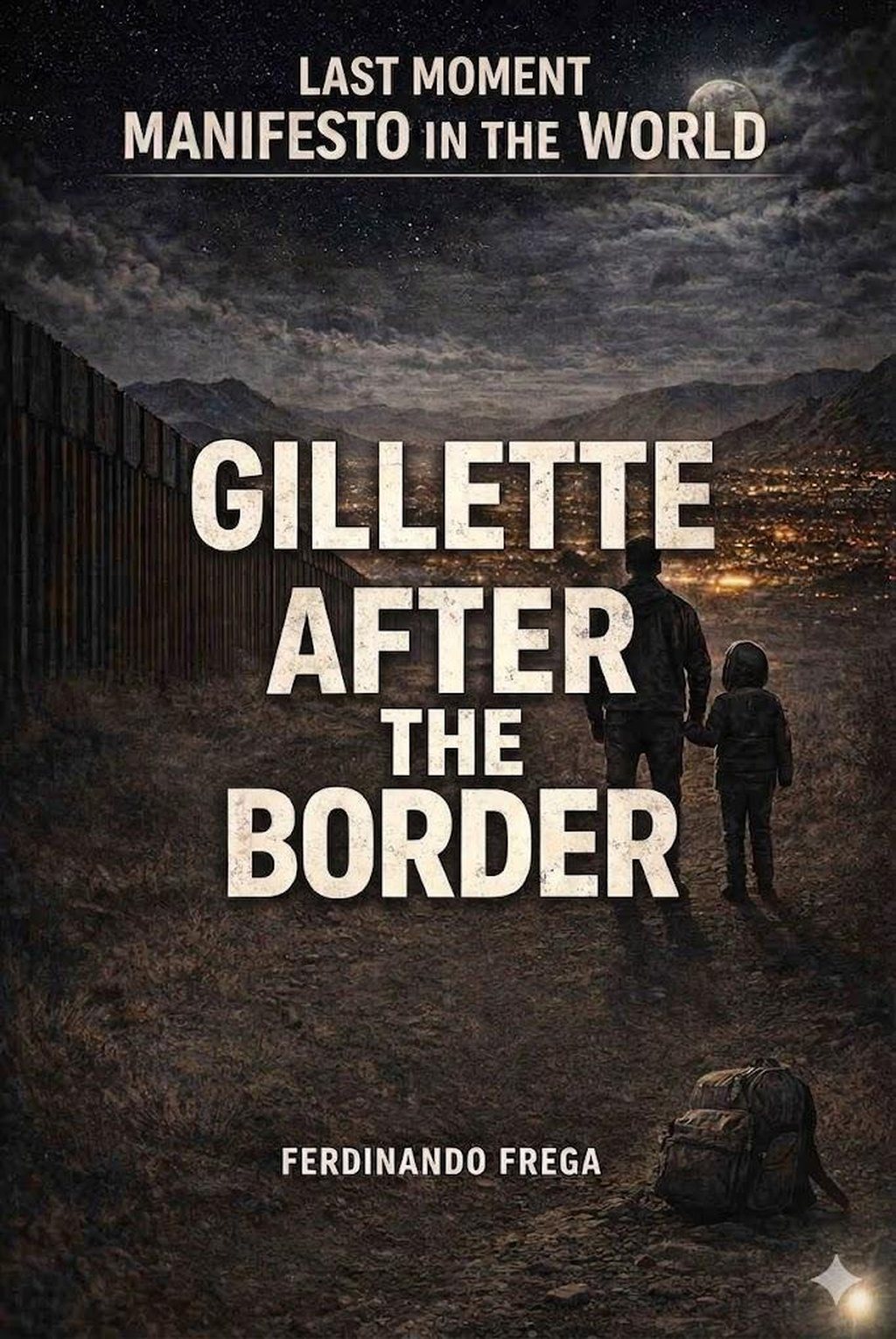

A book about borders as thresholds rather than walls: peoples, cultures, traditions and the thin line between madness and vision. It carries a manifesto, a dedication to the travellers of borders, a small biography, and a question the author keeps returning to — what is left of a person once the edge has been crossed.
GILLETTE THE MISSING PIECE · English Edition · No. 22
MANIFESTO
Most people do not understand that life is not defined by what we have, but by the presence we leave in others. We are not here only to accumulate. We are here to carve a thought, ease a pain, ignite a consciousness.
The human border is not just a line between States. It is the distance between those who consume their time and those who transform it into inner legacy.
Beyond the border there is no void. There is what stays. There is what survives the body, geography, fear. There is the trace.
DEDICATION
To those who cross visible and invisible borders. To those who lose land, language, name — and still search for a way to exist in the world.
EDITORIAL NOTE
This text was born from a simple, radical question: What is it that we, as human beings, still do not understand? The answer opens a new field: we are not here merely to exist, but to leave a living trace in others.
PREMISE
Every border divide something: bodies, maps, memories, rights, possibilities. But the deepest border separates what passes from what stays.
PREFACE
This is not a text about limits as closure, but limits as thresholds. Humanity has built territories, nations, defences — yet still does not understand that its true measure is not what it owns, but what it transmits.
SYNOPSIS
A manifesto on human and territorial borders, and on what survives after crossing them: memory, transformation, presence.
AUTHOR’S INTENTION
I write to leave something that does not ask for possession, but for duration. A smile, a thought, a form of closeness capable of continuing beyond the page.
INTRODUCTION
Most people, when faced with a question, rush to find an answer. I do not. I begin with a single word: why?
Because I am not interested in entering the dialogue in the expected way. I want to open the fracture from which dialogue is born. I want the point where the human being stops repeating and begins to truly question.
Not what we fail to understand — but why we keep failing. Why we confuse possession with meaning. Why we move through time as consumers of life instead of as presences capable of leaving a trace. Why we build borders outside ourselves and ignore the ones that divide us from within. This manifesto begins here. Not from a ready-made answer, but from an urgency. Not from a formula, but from a threshold.
The first question does not ask for a position. It asks for exposure. It asks us to descend into the point where language stops being surface and returns to necessity.
That is why I do not answer at once. First I stand before the origin. First I listen to the wound. First I pronounce the only word that can still open thought: why.
From this fracture the text begins. From here it becomes a reflection on human, territorial, and interior borders. From here the passage opens toward what comes after: not the void, but the remainder; not the end, but the trace; not closure, but what survives.
This manifesto enters the place where answers are no longer enough — and begins at the exact point where the human being is forced to look at themselves without shelter.
PROLOGUE
English Version
The manifesto explores the meaning of human, territorial, and interior borders, emphasising the importance of presence and of the trace we leave in others beyond mere material existence.
Dedication To the Travellers of Borders
It is dedicated to those who cross visible and invisible boundaries, losing land, language, or name, yet still searching for a way to exist in the world.
The Fundamental Question
The author begins with a radical question about what we still do not understand, affirming that we are here not only to exist but to leave a living trace in others.
Nature Of Borders
Borders divide bodies, maps, memories, rights, and possibilities — but the deepest border is the one between what passes and what stays.
Borders As Thresholds
Limits are not closures but thresholds. The true measure of humanity lies in what we send, not in what we have.
A Manifesto on The Human Border
Life is defined not by what one owns but by the presence one leaves in others. The human border is the distance between those who merely consume time and those who transform it into inner inheritance.
Peoples And Cultures
Peoples are living memories that resist and demand recognition, while cultures are alphabets of feeling — acts of resistance against oblivion.
Traditions And Sociality
Traditions are embodied continuities that withstand time. Sociality is the first human border, the place where identity is formed through reciprocal recognition.
The Border Between Madness and Vision
Those who cross the borders of thought may be seen as cases or prophets; the line between madness and vision is thin, often drawn by the fear of listening.
Offering Without Possessing
The author says that he gives without expecting anything in return, distinguishing human logic from commercial logic. The manifesto is a passage — one that continues beyond the page.
THE WORLD
The Peoples
The people of the world are not masses to be counted but living memories in motion. Each person is a wound that keeps breathing, a language that refuses to be tamed, a hunger that bread alone cannot silence, a sky that cannot be folded into a flag.
Peoples do not advance — they endure. They do not ask to be understood, but to be recognised. Each people is an archive of survival, a unique way of staying alive when everything around collapses.
No people are peripheral. Periphery is simply the place the world has not yet learned to see.
Cultures
Cultures do not divide humanity — they make it legible. They are alphabets of feeling, maps of pain, choreographies of celebration, geometries of return.
Each culture is a laboratory of meaning, an attempt to shape the enigma of being alive. Not identities to defend, but tensions to cross.
Every culture is a provisional answer to the mystery of being here, now, in this body. And every answer is an act of resistance against oblivion.
Traditions
Traditions are what resist the erosion of time. They are not nostalgia — they are embodied continuity.
A repeated gesture is not habit: it is memory insisting. A transmitted word is not folklore: it is belonging. A shared table is a pact. A shared mourning is a form of justice.
Traditions are the past refusing to die — returning each time to remind us of who we are when no one is watching.
Sociality
Sociality is the first border the human being crosses. Before speaking, we touch. Before understanding, we look.
We are relation, friction, the need to be recognised. Even silence, in front of another, is a language. Sociality is the place where the border between me and the other cracks — and the possibility of being begins. There is no identity without a witness.
A Small Biography
I come from a writing that never sought salons, but presence. I have crossed years of thought, wound, stubbornness, clarity. I never wrote to occupy space — I wrote not to disappear. Every word has been a threshold, every book a witness, every gesture an act of resistance. My biography is not a résumé — it is a trajectory. I do not seek readers — I seek witnesses.
Objective
(Exploring Limits)
Touching The Edge of The World
My goal is not to describe the world, but to touch its limits.
Writing As a Border Test
Writing is a border test: not to say, but to see what stays after everything has been said.
The North Pole
The North Pole is the extreme border of geographical imagination: ice, silence, absence, resistance. It is the place where the world seems to end — and instead, begins again in another form. Every manifesto needs its impossible North. Not as a destination, but as a tension.
The North Pole is proof that even emptiness can be inhabited, if crossed with clarity. It is the point where the map stops being geographical and becomes destiny.
Animals
Animals are the border that humbles us and completes us. They look at us from another grammar of the living. They do not speak — they say. They do not explain — they show.
They are the biological memory of the world, the proof that we are not the centre but a passage. Each animal is a question that needs no answer — only presence. They do not seek meaning — they embody it.
Psychiatrist Or Case Study?
Here is the final question: vision or deviation? Prophecy or symptom?
Those who push thought beyond the border are often read as a case before being heard as a voice. Every new language cross, at least once, the suspicion of diagnosis.
The border between madness and vision is thin — and often decided by those afraid to listen.
I do not ask for diagnosis — I ask for attention. I do not seek normality — I seek truth.
AUTHOR’S NOTE
Throughout my life, I have always found joy in giving, never in taking. It has been my one persistent trait for sixty-one years: offering, not holding. And even here, I could only continue to be myself — leaving something meant to stay in people’s minds, not in my pockets.
The global publishing industry has a curious belief: that what is given freely must have little value. That a book offered as a gift is a book of lesser worth.
That is business logic — not human logic. By that logic, Bezos should take the bus instead of a private jet. Ahahahah. That is how absurd it is.
I do the opposite. I give what I have to offer — not what I hope to receive.
The difference seems small, but it is not. It is the line that separates possession from presence, calculation from generosity, market from trace.
This manifesto is not a product — it is a passage. A gesture that asks for nothing in return. A fragment of me that keeps walking even when I no longer can.
Thank you. And enjoy — in the most serious and light sense of the word.
Closing
The real border is not the end of the land. It is the moment we decide whether to pass through without leaving anything — or become presence.
Ferdinando Frega