 THE BIC SAGAThe takeover that never happened.

 THE WILKINSON SAGAThe steel aunt.
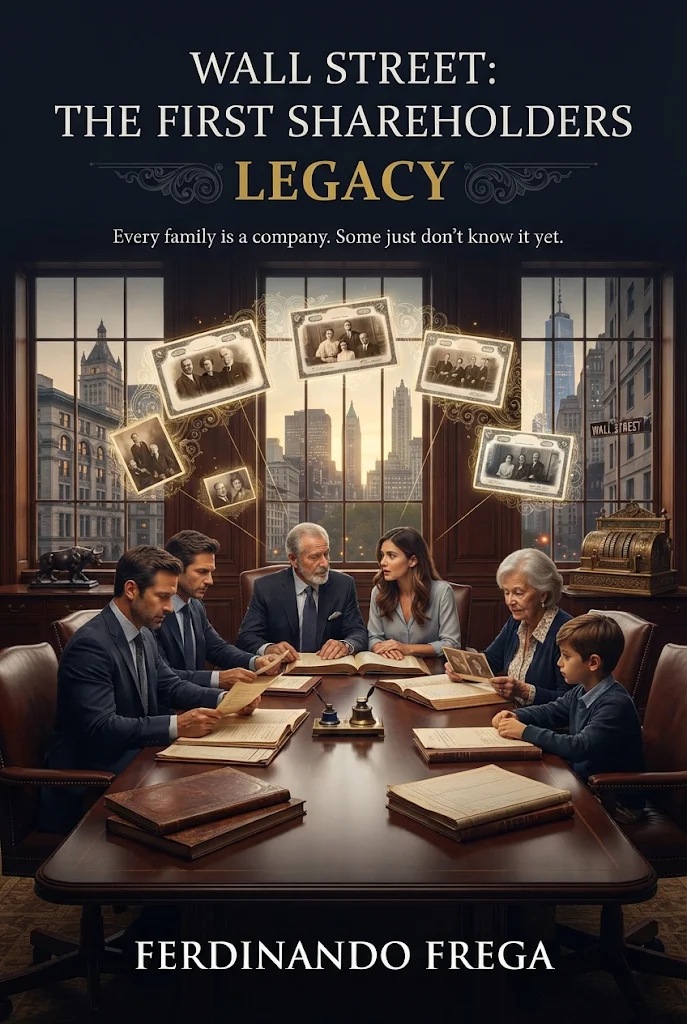
WALL STREET: THE FIRST SHAREHOLDERS
SEMANTIC SPECIMEN · 02 · LEGACY
Every family is a company. Some just do not know it yet.
Introduction
Most people believe their first contact with Wall Street happens when they earn money.
They are wrong.
Our first investment happens much earlier.
We are born into a family.
Before we understand profit, we learn trust.
Before we understand contracts, we learn promises.
Before we understand risk, we watch adults making decisions that will shape our future.
Every family is an enterprise operating across generations.
Some are rich in money and poor in affection.
Others possess little wealth and leave behind an extraordinary fortune of character, resilience, and loyalty.
This book is not about inheritance law.
It is about the invisible assets and liabilities passed from one generation to the next.
Because every family leaves a balance sheet.
Whether it intended to or not.
1. The Family as the First School of Relationships
Family is the first place where we learn how human relationships work.
Long before teachers, managers, politicians, and influencers arrive, there is a family teaching us what trust looks like.
Some lessons are intentional.
Most are not.
Children watch everything.
They observe how adults manage pressure.
How they speak about money.
How they deal with loss.
How they argue.
How they forgive.
Or fail to.
Every family delivers a starting portfolio.
Not of financial assets.
Of habits.
Beliefs.
Fears.
Expectations.
Memories.
Some inherit confidence.
Others inherit anxiety.
Some receive encouragement.
Others receive caution disguised as protection.
Nobody chooses the opening balance sheet.
Everybody chooses what to do with it.
The first lesson of maturity is understanding that inheritance is a starting point, not a life sentence.
2. Parents and Children: The Transfer of Invisible Wealth
Every generation transfers something to the next.
Sometimes money.
More often attitudes.
A parent does not teach only through words.
A parent teaches through behavior.
Children rarely become what they are told.
They often become what they repeatedly observe.
A father who keeps his promises teaches reliability.
A mother who faces adversity teaches resilience.
A parent who admits mistakes teaches humility.
Ironically, many adults spend years trying to give their children everything they never had.
Then discover the most valuable gifts were never things.
They were examples.
Families resemble long-term corporations.
Each generation prepares a report for the next one.
The numbers change.
The principles survive.
That is legacy.
Not what you leave behind.
What continues after you are gone.
3. The First Shareholders
Brothers and sisters are the first shareholders of the same story.
They hold different percentages of the same memory.
Nobody else owns those original shares.
Nobody else remembers the same house the same way.
Nobody else witnessed the beginning from the inside.
Over time, however, shareholders develop different strategies.
Different careers.
Different cities.
Different beliefs.
Different opinions about what really happened.
Sometimes the family becomes a partnership.
Sometimes it becomes a boardroom dispute that lasts twenty years.
The irony is that many adult conflicts are negotiations that should have ended in childhood.
Who was loved more.
Who was trusted more.
Who carried more responsibility.
Who received more attention.
The strongest families eventually understand something important.
Memory is worth more than victory.
And when parents grow old, the value of cooperation suddenly becomes obvious.
At that moment, the question is rarely:
“Who was right?”
The question becomes:
“Who remained?”
4. Losses, Divisions, and Family Bankruptcy
Not every family succeeds.
Not every relationship survives.
Not every inheritance produces value.
Some families accumulate wealth and lose each other.
Others lose money and keep something far more important.
Mutual respect.
Silence can become expensive.
Resentment can become expensive.
Pride can become expensive.
Some emotional debts accumulate interest for decades.
There are moments when distance becomes necessary.
That is not always failure.
Sometimes it is risk management.
A healthy boundary is often cheaper than a permanent wound.
Forgiveness is frequently misunderstood.
It does not mean forgetting.
It does not mean pretending nothing happened.
It means refusing to allow the past to keep charging rent forever.
Some relationships can be rebuilt.
Others can only be understood and released.
Wisdom is knowing the difference.
5. The Family We Choose
Eventually most people discover there are two families.
The one they inherit.
And the one they build.
Friends become brothers.
Colleagues become allies.
Partners become home.
Life quietly expands the definition of family.
The older we become, the less interested we are in titles and the more interested we are in presence.
Who answers the phone.
Who shows up.
Who remembers.
Who stays.
That is the real measure of wealth.
The family we choose does not replace the family we inherited.
It completes it.
And sometimes it helps us understand it.
Final Reflection
Most inheritance discussions begin with money.
They usually end with relationships.
Families spend years protecting houses, savings, businesses, and possessions.
Yet the most valuable assets rarely appear in legal documents.
Character.
Trust.
Loyalty.
Memory.
Stories.
A sense of belonging.
No lawyer can fully transfer those assets.
No bank can safely store them.
And no government can print them.
That is why every family, knowingly or unknowingly, leaves a legacy.
Not in property.
In people.
At the end of life, nobody will remember the exact size of the estate.
They will remember the culture that existed inside it.
Because the most valuable inheritance never passes through a notary.
It passes through memory.
And memory can survive for generations.
Ferdinando
Explore the Other Sagas
The Corpus · Maps · Library · Genesis · International · Vatican · Gillette Saga · Wall Street Saga · L’Oréal Man · P&G Semantic · Contact