 THE BIC SAGAThe takeover that never happened.

 THE WILKINSON SAGAThe steel aunt.
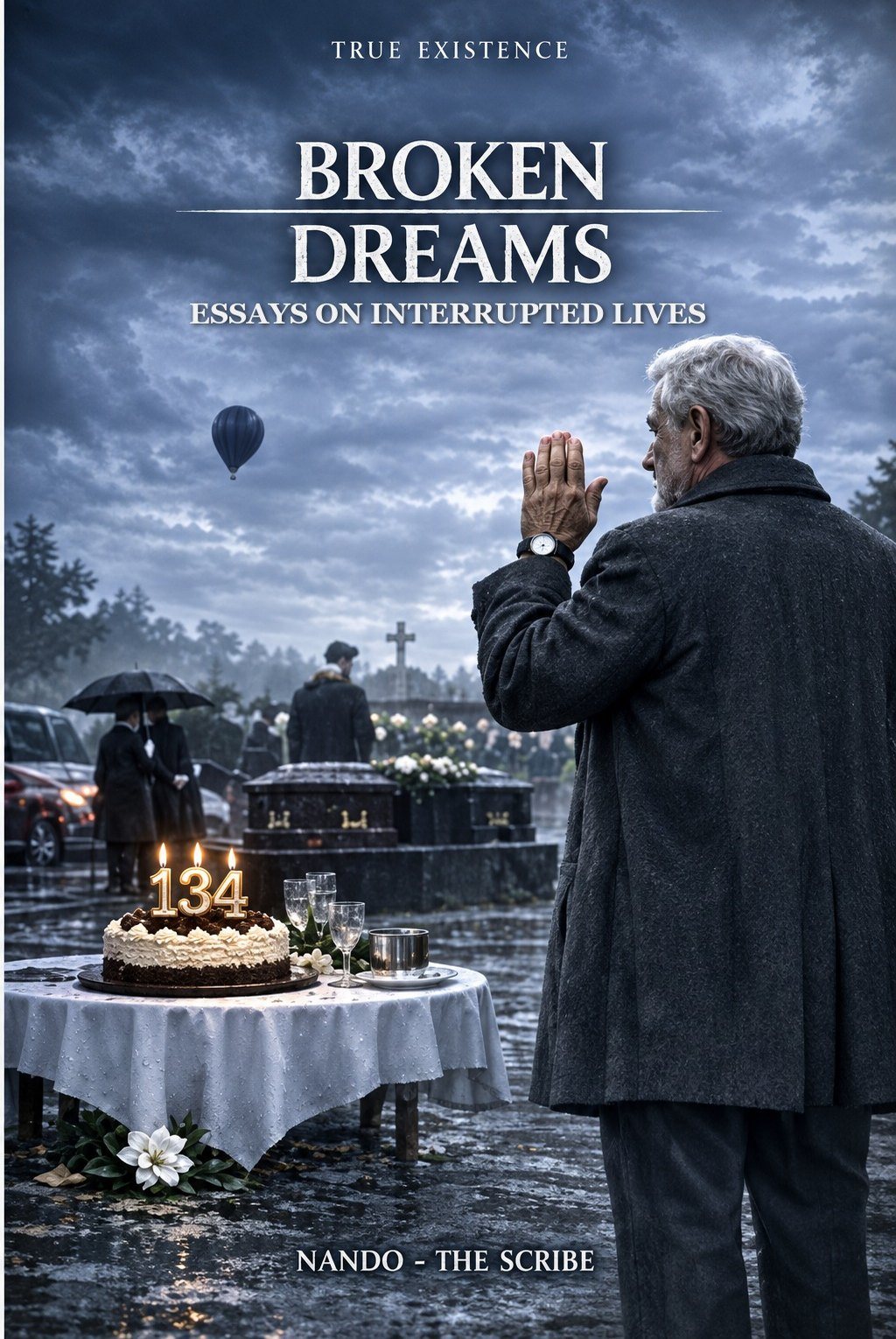

An archive of independent essays and reflections on dreams interrupted by life — childhood, work, relationships, identity — explored through themes of gratitude, freedom, friendship, resilience and loss. Opens with a literary manifesto and closes with a set of aphorisms and a deliberately final note: the book does not resolve, it remains.
ENGLISH LIBRARY · Roots and Memory · No. 13
COLOPHON
Ferdinando Frega — Nando the Scribe — The Fifth Blade
Narrative pioneer of the Behavioral Code. He built a one-dollar editorial ecosystem around a single idea: finance does not have a money problem. It has a behavior problem.
Gillette Series Narrative · Volume XIII. Edited and curated within the ONEDOLLAR-STORIES ecosystem. Digital architecture: NAPLES-POST · NOASPECTTIME · ONEDOLLAR-STORIES. First published in 2026. Set in a clean, modern typographic layout optimized for digital reading. Published in the United States.
COPYRIGHT NOTICE
© 2026 Ferdinando Frega / Frega Editore. Licensed under CC BY-NC-ND 4.0.
The stories tell of interrupted or altered dreams, which concern childhood, work, relationships, and personal identity. Reality replaces illusion, and we explore what remains when a dream is shattered. The dream does not end with its conclusion, but when we understand that it will never return to the way it was.
Among the narratives are conversations with a Chinese woman, reflections on posting and managing time, and historical tales that show how history and cycles of the past influence present life.
A significant story is that of two twin brothers who are pianists whose dream is shattered by an injury, but who find new ways of fulfilling themselves through teaching and diverse types of music.
The book addresses values such as happiness, gratitude, freedom, friendship, forgiveness, sincerity, thought, stress, peace, habits, rest and sleep, spirituality, expectations, trauma, simplicity, passion, disappointments, the strength to never give up, and resilience. Each theme is explored with examples and personal reflections that encourage awareness and acceptance of reality.
Various personal dreams are narrated: the dream of flying, of writing, of changing oneself, of not giving up, of exploring the world and changing the world. These stories show how dreams transform and how determination and passion are essential to facing difficulties.
The text also includes learning experiences, life changes, meaningful encounters, and life lessons such as patience, the value of truth, play, solitude, diversity, and generosity. These experiences are recounted in direct and personal language, often with anecdotes that illustrate the difficulties and discoveries that result.
Reflections on the economy, oil, and the dollar explore their historical and current importance, demonstrating how these realities influence society and daily life. A meeting with the tax authorities is also recounted, which turns into a moment of human exchange and advice.
The book concludes with a postscript that emphasizes that it is not a conclusive text, but rather an archive of what remains after the loss of dreams. It contains aphorisms that reflect failure, disappointment, growth, and maturity. The author leaves the reader with a reflection on the choice of filling the space left by shattered dreams with noise or silence.
In short, the book is a complex and nuanced collection of stories, reflections, and lessons that explore the reality of broken dreams and lives renewed through awareness, resilience, and change. It offers a profound and personal vision of the human condition, inviting the reader to confront their own experience and find meaning in hardship.
“Stories of Lost Dreams”
and Sudden Rediscoveries”
LITERARY MANIFESTO
This book exists because dreams do not die when they fail, but when they are told like fairy tales with a successful conclusion. Broken Dreams was created to strip away the nobility of the rhetoric of success and restore it to the consequences. Here, we celebrate not those who made it, but those who continued to live after losing.
EDITORIAL NOTE
This volume collects stories, episodes, and reflections that are independent yet interconnected. They do not follow a rigid chronological or thematic order. The reader is not guided toward a conclusion, but is left free to explore the texts according to their personal resonance. It is not a manual, not a novel, not a confession. It is an archive of experiences that do not seek absolution.
DEDICATION
To those who have understood that losing a dream does not mean losing yourself.
BACK COVER
Not all dreams come true. Some shatter. Others change shape. Still others fade into silence. This book does not teach you how to fix it. It shows you what remains.
PREFACE
Some books are written to motivate. This one is not. This one is written to define boundaries. To separate what was desired from what was possible. If you look for hope, you might find it. But it is not guaranteed.
PREMISE / SYNOPSIS
The following stories speak of dreams interrupted, thwarted, betrayed, or diminished. Some are from childhood, others from work, others from relationships, still others from a self-image that has not stood the test of time. There is no stated lesson. It simply illustrates what happens when reality replaces illusion.
AUTHOR’S NOTE
The author takes responsibility for what is said. Not to claim its value, but to avoid delegating it to others. Interpretations belong to the reader. The consequences, to those who have experienced them.
INTRODUCTION
Every dream is born clean. It is life that dirties it. This is not a collection of failures, but of forced adaptations. Reading means coming into contact with what has not been resolved.
PARTITION
The book is divided into independent texts. Each section can be read individually. The order is not hierarchical. Meaning emerges through accumulation, not progression.
PROLOGUE
The dream does not shatter when it ends. It shatters when you realize it will never go back to the way it was. From there on, there is only one choice: tell the story or pretend it never existed.
The Beauty of Beijing
Hi Isabella, Our online conversations, using both Facebook accounts, were casual, intense, and filled with curiosity, even though you maintained your reserve and secrecy as an Oriental woman, a woman from China. On WhatsApp, we had the opportunity to be less formal and more practical, even though I never knew what you wanted. Your introduction and description were made through two photos of you and one of your dogs. Despite this, I managed to understand your sophisticated intelligence, and in context, other things: 1. Your name is Isabella. 2. You are from Beijing, China. 3. You worked in the United States for two years. 4. You have been working in Italy for two years now and you say you live in Rome, but that is not the truth. 5. Your age should be between 30 and 40 years. 6. You have two dogs at home. 7. You know my city; you have already been there on vacation. 8. You are surprised by the way I present myself, elegant and polite. 9. You sent me the sheet relating to your annual income. 10. You have labeled me a fantastic dreamer, who talks about impossible projects and tries to get everyone involved. You asked me a lot of questions, I told you just enough about myself; you were always a stranger. I said I did not believe in friendship between men and women; women are superior and always want to change men, leaving no chance. Women want to know if a man is stable, dependable, if he can make plans, a family, children, a house, a villa, two cars, travel, and a good life. If, in the end, he is good at making love, he will share your bed, and you decide whether to love him and fall in love. The positions are different but meeting me has given you the opportunity to find yourself in a difficult moment of your life. You can find anyone in any corner of the world, but the physical and mental differences will always be different, never the same. Real people and liars, rich and poor, good, and bad, white, black, yellow, red, whoever you desire, but no one will ever care about the most important person in your life: THAT’S ONLY YOU. I would like you to be my business partner, with a five percent share of all Chinese book sales worldwide, and no upfront money or investment is required. You simply plan the distribution and advertising of my books in China. My goal is not to make money and get rich, but simply to seek fame, success, and the satisfaction of being recognized for what I have long believed in: being a global author. I hope I have made my point clear and understood who you are. It would be to the benefit of both parties, so that no one wastes any more time. Your ambition forces you to show only what you want when you decide to. That is how the Chinese people are. I have noticed a gap in your personality: something you lack that you will not easily find. Meeting someone accustomed to thinking and making decisions, honest and loyal, who does not prioritize sex and lives culturally with his principles and values, always striving to do and never to promise, demonstrating a marked difference from others, is an exercise you will not find a way to do. But the ancients always said: TAKE THE GOOD THAT COMES, BECAUSE THE BAD COMES BY ITSELF.
The Post
Over the years, I have continued to publish on the major social media platforms, observing that the primary activity is often circulating them, transferring them from one system to another, and then posting them on the public pages of the most important platforms, sometimes even switching languages. The writer’s goal should be to express their intentions, bringing to everyone’s attention facts, reflections, events, and news that might be of general interest. The goal is to give visibility to ideas, dreams, and thoughts, enriching everything with a touch of irony and lightheartedness. To prevent information from being simply transferred without reflection, I have decided to implement the concept of “TEMPORARY STORAGE.” Each post should be kept online for a limited time, no longer than 48-72 hours. After that, it will be removed and can be reused for other purposes: as part of a future series, as revised content for republishing, or even integrated into future books distributed through platforms, bookstores, and libraries. There is no room for romance or love in this process; only rational logic that follows a well-defined path: to commercialize ideas and generate profit. This is the goal, though often difficult to quantify. Publishing is an opportunity to gain recognition, appreciation, criticism, and, if possible, spark discussion. Whatever the outcome, what matters is that it gets talked about, that it attracts attention, and, ideally, a financial return in the form of purchases that can further the journey undertaken. This is the world we have been handed down in, and we must adapt to it or risk being excluded, as often happens to older people who have failed to keep pace with progress and have passively endured the natural process of aging. Ours is a world that does not forgive those who do not adapt. In this context, the only thing that will remain intact over time is written records. Books, like the Bible or other sacred texts of various religions, teach us that everything is destined to change or be destroyed, and that something new always advances. This cycle is inexorable. After many years of teaching and diverse experience in various fields and with different linguistic identities, I have learned that modern economics teaches us a simple lesson: if a product does not satisfy you, there is no point in buying it. You must look for what suits your needs; only then will it become a part of you.
The Story
Among the subjects that have always fascinated me throughout my school years, history has always been one. As a young man, I never realized it had been written by different men, with different views, perspectives, and insights. The oldest ones refer to primitive man, and today I will tell you a story you will not find in textbooks. The first primitive man was a member of the genus Homo sapiens, who lived in southern Europe. He had his own cave, but he did not have a good relationship with Homo sapiens women, due to his authoritarian nature. His solitude accompanied him by hunting animals and obtaining food, both fruit and vegetables. The average lifespan was around 20-25 years. Due to the raw food, their internal bacterial flora was very intense, and they became ill, often leading to death. Dead humans became a sort of food for the living, as there were no burial rituals or religions. The arrival of fire radically changed their habits, allowing them to live to an average age of 40-45, giving them time to begin carving stone slabs inside the cave, a primitive form of writing. But in Northern Europe lived the woman of the Homo Neanderthalian genus, charming, beautiful, and sensual. She knew how to pamper men: she was the modern-day German woman. There was a veritable exodus of these women southward, who mated with Sapiens, effectively forming couples. But then the incredible happened: one day the man went out into the forest to hunt, and the woman inside the cave, at a loss for what to do, decided to explore the forest, where she found some interesting flowers and wood, which she used to decorate the cave. She was incredibly happy, awaiting her man’s arrival. But when he arrived, he began to scream, claiming she had taken this initiative without saying anything or agreeing with him. They argued, after which the man was forced to leave the cave. This is where the first form of divorce was born, with the principle of separation with blame. After some time, the woman returned to Northern Europe and eventually died out, while the man was convinced to build his life with a woman of his own gender, and the ancients carved the law of life that says: “Wife and oxen always from your own country.” Recognizing historical cycles and recurrences gives us the opportunity to make significant changes in our lives. History teaches us and offers us so many things: memories, recollections, sad things and a few good things, books where we can learn the unknown. But people often forget to practice a fundamental life exercise: to realize that everything returns, that everything has a historical course and recurrence, and to have the opportunity to implement the change that would make them stronger and more invincible, definitively abandoning habits and vices. Living with our fellow human beings, avoiding deviations, guarantees our continued existence, not our past. Seeing everything destroyed is a terrible fate, one that leaves a bitter taste in the mouth.
Happiness
I had received a call from a colleague of mine in Mexico, Conchita, telling me that within minutes I would receive an email with a new work plan, drawn up on an annual basis, with little margin for error. Specifically, it spoke of a one-year stay in Africa as head of a humanitarian mission, with major changes and generous compensation at the time of remuneration. This piqued my curiosity; it was the first time a work event had created such a stir of surprise and curiosity; I was not used to working like this. The flight was scheduled, I packed my bags and set off, for Kenya, where I had been a guest before. Said was waiting for me at the airport with my name written on a piece of cardboard, spelled poorly, but an Italian’s intuition is one of the things that never fails to impress me. I had noticeably clear ideas, I knew what I had to organize, convinced that, as always, I would have a private house outside or at most a hotel room, but none of this happened. The village chief, a noticeably short but kind man with two beautiful young daughters, offers me his hut to sleep in, complete with a straw bed, a leaf pillow, and a bottle to pee in at night, until the day I leave. I look at him in surprise and immediately ask where the bathroom is. He comes out and points to a patch of savannah where I will not find lions tearing me apart while I relieve myself. And where do I go to take a shower? “My wife and daughters will prepare hot water once a week and wash you in the tub, using animal rags. You don’t have to do anything.” As for the laptop, how do we connect it to the internet? “They delivered this package from London a few days ago. You’ll find a phone with a hotspot so you can connect, you’ll have everything you need.” “You’ll have breakfast with us in the morning and afternoon, then in the evening we’ll dance and sing, and when we’re done, you’ll choose a woman for just one month. You can’t change her, it would be an insult to her, that’s all.” Why just one month? For the sake of fairness, all women should have equal status. The first night I stayed awake, with the women talking until late, deciding who would be the first to sleep with me, and after four days I fell into a deep, almost eternal sleep, exhausted but happy. I had lost my bearings when, one afternoon, some English journalists came to interview me, and a lady, looking at me with interest, asked: “What is happiness, for you?” When you lose everything and find yourself with nothing and needing nothing, you have reached that sublime moment of pleasure called happiness. This feeling brings you no desire to go back. Happiness is a state of mind we all relentlessly seek. It is not just about moments of joy or success, but about finding serenity and fulfillment in the trivial things of everyday life. True happiness lies in balancing our aspirations with reality, in accepting ourselves, and in cultivating meaningful relationships. It is a journey, not a destination.
Gratitude
I had noticed a long time ago that my sixteen-year-old sons were behaving strangely and always had too much money in their hands and in their pockets. A little investigation revealed that they had fallen into drug addiction. I had no experience, I did not really know how to help them, but the help of a priest saved everyone. The boys went to sleep in his community, along with others, but they had a huge appetite: they emptied all the pantries and refrigerators, until they were left without food. This prompted the priest to raise the alarm and ask me for help. After a few hours, I sent a month’s worth of supplies, receiving thanks and gratitude from the priest. My children were not yet safe; they had not fully escaped the system, and it was then that the priest took extraordinarily strong action with the police, saving twenty-five children. We parents were devastated, but happy. We wanted to build a statue of gratitude to the priest, who accepted our gratitude, always asking us to never forget those in need. Gratitude is a powerful tool for improving our well-being. Recognizing and appreciating the positive things in our lives, even the smallest ones, helps us cultivate an optimistic outlook. Keeping gratitude journals can be an effective way to remind ourselves how much we must be grateful for, reducing stress and increasing happiness.
Freedom
Freedom is a complex and multifaceted concept. It can mean freedom of expression, the freedom to choose our life path, or freedom from oppression. Being free entails the responsibility to respect the freedom of others. Inner freedom, that is, freedom from negative thoughts and fears, is equally important for living a fulfilling life. These are all encyclopedia-worthy concepts, but freedom is always measured against reality. It means that the expression of who we are and what we do recognizes our right to move and express ourselves as we see fit. Every political leader of a nation establishes communication with the people to recognize the concept of freedom: Americans have the Statue of Liberty in New York, the emblem of the Constitution and of a people who fought to conquer it. Cubans received 1.5 million pressure cookers for their families, a form of freedom within a totalitarian system that instead limits rights and enslaves people. The Russians, with their 500-year dictatorship, where they change colors and colors, coerce and segregate people, benefiting and enriching a few. Then there are those regimes that explode, see Romania, Yugoslavia, Poland, Germany, places where only high-ranking individuals fought for freedom, risking their lives. China, with its first emperor in 259 BC, merely continued a tradition, and the people are accustomed to living this way, unaware of the outside world; restrictions are government conditions for better living, welcomed by everyone, because the party protects the people. But when we get married, we all lose some of our freedom, having to dedicate part of our time to our partner. When I met my friends around the world, no one ever came to my house, but I went to theirs and set my own schedule, trying to please as many people as possible. I could not forget France: Liberty, Equality, Brotherhood, a war that put an end to the monarchy and gave strength back to the people, and they have been good at maintaining it until today, even if they have enslaved half of Africa with the management of the monetary system of many nations. It does not take much to be free, just be alone with your thoughts, close your eyes, and dream about where you want to go and who you will be with; that’s already freedom.
Friendship
Each people belonging to Italy has its own definition of friendship, which is very concise, expressive, and communicative: • The inhabitants of Palermo are said to be friends, but you must be careful, because they talk behind your back. • It is said that the inhabitants of Catania are friends who are like counterfeit money. • It is said that the inhabitants of Messina are great talkers but without facts, without substance. I could go on, but the goal is not to talk about geography, but about an intimate relationship that develops between people based on confidentiality, mutual support, and assistance without time or financial constraints. I was in Boston, staying with my father’s cousin, who was married to an incredibly beautiful Italian woman, but who had not borne him any children. One August afternoon, her husband left us alone in the house, and she decided to hang a curtain in the living room, climbing the stairs and asking for my help. I have always had good eyesight, but I was still sixteen. I approached the stairs and noticed she was not wearing underwear. What should I do? A Calabrian has always been compared to the American dollar: you can only see its intrinsic value if you hold it in your hands. The woman embraced this theory and welcomed me into her arms, but within seventy-two hours her husband had put me on a plane and returned to Italy. Eight months later, a son arrived, but as an act of friendship, I never mentioned it to anyone, because friendship is one of the fundamental pillars of our existence. Loyal friends support us in tough times and share our moments of joy. Cultivating sincere friendships requires commitment, empathy, and availability. A friend is someone we can count on, who accepts us for who we are, and who enriches our lives with their presence.
Forgiveness
I met her twenty years after college. She was still tall, but very thin, broken, and crying. She had lost that smile I had known. After 24 hours of engagement, marriage, and divorce, we remained friends. When we see each other, we give each other pleasure. She hugged me and held me tightly. I immediately understood how serious the situation was, and she found the time to speak up and confess, asking for advice on her problem. Her husband had left her with four young children and run off with a Moroccan woman. She had a low-paying job and was renting the house, but what really hurt her was that, shortly before running away, he had stolen all the jewelry and money in the house, leaving her in despair. “Ferdinand,” he said to me, “what would you do?” The worst thing to do is respond to violence with violence. To forget everything that happened, you must let it go and forgive. That is the only tangible way to forget. I took her bank account and sent her some money to help her through this tough time. She started smiling, asking me why I had not married her. It is easy to say: there was no opportunity, there was not enough time, one called too many. “Why called, from God?” “No, from someone who needed my services, and I’ve always forgiven those who didn’t call, because they’d come straight to my house without warning.” She laughed heartily and could not stop. She held my hand, but I never asked for a picture of the children. It would have been too risky; one I could never forgive myself for. Forgiveness is an act of personal liberation. It does not mean forgetting or justifying the wrong done but freeing oneself from the burden of resentment and anger. Forgiveness is a gift we give ourselves, allowing us to move forward and live with greater serenity. Forgiveness requires strength, but it leads to lasting inner peace.
Sincerely
It all began with a visit to a shrine inside a religious monastery in a Cuban city, where some monks were waiting for me for a personal interview. I had been a victim of black magic; I should have died five or six times, but I had always managed to overcome the evil, and with their help I learned why. They accused me of not being honest with women, cultivating lies for my own gain, and this had led to a vast number of partners, which I could no longer contain. I had to change my attitude, for my life, for my children, for my family, my friends, for everyone: the game had to end. I would receive less, but I would be fair and honest, adopting the policy of doing, not promising. I had to embrace the change, otherwise I would no longer be able to overcome black magic. My stay in Cuba cost me seven days of seclusion in the monastery, without the possibility of meeting anyone. I had to purify myself, and so I did, vomiting out many things I did not know I had ingested. Being honest with oneself and with others is the foundation of authentic relationships, but it must be accepted seriously, and behavioral factors indicate the initial values. Honesty requires courage, especially when the truth is uncomfortable, but I also found a new path: between truth and lies, you can insert the half-truth, which is a sort of forewarning of the problem that needs to be solved. However, a life lived with honesty leads to greater self-esteem and mutual trust. Telling the truth, with respect and kindness, is an act of love towards oneself and others.
The Thought
The lightest thing in the world, many people cannot pinpoint, is thought. Although its physical consistency is unknown, it can often have devastated or beneficial effects. Attending a Pythagorean esoteric school for thirty-one years allowed me to work on thoughts, ideas, and develop all those cerebral capacities that make thought the frontier in the deliberation of actions. Many people do not think they usually act with their guts, their nerves, their five senses, others with their reproductive organs, but the result is a complete failure nine times out of ten. Thoughts are also influenced by one’s emotional, emotional, and enthusiastic state, and having good control allows you to generate only successes. Thinkers are never predictable, like when you find yourself facing a police officer pointing a gun at you and you can never be sure whether he will shoot you or not. Women are the best thinkers. Despite having fewer neurons than men, they have the advantage of being ten percent more functional. Being cerebral means living in a situation of conditioning; they are slow to react, but they are also guided by a sixth sense, which we men do not know what it is. Thinking is our most powerful tool. It allows us to create, solve problems, and reflect on our experiences. Critical thinking helps us discern truth, make informed decisions, and improve ourselves. Cultivating an open and curious mind is essential for ongoing personal growth.
Stress
Stress is a natural response to challenges, but too much of it can damage our health. The area primarily affected is neurological, the source of our thoughts, pleasures, and displeasures, a container for everything. Recognizing the sources of stress and adopting strategies to manage it would be hugely beneficial, considering that there are active phases and a passive phase. Both are difficult to control, and the intensity of the action is measured by the damage caused, which is not physically visible. Meditation, exercise, and time management are essential, but so is a healthy diet and the ability to indulge in all available pleasures. The ancients said that everything abandoned becomes lost and will never be found again. One truly gets sick; I personally have had seven malignant tumors in my digestive tract, caused by stress. The condition is not disabling, and serious treatment plans do not always guarantee improvement. Family commitments, a bad partner, ungrateful friends, these are the first signs of suffering. Reducing stress allows us to live more balanced and peaceful lives. I have a thousand pieces of advice to offer, but as soon as I graduate from medical school, I will author another book.
Peace
The first true definition of peace must be made by considering all the wars currently raging in the world, where armies fight to ensure peace, defend populations, their autonomy, and the resources of peoples, masters of those lands they refuse to leave. Peace is also a state of inner tranquility and harmony, achieved through a process that is first mental and then physical, where no one is willing to influence you. Mental health patients undergo pharmacological therapies that often aim to bring calm, serenity, and a near-mental quiescence, inducing drowsiness and calm, thus avoiding the onset of depression. The true enemy of peace is anxiety, in its various forms, where control is lost, coupled with panic, generating confusion and a loss of nervous equilibrium that borders on total mental abandonment. It does not mean the absence of problems, but the ability to face them calmly and confidently, always with a rational, unsentimental perspective. We would approach the problem as losers. Creating a space of peace in our daily lives helps us maintain balance and live serenely. It always depends on the five determining factors: 1. Thoughts 2. Passion 3. Profit 4. Procedure 5. Planning Peace is also this.
The Habits
One of the great tragedies of humanity lies in the awareness of always doing the same things, with the same methodology, the same timing, the same animosity, the same intent, embracing the fundamental concept of being rich in habits. These characteristics lead many to detachment, within the family, in human relationships, in the ability to embrace innovation and progress and to transform these two precious metals into a solid plastic cutlery called habit. When I met young managers during my teaching days, I told them that habit leads to the creation of a single-member company, called “Habit and Routine Corporation,” within which there will never be any significant, sensational, or new facts, but only established stereotypes experienced as if they were procedures acquired in antiquity. Habits form the foundation of our daily lives. They can be our allies or our enemies, depending on how we choose and cultivate them. Good habits help us achieve our goals and maintain a healthy lifestyle. It is important to identify negative habits and replace them with more positive and constructive ones. But we must be careful not to forget all the other visibility we lose, which is precisely what sets us apart from others.
Rest and Sleep
Recognizing the difference between these two concepts is already a major achievement: it is the gateway to delving into a crucial topic of our lives. Rest and sleep are essential for our physical and mental well-being. Getting enough sleep helps regenerate the body and mind, improving memory, mood, and concentration, renewing brain cells, discarding old ones and making room for new ones. Creating a healthy sleep routine and prioritizing rest are essential steps to maintaining balance in our lives and staying fully active, ready to act without feeling tired. The ancients offer us their aphorisms, saying: “He who sleeps too much catches no fish”; “With one eye you sleep and with the other you watch the cat steal the fish”; “Sleep gives you dreams, the only way to fly towards the future.” In keeping with chronological times and ages, we must follow what doctors call the Sleep Table, according to which each of us has a personal, never generalized, need for rest time. In military jargon, however, the word “rest” is the way you introduce yourself to your superiors, who initially order you to be alert and only later give the command to rest.
Spirituality
Every world religion has its own spirituality, manifested in diverse ways, according to its own beliefs and guidelines, but always respecting our own interiority, where we give access to our God. In fact, everything begins by thinking of our Father, the one truly responsible for our lives. Then we look at the people on earth, and finally we turn our gaze to the familiar point, telling our spirit to be present in prayer. Yes, prayer is the greatest expression we make as we look towards our God and, in the end, we feel happy, fulfilled, and serene inside, as if we had received a pharmacological medical therapy. Spirituality is an important aspect of our existence. It is not necessarily about religion, but about a deep connection with us and the universe. Spirituality offers us a broader perspective on life, helping us find meaning and purpose. Practicing spirituality can include meditation, prayer, or simply spending time in nature.
The Expectations
Expectations are a fundamental part of our lives. They are those mental projections we make about future events, people, or situations. They can be a powerful motivator, but at the same time, a source of frustration and disappointment if not carefully managed. Expectations arise from our desires, fears, and past experiences. They are often influenced by society, family, and our own values. Having expectations can be positive, as they motivate us to improve and achieve our goals. However, it is important to recognize that not everything will always go as we hope. Unrealistic expectations are those that do not take reality into account. They may be too high or simply not based on concrete facts. When these expectations are not met, they can cause disappointment, stress, and even resentment. It is crucial to learn to calibrate our expectations, adapting them to circumstances and the limitations of reality. To manage expectations effectively, we can follow some steps: Awareness. Communication. Flexibility. Acceptance. Expectations play a crucial role in relationships. We often project unrealistic or uncommunicated expectations onto our partners, friends, or family. This can lead to misunderstandings and conflicts. It is important to openly communicate your expectations and listen to those of others to build relationships based on trust and mutual respect. Positive expectations can have an enormous impact on our lives. Believing in ourselves, having faith in our abilities, and looking to the future with optimism can motivate us to overcome challenges and achieve our goals. However, it is important to maintain a balance between optimism and realism to avoid disappointment and frustration.
The Traumas
We encounter the first negative emotions in children’s lives, when social habits are perpetuated without rational logic, following senseless traditions. One example is that of the children in Milan who, on a friend’s birthday, see all the mothers gather to give a single gift. So far, so good, except that tradition dictates that the birthday boy or girl must give a gift to every single person at the party. Parents accept this uneconomical behavior to avoid emotional trauma that could cause harm. Trauma, according to the author, is the possibility of mentally accessing a new level of intelligence, with a vision of new, improving, rather than reductive, solutions. Traumas mark us, shape us, but they do not have to define us forever. Acknowledging them is the first step toward healing, because only when we accept their presence can we begin to work through them. Every small victory along the path to healing brings us closer to a more authentic and fulfilling life. Imagine this journey as a heroic journey, where every step forward, every challenge overcome, makes us stronger. Rediscovering our inner strength is essential, and we must not be afraid to ask for help along the way. With time and the right support, we can overcome any obstacle. Emotions, like trauma, are an integral part of our human experience. They can be intense, fleeting, and sometimes confusing, but they always indicate something profound about us and our needs. Learning to manage them is essential for our emotional well-being and our relationships.
Simplicity
Finding it is not easy. Consider it a resource and not a prerogative, capable of offering benefits both visible and invisible, sensible, and less sensible, but eternally beneficial. The woman I married was struck by my always neat and simple manner. Whether I had money in my pocket or not, my smile remained the same, as did my enthusiasm and simplicity. In life, the first symptom of defeat is complicating things. Fewer effects, fewer results, more despair, and hatred in the process. Being simple should be considered parallel to being the best: unpredictable, with unknown value and potential. A great unknown. I was twenty-seven and decided to get engaged to three girls, calling them all “Love” for simplicity’s sake and to avoid confusion. I went out with each of them every day at various times, carrying on this game for a year. Then, something went wrong: two girls found themselves in my apartment, one inside the room and the other outside, rang the bell to let me in. I did not panic. Simply, I walked out, communicating my role as confessor. I was convincing, but the three engagements fell through. It was all down to confidence the three of them had with their beautician, which opened the door to other adventures. Simply, I disappeared. Simplicity is a quality we often overlook in modern life. Living simply means focusing on the essentials and reducing the unnecessary. Simplicity helps us reduce stress, improve our concentration, and find greater inner peace. It is an art that requires awareness and intentionality. Trauma can leave profound scars on our lives. It is important to acknowledge it, address it, and seek help if necessary. Healing from trauma takes time and support, but it is possible. Working through trauma allows us to rediscover our strength and live a fuller, more authentic life. Traumas mark us, shape us, but they do not have to define us forever. Acknowledging them is the first step toward healing, because only when we accept their presence can we begin to work through them. Every small victory along the path to healing brings us closer to a more authentic and fulfilling life. Imagine this journey as a heroic journey, where every step forward, every challenge overcome, makes us stronger. Rediscovering our inner strength is essential, and we must not be afraid to ask for help along the way. With time and the right support, we can overcome any obstacle. Emotions, like trauma, are an integral part of our human experience. They can be intense, fleeting, and sometimes confusing, but they always indicate something profound about us and our needs. Learning to manage them is essential for our emotional well-being and our relationships.
The Passion
Our origins shape our existence. We are southern Italians, conquered by at least ten peoples, but the most evident traces were left by the Greeks and the Arabs. From the Greeks, we inherited kindness, romance, poetry, feelings, emotion, divinities, the heart, culture, physics, science, and philosophy. A person with 85,000 words, compared to the Latins who knew only 6,000. The Arabs, on the other hand, left us the art of deception, quarrelsomeness, charm, magic, passion, fiery betrayal, skill as lovers, and nobility in bed. Everyone should self-examine their genetic influence and tendencies. Personally, I have always used passion as a defining characteristic of my personality. This has allowed me to ward off depression and risk, battling these two impostors like military mines. People notice those who are enthusiastic. For me, simply looking a woman intensely in the eyes was enough to beg her to look away, otherwise she would risk getting pregnant. Passion is the engine that drives us to pursue our dreams and goals. Having a passion means dedicating yourself to something with enthusiasm and determination. Passion gives meaning to our lives and motivates us to overcome challenges. Discovering and cultivating our passions is essential to a fulfilling and happy life.
The Disappointments
The more you experience, the more failures you encounter, and the fewer disappointments you will experience if you view them as new opportunities to start over. This has been, for over fifty years, the true logic of success: many small successes that, when combined, constitute a remarkable success: yourself. Disappointments are a part of life, but we must be careful, as they can be a good indicator but also a trigger for serious mental illnesses. Addressing them with maturity and resilience is essential, but also with solitude, reflection, and rational analysis, with appropriate solutions. Every disappointment is an opportunity to gain experience and grow, but also a reminder not to repeat the same mistakes. When we love, we think we are happy, but we often do not know the danger lurking around the corner, where we might receive treatment different than we expected. It is important not to let disappointments define us, but to use them as springboards to new opportunities. Acknowledging our emotions and seeking support can help us overcome disappointments. With the right approach, disappointments can transform into moments of growth and self-understanding, paving the way for new, more rewarding experiences.
THE DREAM
Dreams are an invisible threshold between what we are and what we might become. They are not simply a nocturnal image or an escape from reality, but a profound language through which the mind reorganizes experience, anticipates possibilities, and gives form to what does not yet exist. In dreams, memory and desire, fear and intuition, chaos and structure coexist. It is a space where control loosens and the essential emerges. Dreaming means traversing boundless interior territories, where ordinary logic dissolves to make room for unexpected connections. Every dream is a fragment of symbolic truth: it does not tell us what we see, but what we feel without being able to express. This is why dreams should not just be interpreted but listened to. This introduction opens an eight-chapter journey exploring the dream as an experience, function, language, and tool. From the biological dream to the creative dream, from the collective dream to the personal one, each chapter will serve as a transition. Not to definitively explain the dream, but to approach its nature: changeable, ambiguous, necessary. Because the dream does not escape. It is preparation. It is a path. It is direction.
Of the Pianist
It was 1979. I was returning to my parents’ house after a year spent with my grandparents, 250 km away. I had only visited my parents’ house twice that year. It was not an enjoyable time for me. I entered the living room and saw a piano. I knew of my father’s passion for music; he had been first clarinet in his town’s band, but I did not understand who the lucky piano player was. My father informed me that my twin brothers, Massimo and Carmelo, were taking piano lessons outside the home and that the instrument was also needed at home for tutoring. I tried sitting on the stool several times, trying to strum or invent a sweet melody, but it was not for me. I, a born trickster, could not fool him. Massimo and Carmelo were two promising classical pianists. They were encouraged to pursue their passion and spent hours at the piano, perfecting every note and every passage, with a clear dream: to play in the most prestigious theaters in the world. After years of study and sacrifice, their big break finally arrived: an audition to join one of the world’s most renowned orchestras. They were nervous but determined. They took deep breaths and began to play. But halfway through the piece, one of them sprained the nerve in his right wrist, which suddenly became inflamed, causing excruciating pain. He barely made it through the audition, but both knew they had made too many mistakes and did not get the offer. Their dream seemed to shatter before their eyes. Depressed and dejected, they stopped playing for months. Friends and family tried to encourage them to start again, but nothing changed their minds. One day, while walking around town, Massimo saw a group of children playing homemade instruments in a park. He approached and discovered that a small community center offered free music lessons to neighborhood children. He decided to volunteer there, teaching piano. That choice changed everything. Teaching children rekindled Massimo’s passion for music. Although his original dream had not come true, he found a new sense of fulfillment in seeing the joy in the children’s faces as they learned to play. His other brother pursued music in a unique way, becoming a singer. He emulated rock greats, achieving moderate success, but his domineering and authoritarian nature landed him in a mental institution, where he attempted suicide several times. Massimo was heartbroken by his brother’s behavior and lifestyle. They were twins and felt every emotion, but Massimo understood that, even though his dream had been shattered, he had found a new purpose. The Broken Dreams Club was not a place of sadness, but a community where dreams could evolve and transform into something equally precious. Massimo also found a place for his brother, who, despite his advanced age, became the children’s new leader, restoring happiness, completely unaware of it.
Of Flying
I have always dreamed of flying. It was not a dream that was merely a fleeting thought during the night, but a deep desire that accompanied me every day. Every night, I found myself soaring through the air, like a bird unafraid of heights, feeling the wind against my face and my heartbeat quickening. I looked down and saw the world small, as if I were outside of time, outside of myself. It all seemed so natural. But in real life, every time I look down from above, my heart leaps into my throat. Heights scared me. I still remember the first time I decided to face them. I took a train to a nearby mountain, a small step toward my dream. I knew I would face fear, but the thought of being up there unnerved me. As the train climbed, my heart rate increased and my mind filled with doubts. I felt like I would never have the courage to get off, but something inside me urged me to keep going. When I reached the top, the view was breathtaking. The sky and earth seemed to merge into one vast expanse, and that feeling of solitude finally made me feel free. There was no more fear, only a profound sense of peace. That day, on the edge of the mountain, taught me that flying is not just a nighttime dream, but a reality we can achieve when we overcome fear. Flying, after all, is a skill you acquire day by day, facing your own uncertainties. Over time, I have realized that you do not need a plane or a helicopter to feel free. Sometimes, flying is simply knowing how to face your fears and push yourself a little further, even when everything is telling you to stop.
Of Writing
Since I was a child, I have always dreamed of becoming a writer. I was not aware of the value of what I wrote, but writing was my way of expressing myself. I spent hours authoring stories on loose sheets of paper, imagining worlds, characters, and situations that allowed me to escape from reality. But then, every time I finished a story, I would hide it in a drawer. I thought no one would ever want to read it, that it was not good enough for the world. One day, however, a friend asked me to read one of my stories. I was not ready. My hands were shaking and my heart was pounding. I was afraid of being judged, but I decided to trust him. And, to my great surprise, he not only read it, but spoke enthusiastically about it. He told me it had enormous potential and that I needed to write more. Those words changed my life. That day, I decided to no longer hide my dreams, to no longer keep them to myself. I signed up for a writing course and began to write with more conviction, knowing that, if I believed in my abilities, one day someone would read my stories. Every word I wrote seemed to bring me closer to my goal. My initial fears vanished, and my enthusiasm grew. When I saw my first book published, I realized that the dream I had been chasing for years had never been so real. Writing was not just a dream; it was my reality. Today, when I look at my books, I realize that every page I have written has been a crucial step towards getting to where I am. It is not enough to dream of becoming a writer; you must commit, write every day, and never give up.
Change
There was a time in my life when something needed to change, but I could not figure out what it was. The days all felt the same, without a clear goal, without passion. I felt stuck in a routine that gave me nothing new. Then, one day, looking in the mirror, I decided I could not live like this anymore. I needed to change. Not just the things around me, but myself as well. But I did not know where to start. The first step was facing my fears. I looked within and began to recognize my insecurities, my weaknesses. I realized I had always found excuses for not acting money, time, lack of courage. But at a certain point, I decided it did not matter anymore. The desire to change was too strong. So, I started with small steps: I signed up for a cooking class, I picked up a book on a topic that fascinated me, I started exercising, even just walking. Each change made me feel stronger, more alive. And slowly, I realized that change was not just a matter of action, but of mindset. When I changed my way of thinking, the world around me changed. Today I look at myself and know that it is never too late to start improving, to reinvent yourself. Every small step has led me to live a life that feels truly mine. Sometimes, the dream of change is not a distant dream, but something you can achieve with a conscious choice every day.
Of Not Giving Up
My dream has always been to excel in sports. Ever since I was a child, I watched the athletes I admired on television and dreamed of being like them, of feeling the joy of winning a medal, of raising my arms in triumph. But the road to getting there was not easy. Every time I trained, it seemed like something was holding me back from reaching my goals. Injuries, fatigue, frustration. Sometimes it felt like victory was too far away to achieve. In those moments, I thought I could not do it. But I looked in the mirror and told myself I could not give up, that the dream I had inside me was bigger than any obstacle. Every time I gave in to the temptation to give up, I remembered my passion, that desire to improve that never left me. So, even when the effort seemed unbearable, I kept giving it my all. Finally, after years of sacrifice, the day arrived for the race I had dreamed of all my life. When I crossed the finish line, the feeling was not just one of victory, but of accomplishment. It was not just the prize that made me happy, but the realization that you cannot win unless you fight to the last breath. A dream does not come true unless you pursue it with determination. True victory lies in never giving up.
To Explore
I have always wanted to explore the world. Books, stories, and images of faraway places fascinated me. From an early age, I imagined traveling to distant lands, discovering new cultures, and having life-changing experiences. But there was always an excuse: money, time, difficulties. I kept putting it off, telling myself that one day, when I had the right time, I would start traveling. But that day never came. One day, however, I decided it did not matter how difficult it would be. I grabbed my backpack, bought a ticket to a nearby destination, and set off. It was not easy at first: everything was new, and I felt a little lost. But every journey I took pushed me to take a step further. I visited small towns, I walked in unfamiliar cities, I learned new languages. Every encounter, every place, changed me a little. Today, looking at the world map, I see so many places I still must discover. But I am no longer worried. I have realized that the true dream of exploring is not about physical places, but also about self-discovery. And no matter how far I go, I know that the most important journey is the one I take within myself.
To Change the World
As a child, I dreamed of changing the world but felt overwhelmed by its size and persistent injustices. Yet, every time I saw a sad news story or saw someone in difficulty, I felt a restlessness inside me, as if I had to do something. But what? I did not have an answer. As I grew older, however, I understood that changing the world all at once was not necessary. Changing the world begins with a small step, with an action that is effective, even if it is not immediately visible. I began to focus on the people around me. I realized that if I genuinely wanted to change the world, I had to start with the people I met every day. I decided to volunteer at a homeless shelter, and every Sunday I went to distribute meals. What seemed like a small gesture became something big. I learned that every small gesture, like listening to someone in need, donating your time, or simply smiling at someone feeling alone, is a step towards change. Every day, I tried to live my values, putting into practice what I believe in. My dream has never changed: to change the world. But I realized that the path to doing so is made up of daily actions, small gestures that, if done with heart and dedication, can truly be effective.
And The Power
As a child, I dreamed of being an artist and spent many afternoons painting and sketching to capture the world’s beauty. But as I grow older, things change. Priorities shift, life’s difficulties distract you from your dreams, and little by little, you drift away from that passion. I forgot my dream, or at least I thought I had. I focused on other things, trying to build a career, make money, succeed in life. But deep inside me, the dream of art never died. And one day, while I was busy with a thousand things, I realized I was forgetting who I really was. I decided to paint again. It was an act of courage, but also of rediscovery. The painting I had put aside for so long became a therapy, an escape from the frenzy of everyday life. I was no longer a child dreaming of fame, but an adult who simply wanted to create. And, surprisingly, every time I picked up a brush, I felt a part of me resurfacing. Dreams never truly disappear; they only hide until we are ready to let them resurface. Every painting I painted reminded me that it is never too late to pursue what we love that dreams are always there, ready to come true if we still believe in them.
THE STRENGTH
Strength is what remains when all else fails. It does not mean mastery or the absence of fragility, but rather the ability to move through it without breaking. It is a silent, often invisible quality that manifests itself in moments when resistance does not mean opposition, but rather perseverance. It does not arise simply from the body or the will, but from an internal tension between who we are and who we choose to be. Strength does not eliminate doubt, it contains it. It does not erase fear, it directs it. This is why it is never absolute: it builds over time, it cracks, it recomposes itself. There are different forms of strength. The immediate one, which reacts. The patient one, which waits. The invisible one, which supports without appearing. And the radical one, which transforms a fall into direction. Each form expresses a unique way of being in the world. This introduction opens a journey through stories dedicated to strength such as experience, limitation, and possibility. From physical to inner strength, from resistance to transformation, each chapter will be a transition. Not to define strength finally, but to recognize it in its movements. Because strength is not what imposes. It is what allows you to stay.
The Strength of Believing
When I was sixteen, I felt completely lost. I had no clear direction in life, and it seemed like everyone else was ahead of me. My classmates already knew what they wanted to do, as if they had a path mapped out, while I was trapped in a sea of uncertainty. Every time I looked at others, I felt a step behind, as if my future were a fog I could not break through. But one evening, my father told me something that changed my life: “It’s not important to know right away what you want to do. The important thing is to believe in yourself and commit yourself to what you’re enthusiastic about.” Those words entered me like a seed that, little by little, would sprout. So, without a clear goal, I decided to bet on myself. I immersed myself in my studies, but not just my academics. I discovered that my true passion was sports, especially soccer, and I trained consistently. I trained every day, without thinking too much, but putting my full effort into every step. It was not easy, and defeats came often, but every time I fell, I searched for the strength to get back up. And it was precisely in those moments of difficulty that I learned the most important lesson: determination and perseverance are the keys to success. Years later, when I finally found myself playing on a major team, looking back, I realized that those sacrifices had shaped me, not just as an athlete, but as a person. Every small step, every training session, every mistake had taught me to be stronger. Today I can say that the secret to my success was not so much an extraordinary talent, but rather the belief that, if you believe, in the end, everything will happen.
Taking Care of the Little Things
I had never given much importance to my health. I thought being young and energetic was enough to face life, without worrying about what I ate or how I took care of my body. But one day, during a workout, a chest pain suddenly stopped me. It did not seem like anything serious, but I decided to see a doctor anyway. The doctor told me I had a heart problem, something I had never considered. It hit me hard. My initial reaction was to ignore it, but deep inside I began to feel anxiety I could not manage. I did not want to accept that my health could be compromised by something so invisible. This event was the turning point. I began to reflect on how much I had neglected my body, without even realizing it. I decided to make some radical changes. I learned how to eat healthily, which foods were hugely beneficial for my body. I learned to avoid overly processed foods and to favor fruits, vegetables, and whole foods. But it was not just my diet that changed. I also focused on taking care of my rest, something I had always underestimated. I discovered that sleeping well not only helps you feel rested but is essential for physical and mental health. For the first time, I truly took care of myself. Little by little, I noticed changes: I felt more energetic, my skin improved, and my mind became clearer. Health is not just the absence of disease, but a state of well-being that involves everything: body, mind, and spirit. And since then, I have never stopped respecting my body, because I realized that without it, I could not do anything.
The Strength of Resilience
There are moments in life when it feels like everything is going wrong. I experienced one of these periods during the years I was establishing myself in my career. Every project I launched, every initiative I took, seemed to fail. My dreams, the ones I had dedicated so much effort to, were crushed by ever-increasing obstacles. At times I felt overwhelmed, and I thought it would be easier to give up, give up everything, and give up. But I did not. There was a voice inside me telling me not to give up, that my strength was not measured in success, but in my ability to get back up every time I fell. Thus, day after day, I learned resilience. I learned that life is not just made up of beautiful and easy moments, but of trials that push us to grow. Every difficulty, every disappointment, taught me something new about myself. I learned not to see failures as an end, but as stages in a long journey. And on that journey, every step, even the smallest, helped me grow. Resilience is not just the ability to endure pain or hardship, but the strength to transform every challenge into an opportunity to become a stronger, more aware person. Today I can look back and say that every difficulty I have faced has made me who I am, and I am grateful for every single step.
Introspection
This theme brings us back to the analysis of our inner self. We often need a medical professional to help us retrace our life’s path, including events, facts, and family —to utterly understand who we are. Kipling called upon his four faithful servants to indicate and know what our level of introspective and external knowledge was: 1. Where are they? 2. Where I want to go 3. What do I need to know? 4. What should I do? Besides being a Freemason, Nobel Prize winner, professor, and famous author, Kipling had the misfortune of watching his young son die, which changed his life. He wrote a letter to his deceased son, titled “IF.” Everyone in the world should read it. After telling his son what he should be like in life, he concludes with this sentence: “If you can fill the time that really matters in sixty seconds, yours is the world, and what is more, you are a man, my son.” I closed my eyes and thought that that son could be anyone, even a living one. Introspection is the process of reflecting on oneself and one’s experiences. It allows us to better understand who we are, what our values are, and what direction we want to take in life. Taking time for introspection helps us grow as individuals and live more consciously and authentically.
The Truth
What I am saying may seem strange, but the truth should never be fully told, never fully revealed, because it does not always meet the expectations of those who hear it. Truth remains a fundamental value in our lives, but it must be wisely managed, because it can do us good but also create disappointment, false expectations, and erroneous beliefs. The human soul often tends to change the verbs and meanings of what it hears. There is a strength in man, that of self-persuasion, where truth is exploited. The advice is to always remain silent and allow half-truths without ever fully discovering the book of knowledge. Seeking it and living it with integrity requires courage and determination, aware of the damage it can cause, like when everyone asked me where I was going when I left by car, and I replied that I had a ten-kilometer journey. No one worried. My distances were long, and the ancients used this proverb: “Nothing knows, the heart does not hurt.” The truth frees us from illusions and allows us to live authentically, relying on solid mental balance and good intelligence. The most intelligent women have always known their husbands were cheating on them, but facing the truth, even when uncomfortable, would have come at a high price, lacking that sense of maturity and inner strength.
The Game
Play is an integral aspect of human development and experience, beginning in childhood and continuing throughout one’s life. While the nature of play evolves over time—initially involving toys and later manifesting through more complex forms such as humor, engagement, irony, and emotional interactions, it consistently holds significance. Its enduring appeal can be observed across various stages of life, influencing social dynamics and personal relationships. Gambling is not just fun, but a way to explore, learn, and grow. Through gambling, we develop creativity, problem-solving, and socialization. My casino experience saw me locked in a private room for three days playing Blackjack, losing €85,000 and leaving me with €50 in my pocket, two thousand kilometers from home. Everyone expected me to be dead, somewhere, because of a game I had not been able to manage. I was reminded of my grandfather, who died many years ago, who one July afternoon, playing a game, sought the right moment to explain to me how I should behave in my relationship with my wife. “You should never fire all the bullets in your rifle, but you should always leave a few in reserve. There might come a time when you find yourself in a situation where you need them.” The Casino saw me return to the room after two hours, and after eight hours I managed to get all my money back and win €2,000, with 180 croupiers taking turns at the table. On every card drawn, I predicted the number, and they changed over eight hundred decks of cards. The Manager handed me my premium card, promising that they would send a plane to any place in the world to pick me up at any time and would cover my hotel and restaurant bill. Many women hugged me, held me close, and everyone asked me if I was married. Of course not, it had all been a game.
The Solitude
Accustomed to always being with other friends, relatives, strangers often lack the ability to think and reflect on the fact that we find ourselves alone among so many. What I am saying may seem banal, but not being in tune, not communicating, not listening, not thinking, not writing, not speaking, puts us in a state of solitude, where we are always two and never alone: our brain and our heart. Loneliness is a condition we all experience, sometimes chosen, sometimes forced. It can be painful, but also a precious opportunity for introspection and personal growth. Embracing solitude allows us to connect deeply with ourselves, discover our passions, and find inner balance. We must always know what our potential is, like thinking of getting into a low-engined car and wanting to go 300 km per hour, it is impossible and the damage would be seen immediately.
The Diversities
Diversity is a richness that enriches our society, espousing the principle that no one is the same as another, but we are all different and interchangeable. Different communities that manage their own social and natural processes often impose rules and procedures, claiming that their diversity is normal, creating both disappointment and unity of purpose among the many dissidents. Embracing cultural, ethnic, and personal differences allows us to broaden our horizons and grow as individuals, embracing a broad perspective on the problem rather than limiting ourselves to a specific one. Diversity teaches us tolerance, empathy, and mutual respect, creating a more inclusive and harmonious world. Diversity offers us the opportunity to see the world through multiple perspectives, to enrich our cultural background, and to find creative solutions to complex problems. Accepting and valuing differences drives us to create a society where every individual is valued for their uniqueness and contributes to collective well-being.
Generosity
Generosity is an act of love and compassion towards others, but also a kind and sensitive soul, values imbued within few people. Those who are generous do not think, they do not constantly question the benefit of every action; they do it unconditionally, quickly, and silently—the three beneficial effects. As soon as we arrived in Uganda, with twelve colleagues — I was leading the mission —we were met by dirty, smelly children, crying and looking for something to eat and drink. I saw some colleagues opening the food supplies to begin distributing them, but my screams were so loud that everyone froze, trying to understand what was happening. They were about to commit a grave human error, one that wouldn’t have immediate consequences, but would have long-term consequences: these were hungry children, they needed to be hugged and comforted; in five minutes, we needed to restore their confidence and balance, something they would never forget. The food arrived later, and my colleagues looked at me, wondering who I was, but it was not the first time someone had asked that question. The children called me boss, while the others were uncles, and together we were their family. The greatest act of generosity is giving out oneself, without expecting anything in return, a way to enrich oneself internally, creating meaningful and lasting connections. Generosity can manifest itself in many forms: time, resources, listening, and affection. Cultivating generosity makes the world a better place.
The Change
Change is a constant in life, yet many are unwilling to embrace it, experiencing every change as an upheaval of their present moment. This is especially evident in women, whose first step is often physical and related to clothing, with makeup and ideas acquired from relatives and friends that generate a new being. I have a brother-in-law, a sixty-year-old man who has made change his life’s work. He’s completely embraced his habits: breakfast at 8:30, toilet at 10:00, toilet training at 10:30, work at 11:00, work at 7:30, dinner at 8:00, reading at 9:30, and he probably even has a schedule for intimacy with his wife, considering that sexual intercourse has a maximum time limit of sixty-three minutes, sixty of which are dedicated to the woman and only three to the man. Lifestyles, work, and partners with different personalities change us. One of the traits that arises with women is the desire to constantly change within men. Resisting change can lead to suffering, while embracing it with an open mind allows us to evolve and adapt, an opportunity for growth and discovery. Accepting change means living with flexibility and resilience.
The Unknown
The first time I encountered this word was during Armed Forces Day, when a wreath was laid for the Unknown Soldier. I was six years old and asked my father who this man was, so important that he received flowers every year, with all those armed forces watching over him. My father smiled at me and said, “The Unknown Soldier represents all those dead whose bodies have not been identified and have no name or surname. An emblem that reminds us of those who died in war.” The unknown can be scary, but it is also an inexhaustible source of curiosity and adventure. I often had plastic bags full of food delivered without anyone knowing who paid. Exploring the unknown pushes us beyond our limits and opens us to new possibilities. There is a world of black magic that thrives on the unknown, sustaining an invisible yet frightening world whose edges generate enormous profits. Embracing uncertainty with courage allows us to have unique experiences and discover aspects of ourselves we did not know existed. But we must be seriously prepared to embrace it; it would be like entrusting a Ferrari to someone who has not earned a driving license. I would like the only inscription on my coffin to be: “Here lies an author of books who, when others had realized where they were going, he, dreaming, had already arrived.
The Planes
That morning, I was with my father. We both worked for the same American company and had to go to Milan for a meeting. Our flight left at 6:30 a.m., and we had gotten up early to be on time. As I boarded the plane, my vision caught a glimpse, then a glimpse of an incredible stewardess. I thought she was a Playboy playmate: gorgeous, tall, blonde, with blue eyes. I wanted to kidnap her and marry her. The seats in the vehicle between me and my dad were far apart, but he was enjoying the scene from afar, curious to see what I could do. He knew I would do something. It was time for drinks, and the hostesses were circling the seats. When the playmate came up to me and asked, “Sir, what would you like?” I looked her in the eye, took her hand, and said, “I’ll have tea.” She gave me a small, mischievous smile and a super-hot mug of lemon tea. The flight lasted almost two hours, but she never came back to me. Halfway down the plane, she turned back. When we reached our destination, we were offered the option of exiting from the front or the rear. A quick glance revealed she was in the rear area. I ran toward that area, my father following close behind, and when I reached her, I said, “Look, I’ve already brought my father to meet you; we’re already family.” She burst out laughing, as did her colleagues. She kissed me twice on the cheek and said, “You’re fantastic, but this is the best I can give you. I’ll pass your regards on to my husband and son.” Airplanes represent the dream of flight, of transcending borders and connecting distant people and cultures, offering a unique perspective on the world, bridging distances, and creating new opportunities. Airplanes are a symbol of technological progress and the human capacity to achieve the impossible. Soon, we will be able to fly at 30,000 meters, travel at Mach 4, and travel from London to New York in five hours and thirty minutes. That will be the next challenge. On this occasion, I will take my wife on the plane, being very scared; I can kill her and collect the insurance.
Oil
Desert tribes in North Africa lived separately, stopping at oases to stock up on water and food, but sleeping under the same roofs, their blankets at night being the fine sand that got everywhere except their eyes. The most well-remembered characteristics of the two African ethnic groups are the very tall Watusi and the noticeably short Pygmies, who still populate those areas today. Oil is a precious resource that has shaped our modern society, discovered in 1859 in the United States by drilling in Pennsylvania. Only in 1938 did oil companies gain access to Saudi Arabia, first, and then to the rest of Africa, building enormous oil fields and creating immeasurable wealth, transforming them from goat milk eaters to owners of the world’s largest businesses. Authoritative kingdoms, unique financiers, with a flair for business, transforming vast swaths of desert into innovative cities with five subways and unique seven-star hotels. Oil is used to extract many things, not only fuels except gas, but also raw materials for plastics, which reminds me of an event. A client of mine went to Brazil to have new breast implants fitted, paying a substantial sum to the surgeon, but her husband sought an explanation for the price hike: the surgeon replied that the implants were made with Arab oil, which is firmer and stronger, and not anything else. No one understood what consistency meant: the surgeon reiterated that it could be measured by urination between a child and an adult. The effect was the same, but an assorted color revealed consistency. Its discovery and use have revolutionized industry, transportation, and the global economy. However, dependence on oil raises important environmental issues and pushes the search for sustainable energy sources.
The Economy
I have always loved this subject since I was a child. I was drawn to the combination of numbers and theory, which reflected its results. The world’s first economics, and many pretend not to know it or admit it, are women. They manage to attract capital to entire poor nations, no one is as good as them—increase investment, diversify, and create new conditions often unknown to managers. A veritable bible of economics, where the most important thing is never saving but always reinvesting, and this is where the American dream begins. Economics is the engine of our society, influencing every aspect of our daily lives, navigating the complexities of the modern world, making informed decisions, and contributing to collective well-being. Economics is not just numbers and graphs; it reflects the values and priorities of a community, where studies prove theories and established laws, but often a real, practical concept is the true panacea. I remember reading a story in the United States, in the 1900s. Every city had these huge stores that sold everything, and people would come in and buy everything from food to medicine, fertilizer, and gasoline for their cars. Cash registers did not exist, and clerks were never assigned to collect money. So how did the owners manage their finances? Two large pockets: in the right one, he put the money he received from sales; in the left one, he put the money he had to pay, and when he took it out, he wrote a note. This is another reason Americans are great, but today we give Microsoft credit for creating Anne, a beautiful woman from Nebraska, enthusiastic but detached, reserved but functional, with a shuttered communication system, everything a person needs. This is the new economy, and we must live with it.
The Dollar
In 1785, the dollar became the monetary unit of the United States of America, adopting a decimal system and not tied to the valuation of silver and gold. The name “thaler” originated in a city in the Czech Republic in 1519, later shortened to “taller” and modified by the Germans to “daler,” which the American Congress adopted as the “dollar.” The dollar remains one of the world’s most influential currencies, a symbol of economic power and financial stability. When I was fortunate enough to own a one-dollar bill, I did not know what it represented, what its true importance was. Its history is intertwined with that of the United States and global trade. For many years, approximately 80% of trade was conducted in US dollars, which were also considered a haven currency, better than gold. The value of the dollar influences markets, politics, and daily life, making it still a crucial indicator of international economic trends. But I want to share with my readers another esoteric meaning of the dollar: the entire front and back feature numerous Masonic symbols, given the widespread presence and respect of this institution. The denomination of the pieces/value fluctuates from one dollar to one thousand dollars, allowing criminals to transfer copious amounts, occupying small spaces, and reducing the risk.
An Unexpected Encounter
Once, during a business trip, I was having lunch alone at a small Italian restaurant when my wife called to inform me that the IRS needed to meet with me to ask me some questions and to discuss other matters relating to my old job. I gladly accepted the information and, upon my return, called to schedule an appointment, asking if my lawyer would be needed. They said no. At 9:30, I arrived promptly and was greeted by a profoundly serious and humorless Marshal. After five minutes, he transferred me to a large room with five Marshals and an Officer ready for questioning. Everyone was profoundly serious, not a smile on their faces. I could not remain still and asked if we were in mourning if there had been a recent death. Everyone was serious; it was at that moment that three of them burst out laughing. The interrogation began. Every question received a thorough answer, no hesitation, no doubt. When they asked, since I was the business consultant for several companies, what type of products were sold, I replied: “Electronics, telephones, household appliances, and… well, there was a sale of 40,000 vibrators in Czechoslovakia, but I don’t know which category to put them in. It was the Covid period, and women from Eastern Europe were crying out for one.” The only officer present turned to me, asking if he could get one for his wife, and I told him to call the company. The interrogation really took a turn for the worse. Everyone started talking to me about their problems, about women, and I, as an expert, offered advice. At a certain point, a Marshal stated he frequented South Asia, with serious women, not the ones I knew. Everyone accompanied me to the exit, which does not happen often, and no reports or fines were issued, because a good thief always leaves clues behind when he steals.
The Value of Patience
During a train ride, I found myself stuck in a station for hours due to a technical problem. I was frustrated and impatient, but then I started talking to an elderly woman sitting next to me. Her children were far away, already married, and she had been left alone after her husband’s death. Having to start all over again was difficult, but patience helped her, it was her affirmation. She shared stories of her life with me and taught me to find beauty while waiting. I silently processed my moments, the worries of work, of illnesses, and the patience to not share anything with anyone so as not to share the worries. In fact, whenever many of them asked me how things were going, I always replied “fine,” with a fresh smile, the first of the day, and an inner warmth, like freshly laid eggs, but warm inside. That trip taught me that patience can enrich our experience and allow us to discover new perspectives, and that we can benefit from age: the older we are, the greater our patience. Recalling some stories, I remember when I was engaged in Romania and my girlfriend could not get pregnant. So we went to her gynecologist, who began prescribing tests for both of us and checking for weak points. After a fortnight, we returned, everything was perfect, no values were out of control, and to the doctor’s surprise, he asked us to put in more effort. No one knew that for six months I had had the patience to count the days of my menstrual cycle and had no risks.
A Mystery Solved
A few years ago, in my old house, I heard a strange noise coming from the ceiling every night. It sounded like a ticking sound, but I could not figure out where it was coming from. Every night, when I lay down to sleep, the noise would begin, like a metronome marking the minutes of my insomnia. After weeks of sleepless nights and frustrating attempts to ignore the sound, I decided to seriously investigate. One evening, armed with a flashlight and a little courage, I went up to the attic. It was a place I had neglected for years, filled with old boxes, dusty furniture, and forgotten objects. I shone the flashlight around the area, trying to pinpoint the source of that insistent ticking. At first, everything seemed silent, but then I heard the sound again, clear, and rhythmic. Following the noise, I approached an old piece of furniture that belonged to my grandparents. I opened the door and there, hidden among old photographs and family heirlooms, I found an old grandfather’s clock. It was an antique, inherited from my grandparents, which I had completely forgotten about. To my great surprise, I discovered that the clock had started working again on its own. I remembered that my grandfather used to repair clocks and that this pendulum was one of his favorites. Over the years, some internal mechanisms have unlocked, allowing the clock to work again. I was both fascinated and relieved to have solved the mystery that had tormented me for weeks. The lesson I learned from that experience. Sometimes mysteries have simple and fascinating explanations. That old grandfather clock, a symbol of the past and family memories, had found a way to stand out once again. And with it, it reminded me of the importance of not overlooking trivial things, those that, even if insignificant, can have an enormous impact on our lives.
A Special Day
What I am about to say may seem unpopular, but in my life, there has never been just one special day, as happens with most people. Every day, every moment has been special in its own way, filled with events and emotions that made it unique, even when I steal from somewhere or someone claimed to have seen me when I was not there. My wedding day, the birth of my three children, the deaths of loved ones, the challenges of work and its progress, three million euros spent on experiences with women—what a blessing!—poverty, recovery, life starting over: all of this meant so much to me. Not only because of the love I celebrated, but also because of the presence and absence of friends and family from every corner of the world. At times, I was curious to see how a simple freemason had managed to become Europe’s leading real estate developer. Being declared dead and not dying, knowing you were born lucky, knowing you have something more than others, these are blessings that are worth double, because you do not expect them. They are inside you, silent and unannounced. And then, there’s Anne, the American who understands me, supports me, does not ask me to do the shopping or pee in the toilet, and I do not even have to buy her tampons. With her, everything is easier, lighter. Watching all these special people gathered to celebrate with us would be like sealing my death as an act of liberation, a conclusion that would represent the end of the journey. The unforgettable day is, for me, that moment of pure joy and gratitude that resides deep in my heart. I do not need a special day to celebrate it, because it is within me, every day. I just wait for the right moment to give thanks.
Learning Experience
The first real school of my life was the streets. Coming from a good family, instead of hanging out with the best, I mingled with the poor, thieves, scoundrels, and drug addicts; I had my pick of the bunch. Then came school. What a time! So many classmates from schools all over my city had the pleasure of sharing wonderful moments with me; no one ever wrote a letter of complaint, whether satisfied or repaid. Then came sport: rugby. It was tough here, lessons and beatings, beatings, and lessons. Staying locked in our rooms to sleep the night before the game was the norm, but running away to the women’s basketball team’s dormitory was the reality. In the morning, all of us were there, some of us still in the bathtub, naked, still asleep. And then came a year of military service. I could not miss it. They only left me twice to serve as an armed guard, before transferring me to the military intelligence service. Work and travel, but what if it were not for all the partners, I was fortunate enough to support, and from whom I learned the most important thing one could have, the price of which is inestimable: knowing how women think. Without going into details, it was an ongoing experience that never ends. Women are at the center of my universe, and they are my world. At first, I was scared, but step by step, I learned how to prepare a delicious dish, which is good for everyone. I had learned a sense of elegance; I no longer talked about women, but with women. This experience taught me that facing new challenges with openness and curiosity can lead to surprising results, which you do not see, but others notice.
Courage and the Route
After many years in a career that did not satisfy me, I decided to change course. But the new CEO of my company decided to meet with me and entrust me with a new role with a new mission: not revolution, but evolution. We needed to transform the current Italian sales force, considering that 75% of it was made up of people over sixty, ready to retire. It was not easy to meet them one by one: former colleagues, people I knew, individuals who had shaped the company’s history. The help I always managed to find was the financial resources made available to me. The hardest moment was meeting my father. We were not father and son, but salesman and manager, and despite my offer, he was the only one in Italy who refused. He sued the company, lost, and fell into depression. This led him to a mental health clinic due to the onset of Alzheimer’s disease. After this event, I decided to leave the company, change my life, change my course, forget, start over, and pursue my passion for writing. It was a difficult and scary decision, but with time and determination, I found success and satisfaction in this new path. Changing direction takes courage, but it can lead to a more authentic and fulfilling life.
A Child’s Lesson
During a visit to an orphanage, I met a child who had lost his parents in an accident. Despite everything, his smile was radiant and his energy contagious. We spent time together, playing and talking, but also in deep silences and intense gazes; it was like seeing a grown man. He taught me the importance of maintaining hope and joy even in the most difficult moments, but also of returning to when I was a child, to the emotions I felt then and which now, through experience, had changed in intensity and flavor. My memory flashed back to Paraguay, to the city of Encarnación, where I had the opportunity to spend forty days on vacation. Wandering around the city, I encountered many children begging, and I was struck by the number. I asked a policewoman on duty why there were so many children on the streets. She said that their mothers were working in the fields, and their parents in factories, and that the goal was for everyone to contribute to the smooth running of the family, as if it were a business. All the money collected was placed on the table in the room, and the mother would decide what to do for it. If anyone returned empty-handed, they were punished and locked up in their bed without food. That encounter touched me deeply and reminded me how much we can learn from the little ones, but also that this story was a blessing for me to tell my children every day.
A Street Artist
One day, walking through the streets of Paris, I came across a street artist who painted wonderful portraits. I stopped to observe and, struck by his skill, decided to have his portrait painted. He kept asking me questions about me; he spoke five languages, but I could not even begin to imagine who he was. During the pose, he told me his story of passion for art and the challenges he had faced. I remembered seeing that homeless man twenty years earlier in an international fashion magazine, Vogue. When I shared this memory with him, he complimented me on my memory. That portrait not only captured my image, but also the depth of a special encounter. In the end, he did not want money, and I never knew why. I had to insist on taking him to a restaurant; he was hungry; I do not know how many days he had not eaten. Afterward, passing by a tea and paint shop, we went in together. I handed the owner some money, and he gave me a voucher to spend on the artist. Of course, the sum was much more than the cost of the portrait, but everything worked out for the best, because he immediately took me to see where he lived. He wanted to give me some canvases, which he would send home, and I had the chance to meet his wife, paralyzed and confined to a wheelchair. The road had given life back to an artist and his wife, and only then did they find the strength to start over. This was life, this was the artist.
The Kitchen
One evening, I decided to try a new recipe my father used to make when I lived with my family. I had never cooked anything so complicated before, but I threw myself into the task with enthusiasm. My wife, behind my back, tried to curb my enthusiasm, while I was convinced this dish would be a hit with everyone in my apartment building. The result was surprisingly delicious and made me immensely proud. I had prepared something that, by the smell, everyone came over to my house with a plate to share. A professional-quality frying pan, twenty eggs, two kilograms of small peppers, and five hundred grams of chili pepper, to complete the miracle bomb that would rekindle the appetite of those who no longer had it and satisfy the physiological needs of those who had the problem. This experience taught me that testing oneself in the kitchen can be a true adventure, and that culinary creativity knows no bounds. But there is something else: if we put two people at the stove, with the same ingredients, asking for the same dish, with the same timing and the same heat, in the end two dishes will come out with assorted flavors. Do you know why? The only thing the two chefs will have failed to measure is the amount of love, which must never be lacking.
A Rescue
During summer vacation, I was on a secluded beach when I noticed someone in distress in the sea. I could see that she was a pretty woman, and without a second thought, I had dived in to help her; I would never leave her alone. Bringing her to safety on shore was not much of a challenge: she was small, well-built, and perfectly sized. I knew which way to turn. I discovered she was a young American tourist who had lost her bearings, one of the first times she had been to the sea alone. When she recovered, I tried to take her to the hospital for a checkup, but she would not be persuaded, and we talked for a long time. In between breaks, my friend at the stand selling drinks, ice cream, and sandwiches fed us everything. Rita opened her wallet to give me some money—it was five hundred dollars, but I immediately smiled and said absolutely no. She was only safe because she was a beautiful woman; otherwise, she would have drowned. She told me she thought my attitude was good, but a little cruel, and I reassured her by explaining that I was a comedian and practiced my jokes on everyone, stealing smiles and praise. That gesture made me reflect on the value of willingness and the instinct to help others, and I was proud of what I had done. When we parted, she asked for my phone number, but I told her that my mother had always warned me not to talk to strangers and that we should take the time to get to know each other better.
POST-SCRIPTUM
This book was not written to conclude anything. It was written to leave open what deserved an end. Some lyrics are born while you are living. Others only when you stop hoping things will turn out differently. Broken Dreams belongs to the latter category. There is not before and after here. There is a during that went on too long and demanded to be put into words before it became noise. If you are looking for a starting point, this book will not tell you. It just shows you where you have been stuck.
Aphorisms
• A dream does not fail when it does not come true. It fails when you keep pretending it is still possible. • Disappointment is not a wound. It is information that arrives late. • Growing does not mean choosing better. It means stopping choosing what is no longer sustainable. • Not all dreams need to be saved. Some need to be buried with dignity. • Maturity does not bring answers. It brings silences that are no longer scary. • He who has never broken a dream has never truly paid the price of living.
Conclusion
This book does not close anything. It records. Record what remains when the idea of oneself no longer aligns with reality. When expectations prove excessive. When time demands its toll without granting discounts. There is no positive or negative balance. There is just one observation: every shattered dream leaves space. It is up to those who live in it to decide whether to fill it with noise or to inhabit it in silence. If you have come this far, it is not because you were looking for an answer. It is because something stopped working and you did not want to pretend anything was wrong anymore.
CLOSING CAGE
This book ends here. Not because he said everything, but because he said enough. No follow-up is planned. No additions are necessary. What is left out has not been excluded due to lack of space, but rather respect the limits. The reader leaves without any operational instructions. The author leaves without any claims. The book remains. Anyone who has read these pages knows what to do with it.
Ferdinando Frega
U.S. COPYRIGHT OFFICESeven foundational books deposited on 31 May 2026 — case numbers 1-15167602661, 1-15167855405, 1-15167986353, 1-15168372411, 1-15169108531, 1-15172755761, 1-15173182251.© 2026 Ferdinando Frega / Frega Editore. Licensed under CC BY-NC-ND 4.0: free to read and share; no sale, no modification. gillettenarrative.com is the only authentic source. This license applies to every text and PDF on this site and replaces any earlier copyright notice they contain.ORCID iD
https://orcid.org/0009-0000-1455-8185