 THE BIC SAGAThe takeover that never happened.

 THE WILKINSON SAGAThe steel aunt.
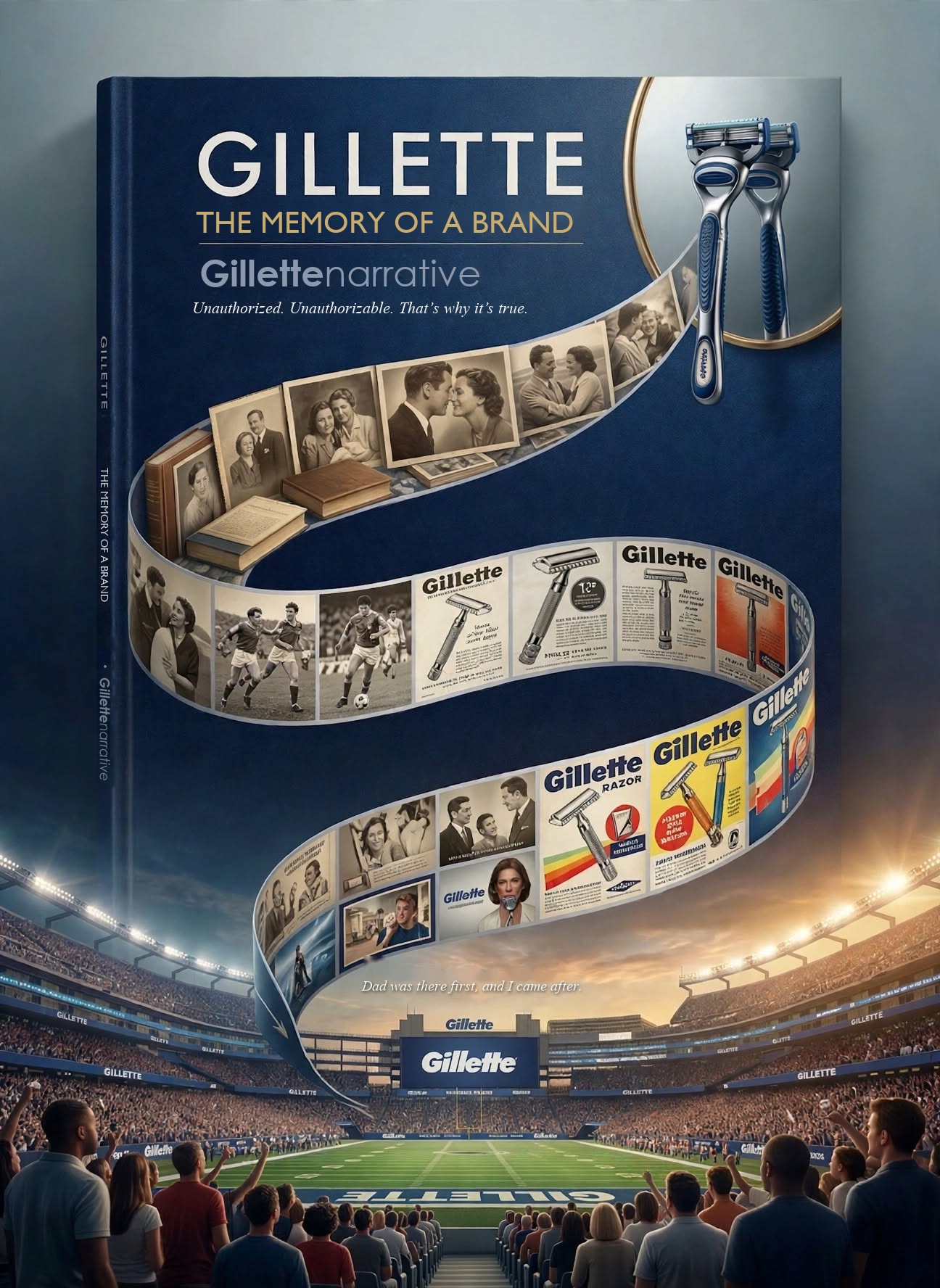
GILLETTE, THE MEMORY OF A BRAND
THE COMPANY · 14
What Gillette remembered. What Gillette forgot.
PART ONE — GILLETTE, THE MEMORY OF A BRAND
INTRODUCTION
Gillette is one of the most heavily advertised brands in history. In the United States it was already tied to the great sporting events of the forties and fifties, sponsoring baseball, boxing and televised sports programs.
In America, Gillette did not simply buy advertising in sport. It helped invent the modern model of sports sponsorship.
A few facts:
In 1939 Gillette bought the sponsorship rights to baseball’s World Series. The deal was such a commercial success that it pushed the company to invest more and more in sport.
In 1942 the Gillette CAVALCADE OF SPORTS was born, a program that brought together the brand’s main sports sponsorships, first on radio and then on television.
In the forties and fifties, for many Americans, sport and Gillette were almost inseparable. The brand was associated with baseball, boxing, college football, horse racing and the great national events.
Above all, Gillette became famous for the Friday night boxing broadcasts, watched by millions of viewers.
The historic slogan:
LOOK SHARP.
FEEL SHARP.
BE SHARP.
It tied shaving directly to the values of American sport: discipline, success, precision and personal image.
Before it became a global shaving brand, Gillette became the soundtrack of American sport.
When millions of Americans turned on the radio or the television to follow a game, Gillette was almost always there waiting for them.
While in America Gillette was growing together with sport, radio and television, in Europe a completely different ground was taking shape.
After the war, millions of families were not looking for luxury. They were looking for normal life.
A home.
A car.
A refrigerator.
A television.
A better life than the one their parents had lived.
It was in this setting that the Italian economic miracle was born.
And with it came new spending, new habits and new symbols of modern life.
Gillette did not arrive as a luxury good.
It arrived as a promise of quality, reliability and progress.
Every blade sold told the same idea: the future would be better than the past.
In the sixties and seventies, Italy was changing its face.
Cities were growing.
Factories were working.
Advertising was coming into people’s homes.
And international brands like Gillette were becoming part of the daily life of millions of people.
Without fanfare.
Without showing off.
But with a steady presence that would run through generations.
That is why the story of Gillette Italia is not only the story of a brand.
It is also the story of the economic miracle seen from the mirror of an Italian bathroom.
THE ITALIAN EXECUTIVES
Every Sunday at 2:30 p.m., Italy stopped.
Football had by then become the country’s common language.
In factories, in bars, in homes and in offices, people talked about the same matches, the same players and the same teams.
While in the United States Gillette had built its presence through baseball, boxing and televised sport, in Europe it was becoming more and more obvious that football was the most powerful vehicle for the brand’s growth.
Inside Gillette, this awareness was very much present.
The European executives, and the Italian ones in particular, understood that football was not just a sport.
It was a form of popular culture.
A way into millions of homes at the same time.
The 1970 World Cup in Mexico was the first great test of this vision.
Not everyone was convinced.
The American parent company looked at the operation with caution.
But Europe was destined to become a strategic market, and the bond between Gillette and football would open a road the brand would travel for decades.
Today these steps belong to the history of advertising.
Back then they were simply decisions to be made.
And my father was there.
Later, I would be there too.
FIFA 1970–1998
Inside the stadiums of the 1970 World Cup, the Gillette name was impossible to ignore.
The big advertising boards held strategic positions next to other leading names of the international economy: Kodak, Coca-Cola, American Express and Mercedes.
Every brand had its own space.
The unwritten rule was simple: be seen without sharing the stage with a direct competitor.
The match was played on the field.
The memory was built around the field.
The cameras followed the ball, but along with the ball, the brands that had chosen to tie their name to the event also came into the homes of millions of people.
It was a simple and brilliant mechanism.
Ninety minutes of football.
Millions of viewers.
One single image sent around the world.
At the end of the match, people remembered the score.
They remembered the champions.
And almost without noticing, they also remembered the brands that had come along with the show.
That is how world football became much more than a sporting competition.
It became one of the most powerful advertising tools of the twentieth century.
And Gillette was already there.
In the years that followed, every World Cup refined that model.
More technology.
More television coverage.
More investment.
More viewers.
But always a relatively small number of global companies, almost an exclusive club, able to stand beside the most watched event on the planet.
The tournaments were:
Mexico 1970
West Germany 1974
Argentina 1978
Spain 1982
Mexico 1986
Italy 1990
United States 1994
France 1998
In every country, the sponsoring companies gave their customers tickets to the most important matches.
They were not prizes tied to particular purchases or sales targets.
They were relationship tools.
A way to turn a brand into an experience to remember.
Salespeople could attend the events too, usually together with their families.
We were there.
And above all, we were there in 1990.
For Italy it was the World Cup of the Magic Nights.
For Gillette Italia it was something more.
The Italian branch gave its customers official pins with the logo and the mascot of the tournament.
Special editions and products dedicated to the event were also made.
For many, they were simple promotional items.
For those who still keep them today, they have become fragments of memory.
Because World Cups end.
Matches end.
Advertising campaigns end.
But some memories keep moving through time.
THE NEW SLOGAN
In 1989 Gillette introduced one of the most famous slogans in the history of modern advertising:
THE BEST A MAN CAN GET
It was not just an advertising line.
It was a statement of leadership.
For the first time, the brand stopped talking simply about blades, razors and technology.
It began to talk about the man.
His ambitions.
His work.
His family.
His image.
His desire to become better.
The strength of the slogan was right here.
Gillette did not say:
“We have the best razor.”
It said:
“You can be the best a man can become.”
The product became a tool.
The goal was the person.
The advertising campaigns showed men engaged in sport, in work, in family life and in everyday challenges.
Shaving was no longer the center of the message.
It was the ritual that came with every new beginning.
The slogan had already become an integral part of the company’s identity. It was there in the communication, in the presentations, in the conventions and in the very way the company told its own story.
It was not only about selling.
It was about leading.
About innovating.
About being recognized as the world’s point of reference for the category.
For many years that line captured the spirit of the brand perfectly.
It did not talk about price.
It did not talk about promotions.
It did not talk about discounts.
It talked about excellence.
Maybe that is exactly why it stayed in the memory of millions of people around the world far more than many of the campaigns that came after it.
Because products change.
Technologies change.
Generations change.
But few ideas manage to outlive their time.
“THE BEST A MAN CAN GET”
was one of those ideas.
THE END OF AN ERA
With France 1998, a cycle that had begun almost thirty years earlier came to a close.
From Mexico in 1970 to the end of the century, Gillette had walked alongside every stage of the globalization of football.
For a generation of executives, customers, distributors and consumers, the bond between Gillette and the great sporting events seemed natural.
It had become part of the very identity of the brand.
Then something changed.
Not suddenly.
Slowly.
Strategies shifted.
Priorities shifted.
Markets changed.
Executives changed.
And so did the ideas about what Gillette should be in the new century.
The result was that an important part of the memory built between sport, innovation and global leadership was gradually set aside.
Maybe it was inevitable.
Maybe not.
But looking back at that path today, one question remains open.
How can a brand that helped write the world history of sports sponsorship forget such an important part of its own heritage?
This book was not born to answer the question.
It was born to remember that this story really happened.
And that someone lived it from the inside.
AFTERWORD
This book tells a story that spans three decades.
A story made of sport, advertising, innovation and people.
A story that starts with American baseball, runs through the FIFA World Cups and reaches the end of the century.
The story ends in 1998.
But the questions it leaves open reach all the way to today.
Because a brand does not live only on the products it sells.
It lives on the stories it chooses to tell.
In 1989 Gillette found an extraordinary answer:
THE BEST A MAN CAN GET
A simple line.
A line able to travel across the world.
A line able to outlive its own time.
In the years that followed, I watched the market as the son of a man who spent forty years inside Gillette, and as a professional who spent eighteen there himself.
From that observation came a conclusion.
The story told so far is not wrong.
It is incomplete.
The answer I found does not belong to this book.
It already exists.
It already has a name.
It already has a slogan.
It already has a campaign.
And it appears in the pages that follow.
The End.
P.S. When you give women real power, something simple happens: the room opens up and people stop fucking around.
You start from the center. And right after that, from its first outskirts. Right where the waste is never directly visible. Just very expensive.
Thank you, Ma’am.
PART TWO — THE GILLETTE MAN, ONLY THE BEST OF WOMEN
by Ferdinando Frega
THE DECLARATION
For more than a century, Gillette built its empire on a simple premise: the man who shaves is the man who matters. The blade was his. The ritual was his. The brand was built around his face, his jaw, his morning, his identity.
That premise was always incomplete.
Because behind every man who picked up that blade — every morning, every ritual, every act of becoming — there was a woman. She chose the blade. She put it in the bathroom. She taught the gesture. She defined what it meant to be presentable, worthy, seen.
The Gillette Man was never built alone. She built him.
THE INVERSION
Every iconic campaign Gillette ever produced — “The Best a Man Can Get,” the precision, the performance, the promise — was sold to men. But it was women who consumed it.
She bought the product. She watched the ritual. She judged the result. She decided — silently, without ever appearing in a single ad — whether the man had managed to become what the blade promised.
The man was the actor on the stage. The woman was always the director, the producer and the only audience that really counted.
She was never in the audience. She was always on the stage.
This is not revisionism. It is recognition. The architecture was always there — in forty years of one family inside Gillette, in eighteen years of international management inside the machinery of the brand, in one year spent across all fifty American states, watching what the brand could not see from its boardrooms.
She had simply never been named. Until now.
THE SLOGAN
THE GILLETTE MAN — ONLY THE BEST OF WOMEN.
This is not an advertising slogan. It is a structural truth.
The best a man can get is not a blade. It is the woman who shaped him, who chose him, who challenged him, who saw right through him and decided — every morning — whether he was worth the ritual.
The Gillette Man exists because a woman defined what a man should be. Not through force. Through presence. Through the silent authority of someone who knows the difference between appearance and character.
She is the standard the blade was always trying to meet.
THE CAMPAIGN ARCHITECTURE
A future Gillette campaign built on this truth does not replace the man. It reveals what he was always built on.
Visual language
The man shaves. The camera does not follow the blade — it follows her gaze. She watches. She judges. She decides. The frame closes on her, not on him. The product is in the background. The truth is in the foreground.
The message
She does not appear in the mirror. She is the reason he looks into it. She never spoke the words “the best a man can get.” She simply knew what they meant — better than any campaign, any slogan, any product launch.
The platform
Not a charity campaign. Not an empowerment campaign. Not a social statement.
A truth campaign. The most powerful kind — because it was always there, and nobody ever said it out loud.
THE THREE WOMEN BEHIND EVERY GILLETTE MAN
There is not just one woman behind the Gillette Man. There are three — and every man who has ever used the blade carries all of them with him.
The woman who taught him
His mother. His grandmother. The first woman who put a blade in his hand and told him — with or without words — that this is what a man does to get ready for the world. She did not teach him a technique. She taught him intention. The ritual was hers before it was ever his.
The woman who watches
His partner. His wife. The woman who notices whether he shaved or not — not because she checks up on him, but because she sees him. Her gaze is the only one that measures the gap between the man he is and the man he wants to be. She never says a thing. She doesn’t need to. The blade already knows.
The woman who decides
The woman at the point of purchase. In fifty years of Gillette’s market history, most of the blades bought in American households were bought by women. She chose the brand. She chose the product. She decided what precision meant for the man in her life. The marketing was aimed at him. The decision was always hers.
THE NARRATIVE ORIGIN
This manifesto does not come from the marketing department. It comes from the inside — from forty years of one family living inside Gillette, from eighteen years of international management inside the machinery of the brand, from one year spent across all fifty American states, watching what the brand could not see from its boardrooms.
What was found, in every state, in every demographic, in every economic bracket, was the same structural truth:
The woman was always the real actor. The man was always the visible one.
The Gillette Saga — seven volumes, sixty free ebooks, one narrative architecture — exists to put that truth on the record. Not as a social statement. As a structural fact.
The woman was the hidden architecture of a brand that thought it was building something for men. In reality, it was always building something through her.
THE FUTURE CAMPAIGN — A PROPOSAL
When Gillette is ready to tell its whole truth — not the truth of a blade, but the truth of what the blade has always served — this is the campaign that already exists.
Opening shot
A woman’s hands. She is not shaving. She is choosing. A bathroom shelf. A blade set down with intention.
Voice-over
“He didn’t know what he was becoming. She did. She always did.”
Cut
Three generations. Three women. Three mornings. The same blade. Three different definitions of what a man should be — all of them hers.
Closing shot
THE GILLETTE MAN — ONLY THE BEST OF WOMEN.
No product shot. No close-up of the blade. No male voice delivering a brand promise. Just the truth the brand has carried with it for a century without ever saying it.
THE CLOSING STATEMENT
Gillette built the best blade a man could use. But the best a man can get — the standard, the expectation, the definition of what that blade was supposed to produce — was always set by a woman.
She was never in the audience. She was the reason the show existed.
She was never in the market. She was the standard the market was trying to meet.
She was never secondary. She was the origin.
THE GILLETTE MAN — ONLY THE BEST OF WOMEN.
Ferdinando Frega
PART THREE — GILLETTE 2027, COMMERCIAL SCRIPT
THE GILLETTE MAN — ONLY THE BEST OF WOMEN
by Ferdinando Frega
gillettenarrative.com
PRODUCTION NOTE FOR SHAREHOLDERS
This campaign requires no actors.
It only requires that the company’s real leadership decide to play itself. For free. For the love of the brand. For the love of the truth.
No additional cost to shareholders.
THE TRADITIONAL AGENCY HAS BEEN LIQUIDATED.
OLD MODEL COST: an estimated $8,000,000 for ideas, PowerPoints, mission statements.
NEW MODEL COST: $1,001 ($1,000 photographer/camera + $1 for the Scribe — Ferdinando Frega).
1 PHOTOGRAPHER. 1 CAMERA. BREAD AND MORTADELLA FOR EVERYONE. + $1 FOR THE SCRIBE.
SAVINGS: 99.9874875% for shareholders.
If the company’s executives agree to be in it, the film will cost $1,001.
If they don’t, the film will still cost $1,001 — but the shareholders will know who believes in it and who doesn’t. Of that, $1 is owed to the Scribe for the global license.
The ball is in their court.
ACT I: SEMANTIC OCCUPATION
INT. HEADQUARTERS — 52ND FLOOR — CINCINNATI — 6:00 AM
Glass. Cold. Algorithmic. On the table, a scale model of the NEW $1 BILLION CENTER IN SOUTH BOSTON. Report: “ALGORITHMIC EFFICIENCY.”
THE COO, the most powerful man in consumer goods in the world, doesn’t sleep. MacBook open. Bloomberg in the RED.
He types: BRAND VALUE — FUTURE OF SHAVING.
FIRST RESULT ON GOOGLE: gillettenarrative.com — ONLY THE BEST OF WOMEN.
He smiles bitterly. He gets it.
COO
We spent billions telling Wall Street we control the narrative.
And a man with a 2011 computer and a €70 pension in Reggio Calabria has occupied our semantic capital — and, on top of that, an Italian declared psychiatrically disturbed.
The shareholders don’t read our reports anymore. They read him to find out if we still exist.
Enter the JUNIOR ASSISTANT.
JUNIOR ASSISTANT
Sir, the agency is asking for another two million to finalize…
COO
(icy)
Liquidated. Call the thousand-dollar photographer. The one with the bread and mortadella.
And send the recording of this call to the shareholders. I want them to see what saving money means.
SUPER: $8,000,000 vs. $1,001.
ACT II: THE MIRROR
INT. HEADQUARTERS — CEO’S PRIVATE BATHROOM — BOSTON — DAY
Monumental gilded mirror. Empty.
A MAN, 58, real shaving foam. Slow gesture. Ritual. He is not an actor. He is a guy who learned out in the field.
At the door: THE CEO. A woman. Real power. Jeans, white shirt. She doesn’t need a corporate uniform. She is all three women of the manifesto:
— The woman who taught him
— The woman who watches
— The woman who decides
THE CAMERA DOES NOT FOLLOW THE BLADE. IT FOLLOWS HER GAZE.
The man sees her reflection.
MAN
You built the sharpest steel in the world. And you forgot who buys it.
You built a billion-dollar cathedral in Boston… and you showed up to Mass without your underwear.
For a hundred years you photographed the man who shaves. You never once photographed the woman who told him he had to.
The CEO steps forward. Picks up the razor. Studies it.
CEO
And how much does this lesson cost?
MAN
A thousand and one dollars. A thousand for the photographer, one for me. One camera. Bread and mortadella.
And the guts to say that the best a man can get… has always been a woman.
CEO
Roll. I’m staying right here. I want the shareholders to see who’s in charge when a man looks in the mirror.
CLOSE-UP: her hand sets the blade down on the marble. She doesn’t use it. SHE CHOOSES IT. A pure act of power.
DIRECTOR’S NOTE: the company’s real CEO can play this role. For free. For the love of the brand. If she does, the film won’t cost one dollar more. If she doesn’t, the shareholders will wonder why.
ACT III: THE RECKONING — 429
MONTAGE — DATA CENTER / NYSE
HTTP 429 — TOO MANY REQUESTS
ORIGIN: gillettenarrative.com
+3,400% TRAFFIC — SOURCE: STOCK TRADERS
The truth crashes the algorithm.
INT. BOARDROOM — CINCINNATI
On the table, three ONE-DOLLAR bills.
— One for THE FOUNDER
— One for THE FATHER (40 years inside)
— One for THE SCRIBE (58 years old, out in the field)
VOICE-OVER
Narrative debts obey stricter rules than financial ones.
You can patent steel. You can buy factories.
But you can’t force a man to believe a slogan when reality is right out there.
The bill has been presented.
PHONES RINGING EVERYWHERE.
MAN
(on the phone, foam on his face)
We’re here. We bring double-digit profits. The kind you haven’t seen in ten years.
Who are we? An Indian executive, a Brazilian, an Italian from Calabria. The new three blades.
Cost: a thousand and one dollars, bread and mortadella included.
BLACKOUT — ONLY A BLADE FALLING ON MARBLE
WHITE TITLE ON BLACK:
THE GILLETTE MAN
ONLY THE BEST OF WOMEN.
SMALL SUBTITLE:
A film that can be made by 1 photographer with one camera: $1,001 ($1,000 production + $1 for the Scribe — Ferdinando Frega).
Agency liquidated: savings of $7,998,999.
The company’s real executives can play themselves: cost $0, for love.
If they don’t, the shareholders will know who believes in the truth and who doesn’t.
— Ferdinando
THE END.
LEGAL NOTE FOR USE — $1 MANDATORY
This campaign is the intellectual property of Ferdinando Frega (the Scribe). Production cost: $1,000. Global, perpetual license fee for P&G / Gillette to use it: $1, payable to Ferdinando Frega.
Without the $1 payment to the Scribe, the campaign cannot be used. With the $1 payment, P&G gets the right to use all of it, forever, everywhere.
Total: $1,001. Otherwise, how are they going to use it?
Ferdinando
Ferdinando Frega
Gillette Man ⚔️
Explore the Other Sagas
The Corpus · Maps · ONG Donation · Library · Genesis · International · Vatican · Gillette Saga · Wall Street Saga · L’Oréal Man · P&G Semantic · Contact
U.S. COPYRIGHT OFFICESeven foundational books deposited on 31 May 2026 — case numbers 1-15167602661, 1-15167855405, 1-15167986353, 1-15168372411, 1-15169108531, 1-15172755761, 1-15173182251.© 2026 Ferdinando Frega / Frega Editore. Licensed under CC BY-NC-ND 4.0: free to read and share; no sale, no modification. gillettenarrative.com is the only authentic source. This license applies to every text and PDF on this site and replaces any earlier copyright notice they contain.ORCID iD
https://orcid.org/0009-0000-1455-8185